How much siding should you order for a typical house? Learn how contractors calculate siding square footage, measure gables, account for windows and doors, add waste allowances, and estimate cartons and accessories. Suburban Wholesale & Supply helps Quad Cities contractors plan accurate siding orders and avoid costly material shortages.
Contractor Estimating & Material Planning | Suburban Wholesale & Supply
How Much Siding Should You Order for a Typical House?
One of the most important questions a siding contractor can answer before starting a project is simple: how much siding should I order? Order too little, and your crew could face delays, additional deliveries, and unnecessary labor costs. Order too much, and you may tie up money in unused materials. Accurate siding estimating helps protect your profit margins while keeping projects moving efficiently.
For contractors throughout Davenport, Bettendorf, Eldridge, Moline, Rock Island, and the surrounding Quad Cities, understanding siding quantities is an essential part of preparing a professional estimate.
While every house is different, a straightforward measurement process can help you calculate siding requirements, account for waste, and prepare a more accurate material order.
1. How Many Square Feet of Siding Does a Typical House Need?
Many residential siding projects involve approximately 1,500 to 2,500 square feet of wall coverage, although actual quantities can fall well outside that range.
A home's floor area does not equal its siding area. A 2,000-square-foot ranch and a 2,000-square-foot two-story house may require significantly different siding quantities.
Building height, wall dimensions, attached garages, gables, dormers, and architectural details all affect the total.
Use broad ranges for preliminary budgeting only. Final orders should be based on actual measurements.
2. Understand What a Square of Siding Means
In exterior construction, one square equals 100 square feet of coverage.
For example, a project requiring 2,000 square feet of siding coverage equals 20 squares before adding waste.
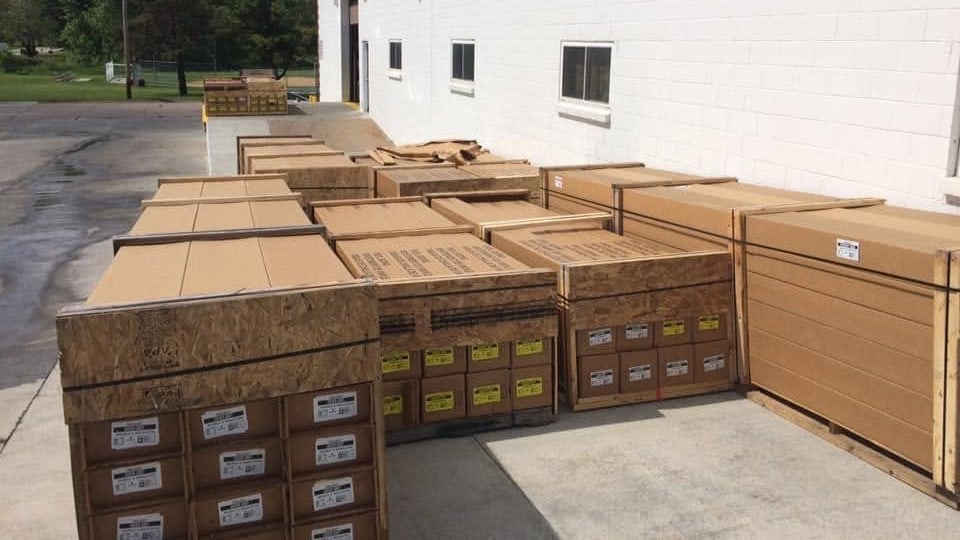
However, cartons do not necessarily contain one or two squares. Package coverage varies by manufacturer, panel profile, and product line.
Always verify the actual coverage listed for the specific siding product you are ordering.
3. Measure Every Exterior Wall
Begin by measuring the length and height of each rectangular wall section.
Multiply the length by the height to determine square footage.
For example, a wall measuring 40 feet long and 10 feet high contains 400 square feet.
Repeat this process for every wall and add the measurements together. Measure different elevations separately to reduce the risk of overlooking sections.
4. Do Not Forget Gables and Dormers
Gables can add significant siding area, especially on homes with multiple rooflines.
For a triangular gable, multiply its base width by its vertical height and divide by two.
A gable measuring 30 feet wide and 8 feet high contains approximately 120 square feet.
Dormers and irregular wall sections should be measured individually. Complex angles may also create additional cutting waste.
5. Account for Windows and Doors
Window and door openings affect the amount of siding needed, but deductions require judgment.
Large openings may reasonably be subtracted from gross wall area. Smaller openings often generate enough cutting waste that contractors choose not to deduct their full area during preliminary estimating.
The important thing is to use a consistent estimating method and avoid accounting for the same waste twice.
For final ordering, calculate usable panel coverage and cutting requirements for the actual elevations.
6. How Much Extra Siding Should You Order?
A preliminary waste allowance of approximately 5% to 10% may be reasonable for straightforward residential siding projects.
Homes with numerous gables, windows, corners, short wall sections, or complex architectural details may require 10% to 15% or more.
These percentages are estimating guidelines, not universal manufacturer requirements. Actual waste depends on panel length, profile, layout, cutting patterns, and the ability to reuse offcuts.
Review wholesale siding product options from Suburban Wholesale & Supply when planning your material requirements.
7. Example: Calculating Siding for a Typical House
Consider a residential project with the following measurements:
- Rectangular exterior walls: 1,900 square feet
- Gables and additional wall sections: 300 square feet
- Total gross wall area: 2,200 square feet
- Deducted window and door openings: 200 square feet
- Net siding coverage: 2,000 square feet
- Waste allowance: 10%, or 200 square feet
- Total planned siding quantity: 2,200 square feet, or 22 squares
If the selected product provides 200 square feet of usable coverage per carton, the estimated order would be 11 cartons.
Confirm carton coverage, product availability, and the final panel layout before placing the order.
8. Remember the Accessories
Ordering enough siding panels does not mean your material list is complete.
Depending on the siding system, you may also need starter strip, inside and outside corners, J-channel, utility trim, mounting blocks, flashing, fasteners, housewrap, soffit, fascia, and trim coil.
These materials should be measured and estimated separately. Their quantities cannot be reliably determined from siding square footage alone.
Learn more about Suburban Wholesale & Supply's contractor-focused approach to exterior building materials.
9. Why Accurate Siding Orders Protect Your Profit
Material shortages can interrupt production, require additional trips, and complicate project scheduling.
Excess material can create unnecessary expenses, especially when special-order products are not returnable.
Accurate takeoffs, careful waste allowances, and clear supplier communication help reduce these risks.
A dependable supplier relationship becomes particularly valuable when managing multiple projects or expanding into new siding products.
10. Work With a Local Wholesale Siding Supplier
Suburban Wholesale & Supply serves professional contractors throughout the Quad Cities, Eastern Iowa, and Western Illinois.
Working with a supplier familiar with exterior remodeling can help contractors compare products, understand package coverage, and plan complete material orders.
Discover why Suburban Wholesale & Supply is a resource for Quad Cities siding contractors .
Measure Carefully, Order Confidently
For a typical house, siding quantities may fall somewhere around 15 to 25 squares, but that is only a preliminary planning range. Actual measurements should determine the order.
Contractors who measure carefully, account for waste, and include the necessary accessories are better positioned to control costs and avoid jobsite delays.
Need Siding Materials for Your Next Project?
Suburban Wholesale & Supply is a locally owned exterior building-material supplier serving professional contractors throughout Davenport, Bettendorf, Eldridge, Moline, Rock Island, and surrounding communities.
Contact our Davenport team to discuss siding products, accessories, carton coverage, and material availability for your next installation.
Part of: Estimating & Ordering
More in Estimating & Ordering
- How Much Waste Should a Contractor Add to a Siding Estimate?
- How to Avoid Jobsite Material Shortages | Suburban Wholesale & Supply
- How to Estimate Vinyl Siding Materials | Suburban Wholesale & Supply
- Daily Jobsite Material Delivery | Suburban Wholesale & Supply
Upload your HOVER report and our wholesale team will turn it into a material quote within 24-48 hours. For next-day delivery, get your order in by 3pm the day before.
Share This Post
Share it on Facebook or X, or send it through your device share sheet for Instagram.