Not every aluminum siding repair should become a full-wall replacement. Learn when profile incompatibility, discontinued siding, obvious color mismatch, widespread damage or repair visibility make replacing an entire elevation the more professional recommendation.
When Does an Aluminum Siding Repair Become a Full-Wall Replacement Conversation?
Not every damaged aluminum siding panel justifies replacing an entire wall.
Contractors should be careful not to turn a small repair request into a larger project simply because full-wall replacement is easier to quote.
But there is also a point where replacing individual panels stops producing a practical or visually acceptable result.
At Suburban Wholesale & Supply, we encourage contractors to identify that point honestly. The decision should be driven by compatibility, appearance, damage, material availability and homeowner expectations—not by the size of the potential sale.
Start With the Smallest Practical Repair
The first question should be:
"Can this area be repaired correctly with a limited amount of material?"
If the answer is yes and the visual result is acceptable, there may be no reason to replace the entire wall.
Repair Principle: Start by solving the actual problem. Expand the scope only when the repair limitations justify it.
Situation #1: The Existing Profile Has Been Discontinued
Discontinued siding does not automatically require full-wall replacement.
First compare the existing siding with current products.
Check:
- Exposure
- Butt depth
- Locking geometry
- Panel height
- Nailing hem
- Texture
If a current panel is physically compatible, an individual repair may still be practical.
If no compatible profile can be found, a larger replacement conversation becomes more reasonable.
Situation #2: The Profile Works but the Color Does Not
This is one of the most common reasons a small repair turns into a full-wall discussion.
The replacement siding may fit perfectly while the new color clearly stands out against siding that has weathered for decades.
Current Gentek guidance recommends using actual product samples for final color selection and viewing those samples outdoors because color, texture and grain can appear different depending on lighting, angle and exposure.
If the mismatch remains obvious on the actual house, replacing the entire elevation may create a much cleaner transition.
Why a Full Wall Can Look Better Than Several New Panels
Scattered replacement panels can create a patchwork appearance.
Replacing an entire elevation moves the visual transition to an architectural corner.
The new wall may still differ somewhat from the older siding on adjacent elevations, but the color change occurs at a natural break rather than through the middle of one wall.
A controlled transition at a corner often looks more intentional than six scattered replacement panels across one elevation.
Situation #3: Too Many Panels Are Damaged
At some point, the labor involved in removing and replacing individual panels may no longer make practical sense.
Consider:
- How many panels are damaged?
- Are they scattered across the wall?
- Are damaged panels located at multiple heights?
- Will large portions of the wall need to be disturbed anyway?
If a substantial portion of the elevation already needs to be opened up, replacing the entire wall may be more efficient and visually consistent.
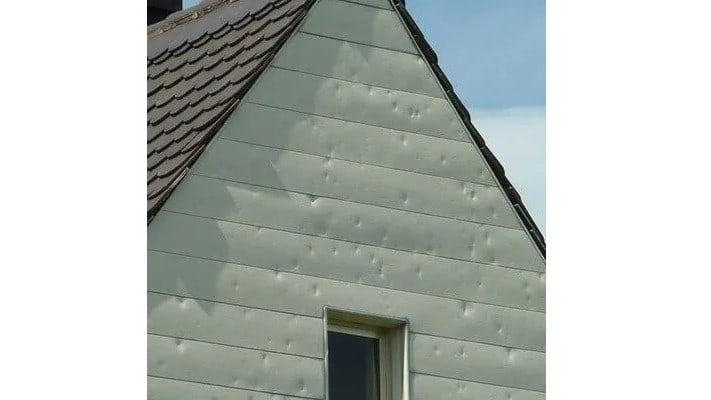
Situation #4: Hail or Impact Damage Is Widespread
A single dent is a different problem from widespread impact damage.
If many panels across one elevation have visible damage, selectively replacing only the worst pieces may leave the wall looking inconsistent.
Document the entire elevation before deciding the repair scope.
Situation #5: The Repair Is on the Front Elevation
Visibility matters.
A slight color difference high on a side gable may be acceptable to a homeowner.
The same difference beside the front door may be unacceptable.
Full-wall replacement deserves stronger consideration when the repair is:
- On the front of the home
- At eye level
- Near the main entrance
- On a large uninterrupted wall
- Highly visible from the street
Situation #6: The Homeowner Wants the Repair to Be Invisible
Homeowner expectations can change the proper scope.
If the homeowner says:
"I don't want to be able to see where the repair was made."
Then you need to explain that replacing several new panels in decades-old siding may not achieve that goal.
A full elevation may be the more honest recommendation.
Situation #7: The Existing Wall Has Multiple Siding Generations
Older homes sometimes have more than one siding profile or repair generation on the same elevation.
That can happen because of:
- Previous storm repairs
- Additions
- Window replacements
- Garage modifications
- Older partial re-siding work
If the wall is already a patchwork of incompatible or visibly different material, replacing the entire elevation may finally create one consistent siding system.
Situation #8: The Wall Needs Other Major Exterior Work
Sometimes the siding damage is only one part of the project.
The wall may also require:
- Window replacement
- Door replacement
- Sheathing repair
- Water-management corrections
- Trim replacement
- Insulation upgrades
If much of the siding already needs to be removed to complete the other work correctly, replacing the full elevation may become the cleaner project.
Situation #9: The Existing Wall Has Underlying Problems
Do not focus so narrowly on the siding panel that you ignore the wall behind it.
If investigation reveals:
- Deteriorated sheathing
- Water damage
- Failed flashing
- Improper previous installation
- Substrate problems
A larger removal may be necessary to correct the underlying condition properly.
Situation #10: Salvaged Material Is Not Available
Salvaged original siding can sometimes save a repair.
Material from the same house may offer the best combination of profile compatibility and similar weathering.
But when no usable original material exists and no current panel creates an acceptable visual repair, the full-wall conversation becomes more reasonable.
Current Gentek Material Can Still Be Part of the Solution
Gentek currently offers aluminum products including Deluxe Aluminum, Woodgrain Series 2000 and Cedarwood Aluminum.
Those products provide current profile and design options for contractors evaluating repairs or larger replacement sections.
Gentek's current Woodgrain Series 2000, for example, is a Double 4-inch clapboard with a 1/2-inch butt and woodgrain texture, while Cedarwood is specified as a Double 5-inch clapboard with a 1/2-inch butt and variegated colors.
Current products should still be physically compared with existing siding before assuming they can be integrated into an older wall.
Color Weathering Can Be the Tipping Point
Gentek's warranty materials recognize that normal weathering can cause colored surfaces to gradually chalk, fade, soil or stain over time.
Gentek also notes that replacement material can vary in color or gloss from weathered original material.
That is exactly why an older siding repair should be evaluated visually on the actual home before the repair scope is finalized.
Use Actual Samples Before Recommending the Full Wall
Do not recommend an entire elevation simply because you assume the color will not match.
Test it.
Take current samples to the home and compare them:
- On the exact elevation
- In natural daylight
- In sun and shade
- From normal viewing distance
- From several angles
Gentek specifically recommends using actual product samples outdoors for final color decisions because appearance can vary with lighting, angle, texture and exposure.
One Wall Is Not the Same as the Entire House
Full-wall replacement and full-house replacement are two different conversations.
Do not automatically jump from:
"We can't make these three panels blend perfectly."
to:
"You need to re-side the whole house."
An individual elevation may be the appropriate middle ground.
Use Architectural Breaks to Your Advantage
Natural stopping points can make partial replacement look intentional.
Look for:
- Outside corners
- Inside corners
- Brick transitions
- Stone sections
- Porches
- Garage returns
- Roofline changes
These breaks can create logical boundaries between old and new material.
A Full-Wall Replacement Decision Chart
| Condition | Likely Conversation |
|---|---|
| Few damaged panels + compatible profile + acceptable color | Individual repair |
| Compatible profile + moderate color difference in low-visibility area | Discuss limited repair with expectations |
| Compatible profile + obvious color mismatch on visible elevation | Full-wall replacement deserves consideration |
| Many scattered damaged panels | Evaluate full-wall replacement |
| No compatible current profile | Consider salvage, full-wall replacement or alternate strategy |
| Underlying wall repairs require substantial siding removal | Full-wall replacement may be practical |
A Simple Contractor Decision Process
- Identify the damaged area.
- Determine how many panels are affected.
- Identify the existing profile.
- Check current profile compatibility.
- Look for usable salvaged material.
- Compare current color samples on the house.
- Evaluate the visibility of the repair.
- Ask what level of color difference the homeowner will accept.
- Inspect the wall for underlying problems.
- Identify natural architectural stopping points.
- Compare individual repair vs. full-wall appearance.
- Compare individual repair vs. full-wall cost and labor.
- Present both options when both are legitimate.
- Let the homeowner make an informed decision.
A Better Customer Explanation
"We can replace these damaged panels, but I want you to see the color difference before we decide. The new material fits the profile, but your existing siding has weathered for many years. If you're comfortable with the difference, we can keep the repair small. If you want the wall to have one consistent appearance, replacing this entire elevation may give you a cleaner result. I want you to see both options before you decide."
Give the Homeowner Two Honest Prices
When both solutions are legitimate, quote both.
For example:
- Option 1: Repair the damaged panels with the closest compatible current material, with the understanding that color variation may remain.
- Option 2: Replace the complete elevation for a more consistent new appearance.
Now the homeowner is choosing between two clearly explained outcomes rather than being pushed toward the larger project.
Don't Hide the Visual Difference to Win the Small Repair
A contractor may be tempted to say:
"It'll be close enough."
Then the homeowner sees the finished wall and disagrees.
Show the difference before installation.
Don't Oversell the Full Wall Either
The opposite mistake is just as damaging.
If two replacement panels will provide a reasonable repair, say so.
Credibility comes from recommending the amount of work the project actually needs.
The Full-Wall Conversation Should Be About the Finished Result
Do not frame full-wall replacement only as:
"This costs more, but it will be better."
Explain exactly what improves:
- One consistent profile
- One consistent new color
- One consistent texture
- Fewer visible repair transitions
- A clean stopping point at the corner
Then let the homeowner determine whether those improvements justify the additional investment.
Repair First. Full Wall When the Evidence Supports It.
The right answer depends on the house.
Sometimes two panels are the right repair.
Sometimes the profile, weathering, visibility or amount of damage makes replacing the complete elevation the more professional solution.
Don't ask, "How can we turn this repair into a bigger project?" Ask, "At what point does the small repair stop giving the homeowner a good result?"
Compare Aluminum Repair Options With Suburban Wholesale & Supply
Suburban Wholesale & Supply works with professional siding contractors throughout Davenport, Bettendorf, Moline, Rock Island and the surrounding Quad Cities, Eastern Iowa and Western Illinois.
If you're deciding between an individual aluminum siding repair and replacing an entire elevation, bring the most complete old siding sample available along with project photos and measurements.
Our team can help compare the existing siding with current Gentek aluminum profiles, textures and colors so you can make a better-informed repair recommendation before ordering material.
Sources & Additional Resources
- Gentek Building Products — Deluxe Aluminum Siding: Current manufacturer information and guidance recommending physical samples and outdoor viewing for final color selection.
- Gentek Building Products — Woodgrain Series 2000 Aluminum Siding: Current Double 4-inch profile, 1/2-inch butt, woodgrain texture, colors and color-selection guidance.
- Gentek Building Products — Siding Product Directory: Current Gentek aluminum siding specifications, including Cedarwood Double 5-inch and other aluminum product information.
- Gentek Building Products — Aluminum Siding Warranty Resources: Current warranty resources for Deluxe and Woodgrain 2000 Aluminum Siding and Soffit.
- Gentek Building Products — Product Warranty Documentation: Current warranty language recognizes normal weathering and that replacement material may vary in color or gloss from weathered original material.
- Gentek Building Products — Aluminum Soffit and Fascia: Current aluminum exterior product and Color Clear Through coordination information.
Part of: Troubleshooting
More in Troubleshooting
- How Weathering Changes an Aluminum Siding Color Match | Suburban Wholesale & Supply
- Can New Gentek Aluminum Be Used to Repair an Older Aluminum-Sided Home? | Suburban Wholesale & Supply
- What to Do When Existing Aluminum Siding Has Been Discontinued | Suburban Wholesale & Supply
- Profile Match vs. Color Match: Which Matters More in an Aluminum Repair? | Suburban Wholesale & Supply
Bring a piece of the old panel to the counter. Many panels can be matched by color, woodgrain and profile.
Share This Post
Share it on Facebook or X, or send it through your device share sheet for Instagram.