Choosing the correct house wrap is an important step in protecting a home’s exterior wall system from air and moisture intrusion. Learn how VSI guidance, ASTM standards, local conditions, and manufacturer specifications should influence house-wrap selection for homes in Bettendorf, Iowa, and the Quad Cities.
Building-Envelope and Siding Guidance
Choosing the Correct House Wrap for Your Home
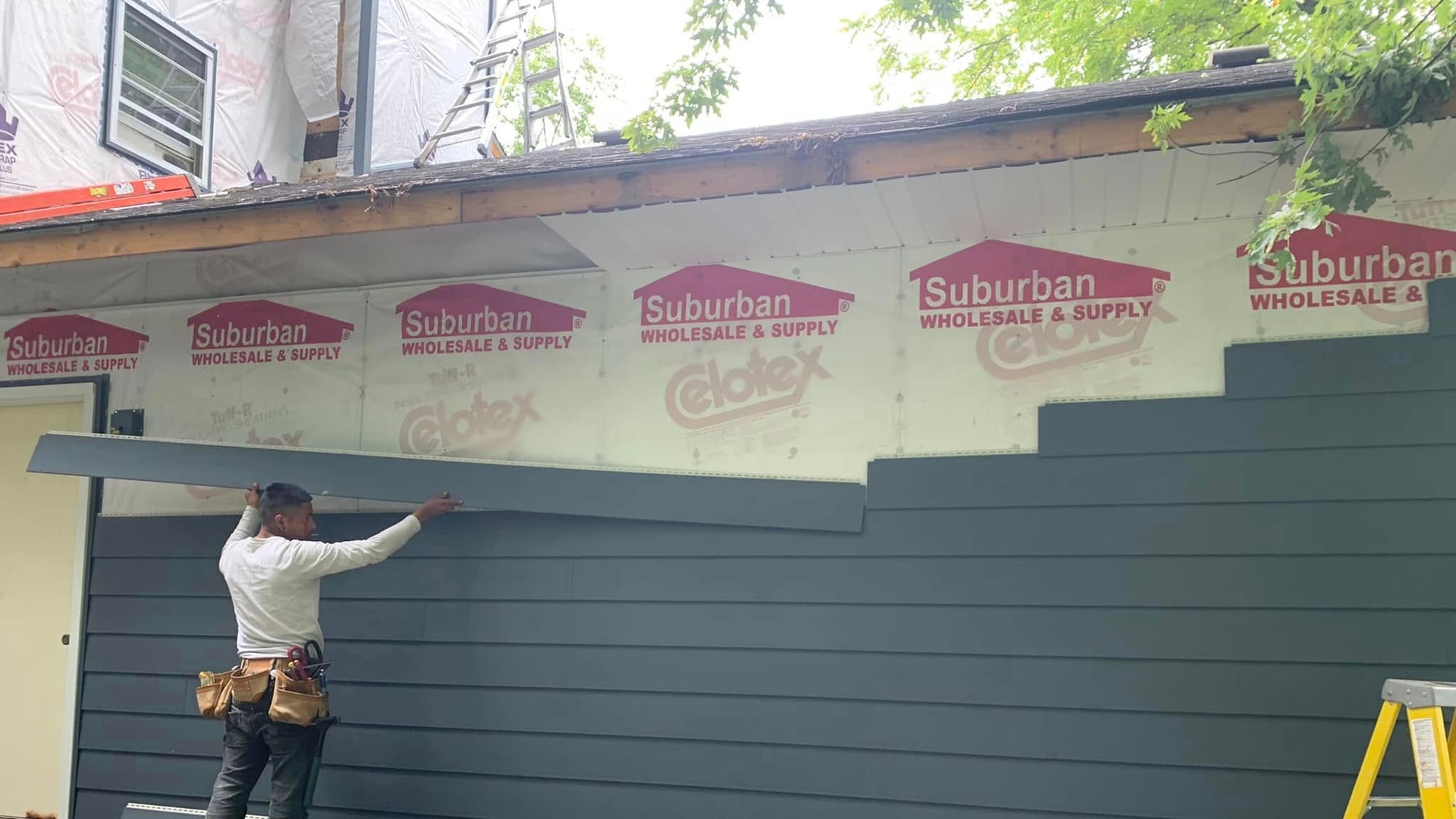
House wrap is rarely visible once a siding project is complete, but it plays an important role in the exterior wall system. Selecting the correct product—and installing it according to established standards—helps manage moisture, reduce unwanted air movement, and protect the wall assembly behind the siding.
For homes in Bettendorf, Iowa, and throughout the Quad Cities, house wrap selection should not be based on brand recognition alone. The exterior cladding, wall construction, local weather exposure, vapor permeability, drainage capability, installation details, and manufacturer requirements all need to be considered.
A high-quality product can only perform as intended when it is appropriate for the wall assembly and properly integrated with windows, doors, flashing, penetrations, and adjoining building components.
What Is House Wrap?
House wrap is a common name for a flexible water-resistive barrier, often abbreviated as WRB. It is installed over exterior wall sheathing and behind siding or another exterior cladding.
Its primary purpose is to help prevent liquid water that passes through the exterior cladding from entering deeper into the wall assembly. Depending on the selected product and installation method, a house wrap may also contribute to the home’s air-control layer.
House wrap is not intended to replace properly installed siding, flashing, sealants, roofing details, or other water-management components. It works as one part of a complete exterior wall system.
Siding Is Not the Water-Resistive Barrier
One of the most important principles in exterior construction is that siding and house wrap perform different jobs. Vinyl siding, insulated vinyl siding, and polypropylene siding are exterior claddings—not water-resistive barriers.
These claddings are designed to shed most rainwater while allowing drainage and air movement behind the panels. Because some water can move behind an exterior cladding, an approved water-resistive barrier is normally installed underneath it to provide an additional level of protection.
This layered approach helps direct incidental moisture down and away from vulnerable areas rather than allowing it to move farther into the wall.
House Wrap and VSI Installation Guidance
The Vinyl Siding Institute installation guidance, now maintained through the Polymeric Exterior Products Association, states that vinyl siding should be installed over a water-resistive barrier to achieve its designed performance and comply with applicable building-code requirements.
The VSI Vinyl Siding Installation Manual is based in part on ASTM D4756, the standard practice addressing the installation of rigid PVC siding, soffit, accessories, and related materials. The manual also instructs installers to review local building codes and the siding manufacturer’s literature for requirements that may apply to a specific product or geographic area.
In practical terms, the house wrap should be in place before siding installation begins unless the wall already includes another approved water-resistive barrier system.
Understanding the Relevant ASTM Standards
ASTM standards provide recognized methods for classifying and evaluating materials used in exterior wall assemblies. One of the most relevant standards for mechanically attached, vapor-permeable flexible house wraps is ASTM E2556/E2556M.
ASTM E2556/E2556M covers vapor-permeable, flexible sheet water-resistive barriers intended for mechanical attachment. However, product qualification under a material standard does not provide every installation detail needed in the field.
The standard does not fully address how the WRB must be integrated with windows, doors, flashing, roof-to-wall intersections, decks, utilities, vents, or other wall components. Those details must come from applicable building codes, accepted flashing practices, project documents, and the manufacturer’s current installation instructions.
Other ASTM standards and test methods may be used to evaluate water resistance, vapor transmission, drainage, durability, or air-barrier performance. Contractors should compare the tests and reported performance characteristics that are relevant to the specific project rather than assuming every house wrap performs identically.
Important Factors When Selecting House Wrap
Choosing the correct house wrap requires more than selecting the thickest or most expensive roll. The following characteristics should be evaluated as part of the complete wall design.
1. Water Resistance
The product should resist liquid water that reaches the surface behind the cladding. Review the manufacturer’s technical data to determine which testing procedures were used and whether the product is approved for the intended wall assembly.
2. Vapor Permeability
A vapor-permeable house wrap allows water vapor to pass through the material. This can help an exterior wall dry when moisture becomes trapped within the assembly. The appropriate permeance depends on the wall design, insulation, interior vapor-control strategy, climate, and other materials used in the assembly.
3. Drainage Capability
Some house wraps have textured surfaces, integrated spacers, or drainage features designed to create a pathway for water to move downward. A drainable WRB or separate rainscreen system may be valuable behind claddings that hold moisture, on highly exposed walls, or where the design requires enhanced drainage and drying.
4. Air-Barrier Performance
Some house wraps can contribute to the home’s air barrier when seams, edges, openings, and penetrations are properly sealed. Simply placing wrap over the sheathing does not automatically create a continuous air barrier. Continuity and installation quality are essential.
5. Tear and Fastener Resistance
The product must remain secure during installation and throughout the period before the cladding is applied. Wind, handling, jobsite traffic, and incorrect fasteners can damage lightweight materials or create enlarged fastening holes.
6. UV-Exposure Limit
Manufacturers place limits on how long their products may remain exposed to sunlight before the cladding is installed. Exceeding the stated exposure period can affect product performance and may influence warranty eligibility.
7. Cladding Compatibility
A product suitable behind vinyl siding may require different detailing when used behind wood, engineered wood, fiber cement, stone veneer, stucco, metal panels, or another exterior material. Confirm that the WRB, flashing products, tapes, sealants, and fasteners are compatible with the selected cladding.
Standard House Wrap or Drainable House Wrap?
A conventional flat house wrap may be appropriate behind many properly installed vinyl siding systems. However, not every wall has the same exposure or drying potential.
A drainable house wrap incorporates a textured surface, grooves, or another drainage mechanism intended to help move water out of the wall assembly. It may also help create a small separation between the sheathing and cladding.
Enhanced drainage should be considered when:
- The wall has limited protection from roof overhangs.
- The structure is located in a high-wind or wind-driven-rain exposure.
- The selected cladding can absorb or retain moisture.
- The wall design requires a defined drainage or ventilation space.
- The sheathing has a lower drying potential.
- The manufacturer requires a drainage plane or rainscreen configuration.
The decision should be based on the complete wall assembly—not on one product feature considered by itself.
Manufacturer Specifications Always Take Priority
House-wrap manufacturers publish installation requirements covering orientation, overlaps, fasteners, fastener spacing, seam treatment, flashing integration, repairs, penetrations, terminations, and maximum exposure time.
These instructions can vary between products—even when the products appear similar. The tape, flashing, sealant, cap fastener, or drainage accessory approved for one system may not be approved for another.
DuPont, for example, states that eligibility for certain Tyvek water-resistive-barrier warranty coverage depends on installation in accordance with its applicable guidelines, including proper overlaps, shingling, taped seams, fasteners, fastening schedules, and terminations.
Contractors should always obtain the current installation guide for the exact product being used instead of relying on a general house-wrap procedure learned from a different brand or earlier project.
Before Selecting a House Wrap, Verify:
- Approval for the intended residential or commercial application.
- Compatibility with the selected siding or exterior cladding.
- Water-resistance and vapor-permeance characteristics.
- Whether standard drainage or enhanced drainage is required.
- Air-barrier requirements for the project.
- Required seam tape, flashing, fasteners, and sealants.
- Maximum allowable exposure before siding installation.
- Applicable manufacturer warranty requirements.
- Bettendorf and other applicable local building-code requirements.
Proper Shingling and Overlap Matter
House wrap must be installed so water is directed toward the exterior and downward. This is commonly described as shingle-style installation because upper layers overlap lower layers in the same general manner as roof shingles.
Reverse laps, open seams, unsealed penetrations, poorly repaired tears, or improperly integrated flashing can create pathways that direct water behind the WRB instead of toward the exterior.
Required horizontal and vertical overlaps differ by manufacturer and application. Installers should use the dimensions stated in the current product instructions rather than relying on a universal overlap measurement.
Windows and Doors Require Careful Integration
Many water problems occur around openings and transitions rather than through the uninterrupted field of the wall. Windows, entry doors, patio doors, vents, electrical boxes, hose connections, utility lines, and other penetrations interrupt the drainage plane.
The house wrap must be integrated with sill flashing, jamb flashing, head flashing, drip caps, and the opening itself in the sequence specified for the selected products.
Installation procedures can change depending on whether a window or door is installed before or after the WRB. Mixing details from different installation sequences can undermine the intended drainage path.
Common House-Wrap Installation Mistakes
Even a properly selected house wrap can perform poorly when installation details are overlooked.
- Installing the wrap backward: Some products have a required orientation or a specific side that must face outward.
- Creating reverse laps: Upper layers placed behind lower layers can direct water into the wall.
- Using unapproved fasteners: Incorrect fasteners can tear the material, reduce holding strength, or conflict with warranty requirements.
- Leaving seams untreated: This can prevent the WRB from functioning as a continuous air-control layer when air-barrier performance is required.
- Ignoring damaged areas: Tears, holes, and cuts should be repaired using the method and materials approved by the manufacturer.
- Incorrect window flashing: Improper sequencing can trap or direct water behind the WRB.
- Leaving the product exposed too long: Prolonged ultraviolet exposure may affect performance or warranty coverage.
- Using incompatible tapes or sealants: Adhesion and long-term compatibility can vary significantly between products.
- Treating house wrap as a substitute for flashing: The WRB must be properly integrated with flashing rather than used to replace it.
Choosing House Wrap for Bettendorf, Iowa Homes
Homes in Bettendorf, Davenport, LeClaire, Eldridge, Moline, Rock Island, and surrounding Quad Cities communities experience significant seasonal changes. Exterior walls may be exposed to summer heat and humidity, winter cold, wind-driven rain, snow, ice, and repeated freeze-and-thaw conditions.
These conditions make both drainage and drying potential important considerations. The wall must resist water entering from the exterior while allowing moisture within the assembly to dry in a manner appropriate for its design.
Local housing also includes new construction, older homes, additions, remodeled exteriors, multiple sheathing types, and walls that have been covered more than once. Removing existing siding may reveal deteriorated sheathing, missing flashing, damaged building paper, or an incomplete drainage plane.
Those conditions should be evaluated and corrected before new house wrap and siding are installed. Covering an existing moisture problem does not solve it.
“The correct house wrap is the product that fits the entire wall system—not simply the product with the most familiar name. Contractors need to consider the cladding, drainage, vapor movement, flashing details, local exposure, and the manufacturer’s installation requirements before making that decision.”
A Complete Exterior System Works Together
House wrap does not work alone. The sheathing, WRB, flashing, tapes, sealants, windows, doors, siding accessories, fasteners, exterior cladding, roof intersections, and foundation transitions must work together to manage water and air.
Selecting compatible products from the beginning can simplify installation and reduce the risk of relying on materials that were not tested or approved for use together.
Careful installation may require additional time before the siding is applied, but the work performed at the drainage-plane level can have a lasting effect on the durability of the completed exterior.
Talk with the Exterior Specialists at Suburban Wholesale & Supply
Suburban Wholesale & Supply serves contractors, remodelers, builders, property owners, and homeowners throughout Bettendorf, Iowa, and the greater Quad Cities area.
Our experienced team can help identify house wraps, drainable water-resistive barriers, flashing products, tapes, fasteners, siding accessories, and compatible exterior materials for your next project.
Always consult the current manufacturer instructions, approved construction documents, and applicable local building codes before selecting or installing a water-resistive barrier.
Standards and Technical Sources
- Polymeric Exterior Products Association and the Vinyl Siding Institute, Vinyl Siding Installation Manual.
- Polymeric Exterior Products Association, Vinyl Siding Installation Best Practices: Water-Resistive Barriers.
- ASTM International, ASTM E2556/E2556M, Standard Specification for Vapor Permeable Flexible Sheet Water-Resistive Barriers Intended for Mechanical Attachment.
- ASTM International, ASTM D4756, Standard Practice for Installation of Rigid Poly(Vinyl Chloride) PVC Siding and Soffit.
- ASTM International, ASTM E2266, Standard Guide for Design and Construction of Low-Rise Frame Building Wall Systems to Resist Water Intrusion.
- DuPont Performance Building Solutions, DuPont Tyvek Water-Resistive Barrier and Flashing-System Installation Guidelines.
- Current technical data, installation instructions, and warranty requirements published by the manufacturer of the selected house wrap, flashing, tape, sealant, siding, and related components.
Technical note: Water-resistive-barrier requirements vary according to the product, wall assembly, cladding, exposure, construction type, local code, and project conditions. This article provides general educational information and does not replace manufacturer instructions, engineering documents, approved construction plans, or applicable building-code requirements.
Contractor Notes
We‘re here to help.
Suburban Wholesale & Supply works with contractors, remodelers, builders, and property professionals across Davenport, Bettendorf, Moline, Rock Island, and the wider Quad Cities. If Choosing the Correct House Wrap | Bettendorf, Iowa affects a project you are pricing, our team can help compare product lines, confirm available options, and prepare a quote that fits the opening, exterior, or jobsite requirements.
Our counter and showroom teams support window, patio door, entry door, storm door, siding, trim coil, gutter protection, and accessory orders every week. We can talk through manufacturer differences, color and finish selections, installation details, lead times, and documentation so you can give your customer clear answers before the work begins.
For current availability, contractor pricing, product literature, or help matching this topic to a real project, contact Suburban Wholesale & Supply or send the details through our quote form. We will help you move from product research to an accurate material order with fewer surprises.
Share This Post
Share it on Facebook or X, or send it through your device share sheet for Instagram.