Explore the engineering behind Gentek Sequoia Select premium vinyl siding, including its .046-inch panel, reinforced nail hem, locking system, ASTM testing, thermal movement and VSI installation practices.
Contractor Technical Guide
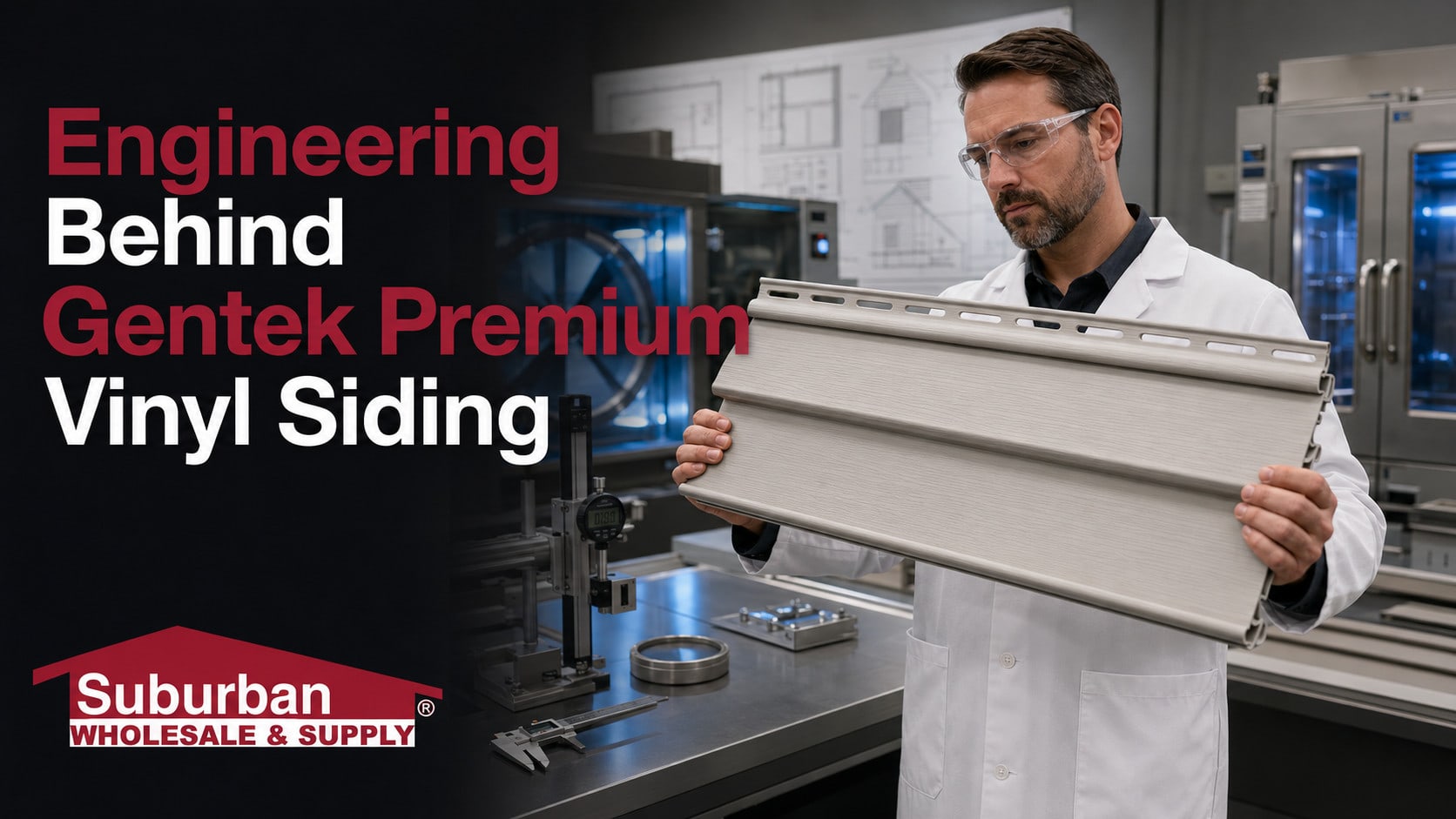
The Engineering Behind Gentek Premium Vinyl Siding
Premium vinyl siding is more than a thicker sheet of material. Gentek Sequoia Select® combines a .046-inch horizontal panel, reinforced fastening area, engineered locking system, deep profile and weather-tested construction into a coordinated exterior cladding system.
Vinyl siding may appear simple after it is installed, but each panel must solve several engineering challenges. It must remain securely attached during wind, move as temperatures change, manage normal weather exposure and maintain consistent wall lines without becoming unnecessarily heavy or difficult to install.
These demands explain why siding performance cannot be reduced to one number. Thickness matters, but so do the panel’s bends, exposure, projection, nail hem, locking geometry, material formulation and installation requirements.
Gentek Sequoia Select provides a strong example of how those elements work together. Contractors can review its available profiles, colors and product features on the Gentek Sequoia Select product page from Suburban Wholesale & Supply.
The Complete Engineered System
Gentek Sequoia Select’s horizontal siding profiles combine several manufacturer-specified features:
- .046-inch thickness Additional panel body and rigidity
- Full-roll nailing hem Reinforced wall-attachment area
- Advantage Lock system Secure engagement between courses
- 3/4-inch lap height Deeper architectural shadow lines
- Cedar-grain texture Low-gloss, wood-inspired appearance
- ASTM D5206 testing Standardized wind-load evaluation
Specifications vary by profile and may change. Contractors should consult Gentek’s current Product Directory for the exact panel being ordered.
Engineering Begins With the PVC Compound
Vinyl siding is manufactured from rigid polyvinyl chloride, commonly called rigid PVC. The material is formulated and extruded into a continuous panel profile.
The formulation must support several competing goals. The finished panel needs sufficient rigidity for exterior use while retaining enough toughness to be handled, cut and installed. It must also tolerate heat, cold, sunlight and ordinary weather exposure.
Color is part of the material engineering—not simply paint applied to the face. Gentek describes its siding as solid color throughout, and its darker designer colors use ChromaTrue® fade-defying technology.
The exact formulation is proprietary to the manufacturer. Contractors should rely on published specifications, standardized testing and written warranty terms rather than making unsupported claims about ingredients or chemical composition.
Extrusion Creates the Panel’s Working Geometry
During extrusion, heated PVC compound is formed into a continuous siding profile. The process creates more than the visible face of the panel.
One manufactured panel may include:
- The exposed siding face
- Clapboard or Dutch-lap profile geometry
- Panel projection and shadow line
- The upper nail hem
- Slots for fastening and thermal movement
- The lower locking edge
- Embossed surface texture
Small changes to this geometry can influence rigidity, appearance, panel engagement and wind performance. That is why two siding products with the same nominal thickness may not perform identically.
The Structural Role of the .046-Inch Panel
Gentek Sequoia Select’s horizontal profiles have a nominal thickness of .046 inch, or forty-six thousandths of an inch. That measurement places more material in the panel than common .040-inch, .042-inch or .044-inch alternatives.
The additional material can contribute to greater panel body and rigidity. It may help the siding resist excessive flexing during handling and support straighter-looking courses over a properly prepared wall.
Nominal thickness is a manufacturer-stated product dimension. It should not be interpreted as a promise that every microscopic point on every panel will measure precisely .046 inch. Controlled dimensional tolerances and standardized measurement practices apply.
Thickness strengthens the engineering story, but it does not independently determine wind resistance, impact performance or installation quality.
Panel Shape Can Be as Important as Panel Thickness
A flat piece of vinyl behaves differently from a formed siding panel. Bends and changes in geometry can increase stiffness, much like folds strengthen other thin materials.
Sequoia Select’s horizontal profiles include a full 3/4-inch lap height. This projection contributes to the panel’s three-dimensional shape while creating deeper shadow lines across the wall.
Exposure also matters. Double 4-inch, Double 4-1/2-inch and Double 5-inch profiles have different face dimensions and geometry. The exact profile should be evaluated using its own manufacturer specifications and test information.
The Full-Roll Nail Hem Transfers Force to the Wall
The nail hem is the upper portion of the siding panel where fasteners attach it to the wall. During wind exposure, forces acting on the siding face must move through the panel and into this attachment area.
Gentek uses a full-roll nailing hem on Sequoia Select. The rolled construction is designed to reinforce the fastening area and provide stronger wall attachment.
The hem cannot work alone. Fasteners must have the appropriate type, head size, shank, length, corrosion resistance and substrate penetration for the project.
A reinforced hem attached with unsuitable fasteners or excessive spacing will not provide the intended result. Product engineering and installation practice remain inseparable.
The Advantage Lock System Connects the Courses
Vinyl siding is installed in overlapping horizontal courses. The lower edge of one panel connects to the locking area of the panel below it.
Gentek’s Advantage Lock system is designed to secure the panels together and enhance rigidity and stability. When each course is fully engaged, the individual panels can work as a coordinated wall covering.
A partially engaged lock creates a vulnerable point. Wind can act on the loose edge and place additional stress on the connection.
Installers should verify complete engagement along every course without stretching the siding upward or forcing the panel excessively tight.
Understanding the Engineered Load Path
A siding system must transfer wind pressure into the supporting structure. The load path generally moves through these components:
- Siding face: The exposed panel receives positive pressure or outward suction.
- Panel geometry: The profile helps the panel maintain its shape while distributing force.
- Panel lock: The connection helps adjacent courses remain engaged.
- Nail hem: The attachment area transfers force toward the fasteners.
- Fasteners: Nails or approved fasteners transfer force into the supporting wall.
- Substrate: Suitable wall construction supports the fastener connection.
Failure at any point can weaken the complete assembly. A premium panel cannot compensate for rotted sheathing, inadequate fastener penetration or incomplete panel engagement.
Vinyl Siding Is Engineered to Move
Vinyl expands when temperatures rise and contracts when temperatures fall. A properly installed siding system accommodates this movement instead of attempting to eliminate it.
The elongated nail slots permit lateral movement when fasteners are placed correctly. Clearance at corners, trim, openings and accessories gives the panel room to change length.
Driving fasteners tightly against the nail hem can restrict that movement. The resulting stress may contribute to buckling, distortion or enlarged nail slots.
The engineering goal is secure attachment with controlled freedom of movement—not clamping the siding rigidly to the wall.
Vinyl Siding Is Part of a Water-Managed Wall
Vinyl siding is an exterior cladding, not the wall’s only line of water defense. Wind-driven rain can reach areas behind exterior siding through laps, joints and transitions.
The wall therefore needs a properly installed weather-resistant barrier and correctly integrated flashing. Windows, doors, roof intersections, utility penetrations and other openings require particular attention.
Premium siding installed over a poorly managed wall cannot correct missing flashing. The cladding, weather-resistant barrier, flashing and drainage details must function as one system.
ASTM D3679: The Primary Vinyl Siding Specification
ASTM D3679 establishes requirements and test methods for extruded, single-wall rigid PVC siding. It demonstrates how broadly vinyl siding must be evaluated.
The standard addresses areas that include:
- Materials and composition
- Length and width
- Panel thickness
- Camber
- Heat shrinkage
- Impact resistance
- Linear expansion
- Gloss and surface appearance
- Weathering performance
- Wind-load resistance
ASTM D3679 confirms that premium siding should never be judged using thickness alone. Dimensions, stability, impact performance, appearance and wind resistance are separate parts of the product evaluation.
ASTM D5206: Evaluating Wind-Load Resistance
ASTM D5206 describes a laboratory procedure for testing the wind-load resistance of rigid plastic siding under a specified uniform static pressure difference.
The siding is evaluated in an installed configuration. This allows the panel face, lock, nail hem, fasteners and installation arrangement to be tested as a system.
Gentek states that Sequoia Select has been tested for negative wind-load resistance according to ASTM D5206 and meets or exceeds the applicable industry standard for wind-load performance.
Wind performance may vary by profile. Contractors should use Gentek’s current data for the exact panel rather than converting one test result into a universal claim for every profile or building.
ASTM D7856: Engineering Color and Appearance Retention
Exterior color is also a performance characteristic. Sunlight, temperature, moisture and environmental exposure can affect the appearance of exterior materials.
ASTM D7856 establishes requirements and test methods for evaluating the color and appearance retention of solid and variegated plastic siding products. The standard uses controlled measurements and specified outdoor-weathering exposures.
Contractors should rely on the current Gentek written warranty when discussing fade protection. The warranty determines covered conditions, exclusions, measurement methods and available remedies.
VSI Standards and ASTM D4756 Connect Engineering to Installation
ASTM D4756 addresses practices for installing rigid PVC siding and soffit. ASTM D3679 also directs installers to follow ASTM D4756 and the manufacturer’s installation instructions for the specific product.
The Vinyl Siding Institute has long supported product certification and professional installer education. Recognized VSI principles help contractors preserve the product’s engineered ability to remain attached while moving with temperature changes.
Critical installation practices include:
- Inspecting and correcting significant wall irregularities
- Installing the weather-resistant barrier and flashing correctly
- Using manufacturer-approved fasteners
- Providing the required fastener penetration
- Following specified fastener spacing
- Positioning fasteners correctly in the nail slots
- Leaving appropriate space beneath fastener heads
- Maintaining clearances at trim and accessories
- Fully engaging each panel lock
- Checking course alignment throughout installation
Product engineering creates potential performance. Proper installation turns that potential into a successful exterior.
Aesthetic Engineering Is Still Engineering
Sequoia Select is designed to perform, but it is also engineered to create a specific architectural appearance.
The full 3/4-inch lap height produces deeper shadow lines than flatter profiles. Those shadows change throughout the day as sunlight moves across the wall, giving the exterior more depth.
The low-gloss cedar-grain emboss is designed to soften reflected light and suggest the character of painted wood. Multiple clapboard and Dutch-lap profiles allow contractors to select proportions that complement the house.
Gentek’s coordinated siding, soffit, fascia, trim and rainware colors also help contractors create a unified exterior rather than assembling disconnected components.
Manufacturer Specifications Contractors Should Verify
Before ordering or installing a Gentek siding project, contractors should confirm:
- Exact product name and product code
- Profile and panel exposure
- Panel length and packaging
- Nominal thickness
- Panel projection and butt height
- Available colors for the selected profile
- Required starter strips and accessories
- Wind-load information for the exact panel
- Fastener type and spacing requirements
- Installation-temperature clearances
- Current installation instructions
- Current written warranty terms
Installation Errors That Defeat Good Engineering
Even a well-engineered panel can underperform when critical installation requirements are ignored. Common problems include:
- Fastening into an unsuitable substrate
- Using incorrect or undersized fasteners
- Exceeding required fastener spacing
- Driving fasteners tightly against the siding
- Failing to leave room for thermal movement
- Partially engaging panel locks
- Stretching panels upward during installation
- Installing over severely uneven walls
- Ignoring flashing and drainage details
- Substituting incompatible accessories
Why the Engineering Matters in the Quad Cities
Homes in Davenport, Bettendorf, Moline, East Moline and Rock Island experience cold winters, hot and humid summers, strong thunderstorms, wind and frequent temperature changes.
These conditions demand a siding system that can remain attached while repeatedly expanding and contracting. The wall must also manage wind-driven rain around windows, doors, roof intersections and penetrations.
Gentek’s heavier panel, full-roll nail hem and locking design provide a strong foundation. A trained contractor must complete that system with proper fasteners, wall preparation, flashing and clearances.
Gentek Technical Support for Quad Cities Contractors
Suburban Wholesale & Supply is a Gentek building-products distributor serving contractors throughout Davenport, Bettendorf, Moline, East Moline, Rock Island and surrounding communities.
Contractors can compare panel profiles, thicknesses, locks, nail hems, colors and accessories before ordering. The Suburban Wholesale team can also assist with product selection, takeoffs and next-day delivery on many stocked panels.
JR Girskis is a VSI Certified Trainer with more than 25 years of building-material experience. Contractors can speak with JR about Gentek manufacturer specifications, recognized installation practices and jobsite conditions that may affect product performance.
The Bottom Line on Gentek Siding Engineering
Gentek Sequoia Select’s premium position is not based on .046-inch thickness alone. The panel combines material thickness, profile geometry, a full-roll nail hem, Advantage Lock system, deep lap height, surface texture and standardized testing.
ASTM D3679 establishes broad requirements for rigid PVC siding. ASTM D5206 provides a recognized method for evaluating wind-load resistance. ASTM D7856 addresses color and appearance retention, while ASTM D4756 and recognized VSI principles guide installation.
The engineering is complete only when the product is installed correctly. A premium panel and trained installer must work together to create an exterior that looks clean, manages weather and performs as the manufacturer intended.
Explore Gentek Sequoia Select Premium Vinyl Siding
Review Gentek Sequoia Select product information or contact Suburban Wholesale & Supply for samples, current manufacturer specifications, contractor pricing, accessories and delivery options.
View Gentek Sequoia SelectTechnical References
- Gentek Building Products: Sequoia Select manufacturer specifications
- Gentek Building Products: Current Siding Product Directory, installation information and written warranty
- ASTM D3679: Standard Specification for Rigid Poly Vinyl Chloride PVC Siding
- ASTM D5206: Standard Test Method for Wind-Load Resistance of Rigid Plastic Siding
- ASTM D4756: Standard Practice for Installation of Rigid PVC Siding and Soffit
- ASTM D7856: Standard Specification for Color and Appearance Retention of Plastic Siding
- Vinyl Siding Institute installation and installer-training principles
Product specifications, profiles, colors, test results, warranties, standards and installation instructions may change. Confirm the current Gentek literature and applicable building-code requirements before ordering or installing siding.
Part of: Vinyl Siding
More in Vinyl Siding
- Complete Guide to Gentek Concord Vinyl Siding
- Complete Guide to Gentek Sequoia Select Vinyl Siding
- Gentek .046 vs .044 Vinyl Siding: Worth It?
- Why Gentek .046 Vinyl Siding Outperforms Many Brands
We stock all 29 colors of Gentek Sequoia Select D4 in our Davenport warehouse, and stocked items are usually ready same day or next day.
Share This Post
Share it on Facebook or X, or send it through your device share sheet for Instagram.