What's the real difference between .040" and .046" vinyl siding? Compare Gentek vinyl siding construction and learn how ASTM D3679, VSI certification, panel thickness, rigidity, and manufacturer specifications can help contractors and homeowners understand long-term value.
Vinyl Siding Quality & Long-Term Value
The Cost of Cheap Vinyl Siding: Gentek .040" vs. .046" Vinyl Siding
Saving money on vinyl siding can make sense when the product fits the project. But comparing siding on price alone can hide meaningful differences in panel construction, rigidity, appearance, and manufacturer specifications. Understanding the difference between a .040" vinyl panel and a premium .046" panel can help contractors and homeowners make a better long-term decision.
Not all vinyl siding is built the same.
Two products can both be vinyl siding. Both can meet applicable industry standards. Both can be appropriate products when properly specified and installed.
But that doesn't mean they're equivalent.
Gentek's product lineup provides a useful example. Gentek offers vinyl siding at different construction and performance levels, including .040" nominal-thickness products and its premium Sequoia Select siding at .046" nominal thickness.
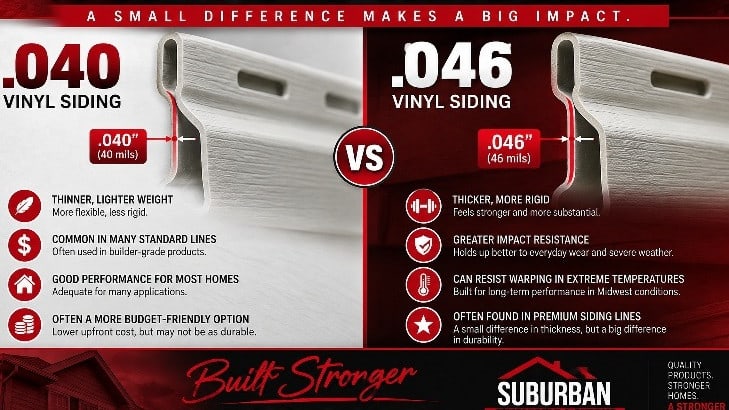
Six thousandths of an inch doesn't sound like much. Across an exterior siding system, however, thickness is one of several specifications that can influence rigidity, appearance, handling, and the overall feel of the finished installation.
First: .040" Vinyl Siding Isn't Automatically "Bad" Siding
This distinction is important.
A lower-cost vinyl siding product shouldn't automatically be described as poor quality simply because it has a thinner nominal wall thickness.
Vinyl siding sold for code-compliant applications should be evaluated against the applicable product standards, manufacturer specifications, installation requirements, and local building codes.
The better question isn't, "Is .040 siding bad?"
It's "What am I getting when I move from a .040" product to a .046" premium product?"
What ASTM D3679 Actually Means
ASTM D3679 is the primary ASTM product specification for rigid PVC vinyl siding.
It goes well beyond a single thickness measurement. The standard establishes requirements and test methods covering areas such as dimensions, shrinkage, impact strength, expansion, appearance, weathering, and wind-load resistance.
That's important because siding performance can't be reduced to one number on a brochure.
Thickness matters, but so do material formulation, panel geometry, locking design, nail-hem construction, dimensional stability, manufacturing consistency, wall preparation, and installation.
Where VSI Standards and Certification Fit In
The Vinyl Siding Institute's product certification program, now operated under the Polymeric Exterior Products Association, provides independent third-party verification for certified vinyl siding products.
Certified vinyl siding is evaluated for compliance with ASTM D3679. Testing and certification address more than thickness, including weatherability, wind load, impact resistance, expansion and shrinkage, surface distortion, dimensions, and other product characteristics.
That's why contractors should look beyond marketing terms such as "builder grade," "premium," or "heavy duty" and review the actual product specifications and certifications.
Gentek .040" vs. Gentek .046": What Changes?
Gentek's product specifications make the difference easy to see.
Gentek offers vinyl siding profiles with a .040" nominal thickness, while Sequoia Select horizontal siding profiles carry a .046" nominal thickness.
| Comparison | Gentek .040" Vinyl | Gentek Sequoia Select .046" |
|---|---|---|
| Nominal Thickness | .040" | .046" |
| Positioning | Value-focused vinyl | Ultra-premium vinyl |
| Panel Feel | Lighter construction | Heavier-duty construction |
| Rigidity | Designed for its product class | Greater rigidity is a stated manufacturer feature |
| Wall Appearance | Traditional vinyl appearance | Designed for straighter, smoother walls and deeper dimension |
| Best Fit | Budget-sensitive projects | Projects prioritizing rigidity, appearance, and premium construction |
.046" Is 15% Thicker Than .040"
Numerically, the difference between .040" and .046" is .006".
Relative to a .040" panel, .046" represents a 15% increase in nominal thickness.
That doesn't mean the .046" product is automatically "15% better." Siding performance doesn't work that way.
What it does show is that the difference isn't merely a marketing label. There is a measurable difference in the amount of material represented by the nominal wall-thickness specification.
Why Rigidity Matters on the Wall
One of the clearest reasons to consider heavier vinyl siding is rigidity.
Gentek specifically describes Sequoia Select's .046" construction as providing increased rigidity for straight, smooth walls.
A siding panel doesn't exist by itself. It spans the exterior wall, moves with temperature changes, locks into adjacent courses, and interacts with the surface underneath it.
Greater panel rigidity can contribute to a more substantial feel and help the finished wall maintain the crisp appearance expected from a premium siding system.
Wall preparation still matters. No siding thickness can compensate for serious problems with the substrate underneath it.
Thickness Isn't the Only Upgrade in Sequoia Select
This is where comparing products solely by .040" versus .046" can become misleading.
Sequoia Select isn't simply a thinner siding panel made six thousandths thicker.
Gentek's manufacturer specifications identify additional design features, including:
- .046" nominal wall thickness on horizontal profiles
- Full-roll nailing hem
- Advantage Lock system
- 3/4" lap height for deeper dimension and shadow lines
- Cedargrain texture with a low-gloss appearance
- Manufacturer testing for negative wind-load resistance
In other words, the premium difference is better understood as a complete panel system rather than a thickness measurement alone.
The Cost of Cheap Siding Can Show Up in Appearance
Homeowners see their siding every day.
That makes appearance part of the long-term value equation.
A lower-cost siding product may satisfy the requirements of a budget-driven project perfectly well. But when the homeowner expects deeper shadow lines, a more substantial panel, and a smoother premium appearance, stepping up in product class may make sense.
Saving money at installation isn't much of a victory if the homeowner spends the next several years wishing they had chosen the product they actually preferred.
ASTM Compliance Establishes a Baseline—Not That Every Product Is Identical
This is one of the most important points for contractors to explain.
ASTM D3679 establishes standardized requirements and test methods for vinyl siding. VSI certification provides third-party verification that certified products comply with the applicable standard.
Neither of those facts means every compliant vinyl siding product has identical construction, thickness, locking systems, appearance, warranty terms, or manufacturer-specific performance features.
Standards establish an important quality and performance framework. Manufacturers can then design products at different levels within that framework.
Manufacturer Specifications Matter
When comparing siding, go back to the manufacturer documentation for the exact product and profile being considered.
Review specifications such as:
- Nominal panel thickness
- Panel profile and exposure
- Butt or lap dimensions
- Nailing-hem construction
- Locking-system design
- Wind-load information
- Available colors
- Texture and finish
- Warranty coverage and limitations
- Manufacturer installation requirements
Those specifications tell a much more complete story than simply asking for the cheapest carton of siding.
Installation Can Erase the Advantage of a Better Product
You can buy premium .046" siding and still end up with a poor exterior if it isn't installed correctly.
Vinyl siding is designed to expand and contract. Fasteners, clearances, wall preparation, flashing, accessories, and panel engagement all need to follow the manufacturer's instructions.
Industry installation guidance also emphasizes following local building-code requirements and the specific siding manufacturer's instructions.
Better material and better installation should work together.
Where .040" Vinyl Can Still Be the Right Choice
There are plenty of projects where a value-focused vinyl siding product makes sense.
- A strict project budget
- Rental or investment properties
- Projects where premium aesthetics aren't the primary objective
- Customers who prioritize initial cost
- Applications where the selected product meets the project's specifications and requirements
Choosing .040" siding isn't necessarily making a mistake. The mistake is choosing it without understanding what changes when you move into a heavier premium product.
Where .046" Vinyl Starts to Earn Its Premium
The step to .046" siding becomes easier to justify when the homeowner places greater value on the finished appearance and construction of the exterior.
- Long-term ownership is expected
- Curb appeal is a major priority
- The homeowner wants a more substantial siding panel
- Rigidity and smooth wall appearance matter
- Deeper shadow lines are preferred
- The project calls for a premium siding package
In those situations, the difference in material cost should be weighed against the fact that the homeowner will live with the finished exterior for years.
Contractors Should Show the Difference, Not Just Explain It
One of the easiest ways to explain .040" versus .046" siding is to put the products in the customer's hands.
Let them compare the panel construction. Let them look at the profile, texture, lap, locking system, and finished appearance.
Then explain the price difference.
That's a much better sales conversation than simply saying one product is "cheap" and the other is "premium."
Cheap Today Isn't Always the Best Value Tomorrow
There is a place for value-focused .040" vinyl siding, just as there is a place for premium .046" siding. The important thing is making the decision with a clear understanding of what separates the products.
Gentek Sequoia Select doesn't become a premium product simply because the number changes from .040" to .046". The heavier nominal thickness is part of a broader package that includes panel rigidity, nailing-hem construction, locking design, dimensional appearance, texture, and manufacturer-specific performance features.
At Suburban Wholesale & Supply, our sales counter team can help contractors compare siding specifications, understand product differences, work through takeoffs and accessories, and select materials that fit both the project and the customer's expectations.
Comparing .040" and .046" Vinyl Siding?
Don't make the decision from thickness or price alone. Talk with the sales counter team at Suburban Wholesale & Supply. We can help you compare Gentek siding products, manufacturer specifications, profiles, accessories, and the complete material package for your next project.
Compare Siding Options With Our TeamPart of: Vinyl Siding
More in Vinyl Siding
- Hidden Costs of Builder-Grade Vinyl Siding | .038 vs .040 vs .042
- Premium Vinyl Siding vs Builder-Grade Siding
- Gentek .046 vs .044 Vinyl Siding: Worth It?
- Dutch Lap vs. Traditional Clapboard: Which Architecture Fits Each Profile?
We stock all 29 colors of Gentek Sequoia Select D4 in our Davenport warehouse, and stocked items are usually ready same day or next day.
Share This Post
Share it on Facebook or X, or send it through your device share sheet for Instagram.