Compare premium vinyl siding with builder-grade siding by examining thickness, rigidity, panel design, appearance, ASTM performance standards, VSI installation practices and Gentek manufacturer specifications.
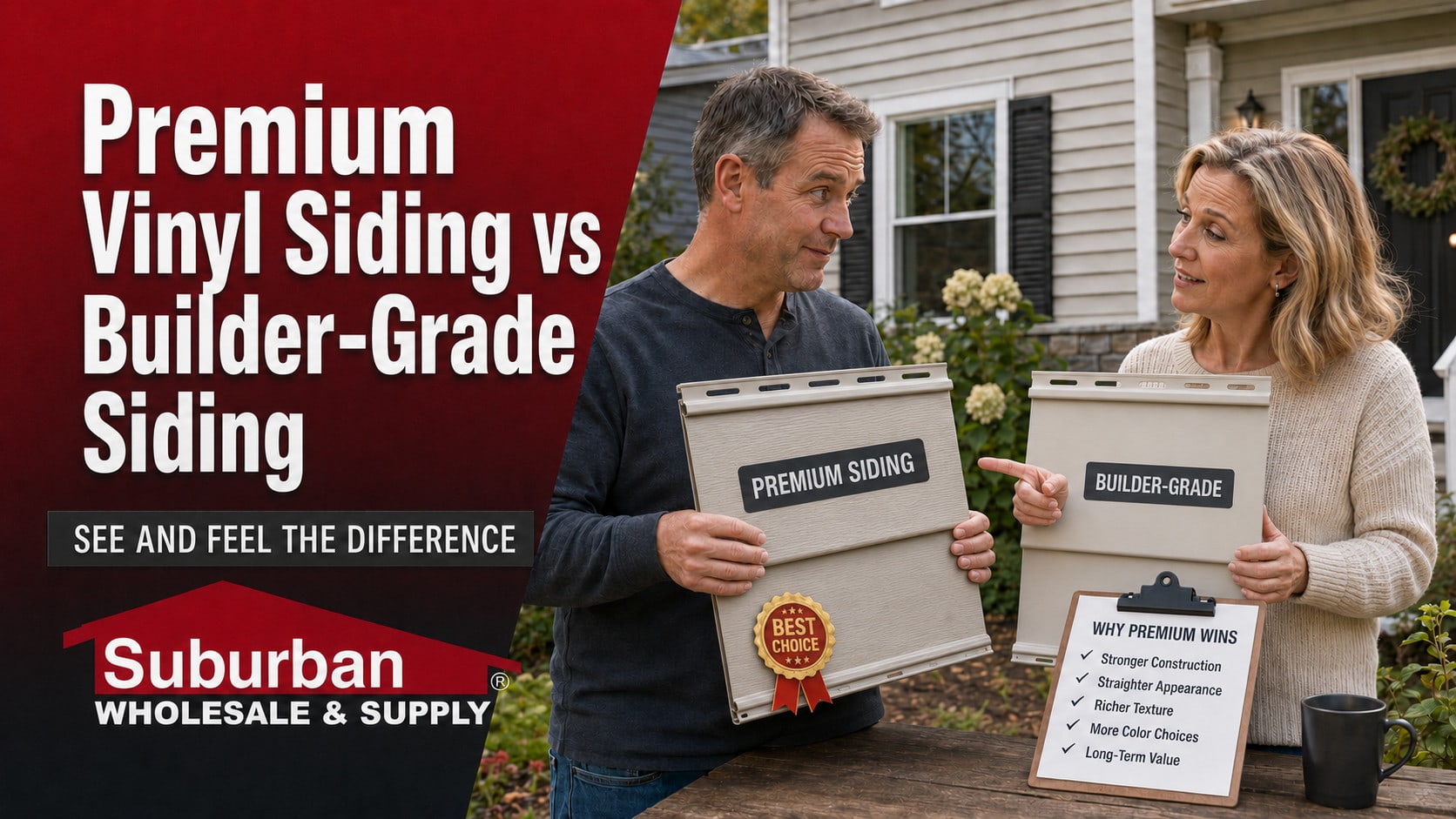
Contractor Siding Comparison
Premium Vinyl Siding vs Builder-Grade Siding
Premium and builder-grade vinyl siding may look similar in a photograph, but important differences can exist in thickness, rigidity, nail-hem construction, panel engagement, profile depth, color technology and warranty protection.
Most homeowners do not replace siding very often. When they compare proposals, they may see one contractor offering “premium vinyl siding” while another describes the material only as “standard” or “builder grade.”
Those terms sound meaningful, but they are not complete technical specifications. “Builder grade” is generally a market description for a product selected primarily around affordability and basic performance. It is not a single ASTM or Vinyl Siding Institute classification.
Premium siding should be supported by measurable product differences. Contractors should compare nominal thickness, panel geometry, nail hem, locking system, wind-load information, surface design and written warranty rather than relying on marketing labels.
Gentek Sequoia Select® provides a useful example of an ultra-premium product. Its horizontal profiles feature a nominal .046-inch thickness, full-roll nailing hem, Advantage Lock system, full 3/4-inch lap height and low-gloss cedar-grain texture. Contractors and homeowners can review the Gentek Sequoia Select product information through Suburban Wholesale & Supply.
“Builder Grade” Is Not an Official Performance Standard
ASTM standards do not create one universal category called builder-grade vinyl siding. Manufacturers may also use different names for their entry-level, standard, premium and ultra-premium products.
The only reliable comparison is a product-to-product evaluation using the current manufacturer specifications, standardized test information, warranty and proposed installation method.
Premium and Builder-Grade Siding at a Glance
| Comparison Point | Premium Vinyl Siding | Typical Builder-Grade Siding |
|---|---|---|
| Product priority | Appearance, rigidity, performance features and long-term value | Basic protection and lower initial material cost |
| Panel thickness | Often heavier, depending on the exact product | Often thinner, but manufacturer specifications must be checked |
| Rigidity | Commonly engineered for greater panel body and stability | May feel lighter and reveal wall irregularities more readily |
| Nail hem | May include reinforced or full-roll construction | Commonly uses a more basic attachment design |
| Panel projection | Often deeper for stronger shadow lines | May have a flatter or shallower profile |
| Texture | Frequently uses refined, low-gloss wood-inspired finishes | May have a simpler or more reflective surface |
| Color selection | Often includes broader palettes and deeper designer colors | Commonly emphasizes basic, high-volume colors |
| Warranty | May include broader protection, subject to written terms | Coverage varies and must be reviewed carefully |
These are common market tendencies, not universal rules. Some builder-oriented products perform well, while some products marketed as premium may offer few meaningful upgrades. Always compare the exact specifications.
Difference One: Panel Thickness
Panel thickness is one of the clearest differences between many premium and builder-grade siding products. Thicker siding contains more material and can provide additional body and rigidity.
Gentek Sequoia Select’s horizontal profiles have a nominal thickness of .046 inch. Many value-oriented siding products are manufactured with thinner nominal measurements, although there is no single thickness that defines every builder-grade panel.
“Nominal thickness” means the manufacturer’s stated product thickness. It should not be interpreted as a promise that every microscopic point on every panel will measure precisely the same. Manufacturing tolerances and standardized measurement methods apply.
Thickness is important, but contractors should never use it as the sole measurement of siding quality.
Difference Two: Rigidity and Wall Appearance
A heavier premium panel can feel more substantial during handling and installation. Increased panel body may also help create straighter-looking courses over a properly prepared wall.
A lighter panel may follow minor wall irregularities more visibly. This does not mean every thinner panel will look wavy, nor does it mean premium siding can hide a severely uneven surface.
Vinyl siding follows the wall beneath it. Bowed framing, damaged sheathing, poorly installed underlayment and protruding fasteners can compromise either type of siding. Premium material is not a substitute for proper wall preparation.
Difference Three: Nail-Hem and Locking-System Design
The nail hem connects the siding to the wall, while the locking system connects one course to the next. These features are critical parts of the panel’s overall construction.
Gentek Sequoia Select includes a full-roll nailing hem designed to provide a reinforced wall-attachment area. Its Advantage Lock system is designed to secure adjoining panels and enhance rigidity and stability.
A basic panel may use a simpler nail hem or lock. That does not automatically make it unacceptable, but the contractor should understand what is being removed from the product when the lowest material price becomes the primary goal.
Difference Four: Architectural Depth and Aesthetics
Premium siding should improve the architecture of the house—not merely cover the walls. Panel projection, exposure, texture, gloss and color all affect how the finished exterior looks.
Sequoia Select’s horizontal profiles feature a full 3/4-inch lap height. The deeper profile produces stronger shadow lines as light moves across the wall. Its low-gloss cedar-grain texture supports a softer, more natural appearance.
Builder-grade siding may use a shallower projection or simpler surface treatment. The difference may be most noticeable on:
- Large, uninterrupted walls
- Highly visible front elevations
- Two-story homes with broad siding areas
- Homes with strong natural-light exposure
- Projects using premium windows, doors and trim
What ASTM D3679 Says About Vinyl Siding Quality
ASTM D3679 is the principal product specification for extruded, single-wall rigid PVC siding. It establishes requirements and test methods for more than panel thickness.
ASTM D3679 addresses areas that include:
- Materials and composition
- Panel dimensions
- Thickness
- Camber
- Heat shrinkage
- Impact resistance
- Linear expansion
- Surface appearance
- Weathering performance
- Wind-load resistance
This standard demonstrates why “premium” cannot be established from one specification. Vinyl siding is an engineered exterior cladding with several performance characteristics.
Meeting a Minimum Standard Is Not the Same as Offering a Premium Product
A builder-grade and premium product may both be represented as meeting an applicable product standard. That does not make their construction, appearance or warranty identical.
Standards establish recognized requirements and testing methods. Manufacturers can then engineer products with heavier panels, deeper profiles, reinforced hems, specialized locks, expanded colors or other features that distinguish one product tier from another.
How ASTM D5206 Relates to Wind Performance
ASTM D5206 describes a laboratory procedure for testing rigid plastic siding under a specified uniform static pressure difference. It provides a consistent method for evaluating wind-load resistance.
Gentek states that Sequoia Select has been tested for negative wind-load resistance according to ASTM D5206 and meets or exceeds the applicable industry standard for wind-load performance.
A contractor should never assume that thickness alone establishes wind resistance. Performance also depends on profile design, panel lock, nail hem, fastener spacing, substrate and installation configuration.
Contractors should consult Gentek’s current data for the exact profile and avoid converting a laboratory result into a blanket promise that every wall will withstand a particular wind speed or storm.
VSI Installation Standards Matter for Both Product Levels
The Vinyl Siding Institute has long supported product certification and professional installer education. Recognized VSI practices emphasize that vinyl siding must be attached securely while remaining free to expand and contract.
ASTM D4756 addresses installation practices for rigid PVC siding and soffit. ASTM D3679 also directs installers to follow ASTM D4756 and the manufacturer’s current installation instructions.
A proper installation should include:
- Wall inspection and preparation. Damaged sheathing, protruding fasteners and major wall irregularities should be corrected.
- A coordinated water-management system. The weather-resistant barrier and flashing must direct water away from vulnerable areas.
- A level starter strip. The first course controls the alignment of the entire elevation.
- Correct fastening. Fasteners must secure the panels without preventing thermal movement.
- Required clearances. Installers must follow Gentek’s instructions at corners, trim, openings and accessories.
- Complete panel engagement. Each course should be locked fully without being stretched upward.
- Frequent alignment checks. Small errors should be corrected before they accumulate across the wall.
A carefully installed builder-grade panel can outperform a poorly installed premium panel. Premium siding gives the contractor a stronger product foundation, but workmanship determines whether its intended advantages reach the homeowner.
Color Retention Requires Its Own Evaluation
Panel thickness does not determine color retention. Color performance depends on the product’s formulation, pigments, color technology, weather exposure and manufacturer specifications.
ASTM D7856 establishes test methods and performance requirements for evaluating the color and appearance retention of solid and variegated plastic siding products.
The current written manufacturer warranty should control every discussion of fade protection. Contractors should not promise that a color will never change or imply coverage beyond the warranty’s actual terms.
Manufacturer Specifications Contractors Should Compare
Before recommending premium or builder-grade siding, request the current technical information for both products and compare:
- Exact product name and profile
- Nominal panel thickness
- Panel exposure and projection
- Nail-hem construction
- Locking-system design
- Wind-load test information
- Surface texture and gloss
- Available standard and designer colors
- Required accessories
- Installation instructions
- Written warranty terms
- Transfer, labor and claim limitations
Questions to Ask When a Proposal Says “Builder Grade”
A proposal that lists only “vinyl siding” or “builder-grade siding” leaves too much unanswered. Homeowners and contractors should ask:
- What is the manufacturer and exact product line?
- What is the nominal panel thickness?
- Which profile and exposure are included?
- Does the panel have a reinforced nail hem?
- What locking-system design does it use?
- What standardized testing applies to the exact profile?
- Which trim pieces and accessories are included?
- How will the wall be prepared and flashed?
- What do the product and workmanship warranties cover?
If a contractor cannot identify the exact product being installed, the homeowner cannot make a serious comparison between proposals.
Is Premium Vinyl Siding Worth the Additional Cost?
Premium siding is often worth considering when the product upgrade represents a manageable portion of the entire installed project. Labor, removal, disposal, wall preparation, housewrap, flashing and accessories may remain similar regardless of the panel selected.
If a homeowner already plans to invest in a complete siding replacement, choosing a more substantial panel may provide better value than saving only on the most visible exterior material.
Premium siding is especially compelling for:
- Long-term homeowners
- Large or highly visible elevations
- Higher-value properties
- Homes with premium windows, doors and trim
- Owners who prioritize curb appeal
- Customers concerned about panel rigidity
When Can Builder-Grade Siding Be a Reasonable Choice?
Builder-grade siding is not automatically defective or inappropriate. A properly manufactured and installed value-oriented product can provide a serviceable exterior.
It may make sense when:
- The project has a strict budget
- The property is a short-term investment
- The building has small or minimally visible siding areas
- Basic colors and profiles meet the design goal
- The exact product has acceptable specifications
- A qualified contractor will install it correctly
The mistake is not choosing a lower-cost product. The mistake is choosing it without understanding which features, appearance benefits or warranty provisions have been removed to reach that price.
Why the Difference Matters in the Quad Cities
Homes in Davenport, Bettendorf, Moline, East Moline and Rock Island experience cold winters, humid summers, wind and rapid temperature changes.
Vinyl siding naturally expands and contracts as temperatures change. Both premium and builder-grade siding must be fastened in a way that permits this movement.
A heavier panel with a reinforced nail hem and secure locking system gives the contractor a stronger starting point. Proper wall preparation, fastening, clearances and water-management details allow those product features to work as designed.
Compare Premium Siding Products in the Quad Cities
Suburban Wholesale & Supply is a Gentek building-products distributor serving contractors throughout Davenport, Bettendorf, Moline, East Moline, Rock Island and surrounding communities.
Contractors can compare actual panel samples, thicknesses, profiles, textures, colors and accessories before recommending a product. Suburban Wholesale also provides takeoff assistance and next-day delivery on many stocked panels.
JR Girskis is a VSI Certified Trainer with more than 25 years of building-material experience. Contractors can speak with JR about Gentek manufacturer specifications, recognized installation practices and ways to explain the difference between premium and builder-grade siding without relying on vague sales claims.
Final Verdict: Premium or Builder Grade?
Premium vinyl siding is generally the stronger choice for homeowners who value rigidity, architectural depth, refined texture, broader design options and a more substantial exterior.
Gentek Sequoia Select supports its ultra-premium positioning with a nominal .046-inch horizontal panel thickness, full-roll nailing hem, Advantage Lock system, full 3/4-inch lap and low-gloss cedar-grain texture.
Builder-grade siding can still be appropriate when affordability is the primary concern and the exact product has acceptable specifications. It must also be installed correctly.
The real decision should never be based on labels alone. Compare the exact products, manufacturer specifications, ASTM test information, written warranties and complete installation scopes. That is the only way to determine whether a lower price represents good value or simply fewer features.
Explore Gentek Sequoia Select Premium Vinyl Siding
Review Gentek Sequoia Select product information or contact Suburban Wholesale & Supply for samples, contractor pricing, current specifications, color availability, accessories and delivery options.
View Gentek Sequoia SelectTechnical References
- Gentek Building Products: Sequoia Select manufacturer specifications
- Gentek Building Products: Current Siding Product Directory and written warranty
- ASTM D3679: Standard Specification for Rigid Poly Vinyl Chloride PVC Siding
- ASTM D5206: Standard Test Method for Wind-Load Resistance of Rigid Plastic Siding
- ASTM D4756: Standard Practice for Installation of Rigid PVC Siding and Soffit
- ASTM D7856: Standard Specification for Color and Appearance Retention of Plastic Siding
- Vinyl Siding Institute installation and installer-training principles
Product specifications, profiles, colors, test results, warranties, standards and installation instructions may change. Confirm current Gentek literature and applicable building-code requirements before ordering or installing siding.
Part of: Vinyl Siding
More in Vinyl Siding
- Hidden Costs of Builder-Grade Vinyl Siding | .038 vs .040 vs .042
- .040 vs .046 Vinyl Siding: What's the Real Difference? | Suburban Wholesale & Supply
- Gentek .046 vs .044 Vinyl Siding: Worth It?
- Dutch Lap vs. Traditional Clapboard: Which Architecture Fits Each Profile?
We stock all 29 colors of Gentek Sequoia Select D4 in our Davenport warehouse, and stocked items are usually ready same day or next day.
Share This Post
Share it on Facebook or X, or send it through your device share sheet for Instagram.