Builder-grade vinyl siding may lower the upfront price, but thinner panels can come with tradeoffs in rigidity, wall appearance, installation sensitivity, and product features. Learn what contractors should consider when comparing .038", .040", and .042" vinyl siding.
Vinyl Siding Quality & Long-Term Value
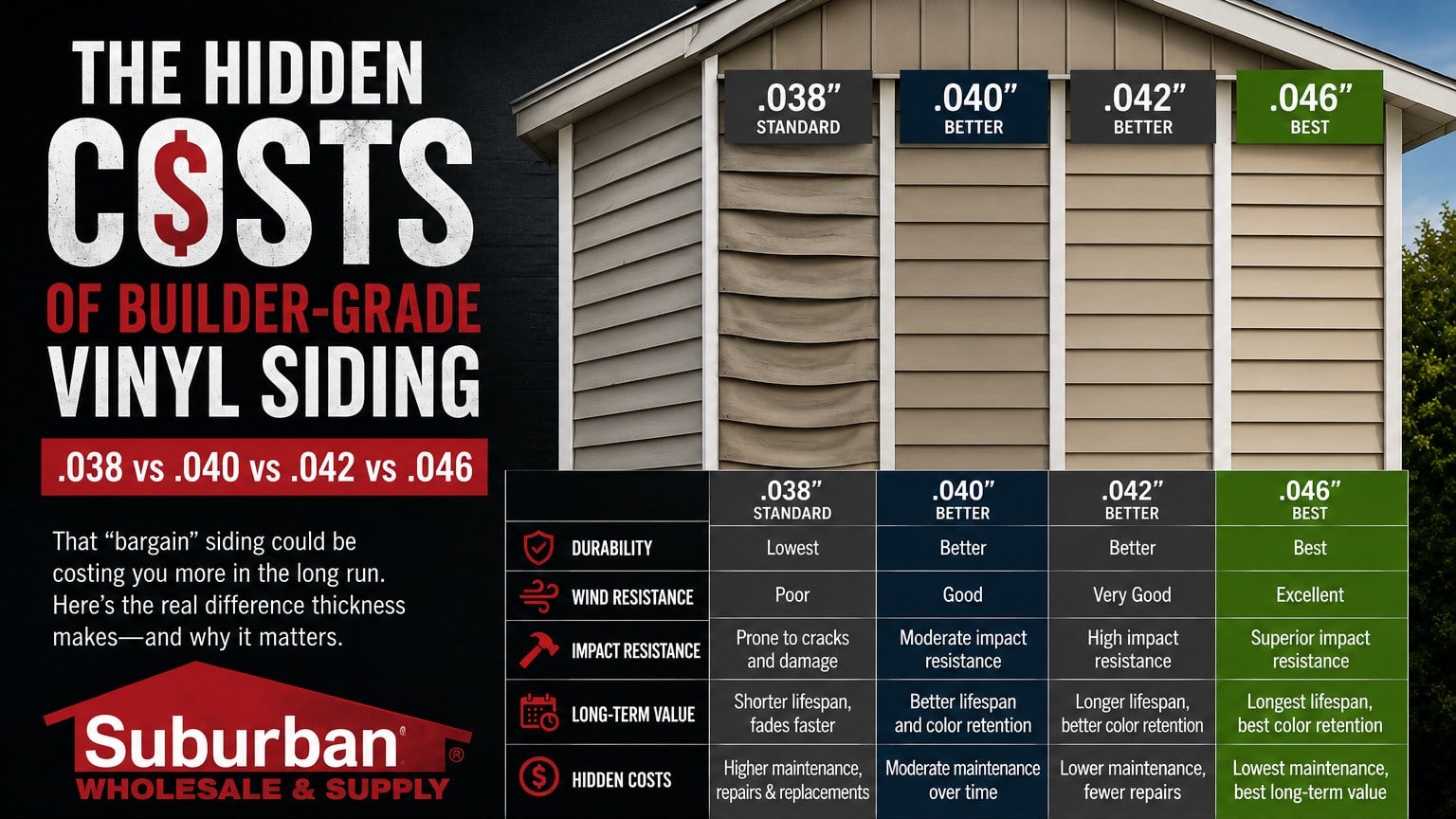
The Hidden Costs of Builder-Grade Vinyl Siding: .038", .040" and .042"
Lower-cost vinyl siding can look attractive on an estimate, but the initial material price does not tell the whole story. Panel thickness, rigidity, wall preparation, installation quality, appearance, and long-term expectations all influence whether a lower-priced siding package is actually the better value.
Builder-grade siding is usually chosen for one reason: keeping the upfront cost down.
There is nothing inherently wrong with that. A value-focused siding product can be appropriate when it matches the budget, project requirements, and homeowner expectations.
The problem starts when .038", .040", .042", and heavier premium siding are treated as though they are interchangeable simply because all of them are vinyl.
They are not.
Thickness is only one part of a complete siding system, but it can influence rigidity, handling, finished wall appearance, and how sensitive the installation is to the condition of the surface underneath it.
What Does "Builder Grade" Actually Mean?
"Builder grade" is not a formal ASTM product classification. It is generally used in the market to describe products selected primarily around initial cost and basic project requirements.
That distinction matters because contractors should compare actual specifications rather than relying on labels.
A .038" or .040" panel should not automatically be called poor-quality siding, and a thicker panel is not automatically superior in every possible performance category.
The better question is:
What changes as we move up in siding construction, and does that difference matter for this particular project?
.038", .040" and .042" May Sound Nearly Identical
On paper, the numbers are close.
But small differences in material thickness are repeated across every panel covering the exterior.
| Nominal Thickness | Relative Position | Typical Conversation |
|---|---|---|
| .038" | Very value-focused | Lowest initial material cost |
| .040" | Value-oriented | Affordable everyday siding |
| .042" | Step-up construction | Added rigidity and product substance |
These categories are not universal industry grades. Manufacturer specifications for the exact siding product should always control the comparison.
Hidden Cost #1: The Wall Underneath Matters More
Vinyl siding follows the exterior surface underneath it.
If the wall is uneven, bowed, poorly prepared, or inconsistent, the finished siding can reflect those conditions.
As panel construction becomes lighter, contractors may have less margin for hiding irregularities in the substrate. That puts even more importance on proper wall preparation before installation begins.
The hidden cost is not necessarily a siding failure. It can be the additional labor required to prepare the wall well enough to produce the appearance the homeowner expects.
Hidden Cost #2: Rigidity Affects the Finished Appearance
Rigidity is one of the most noticeable differences contractors feel when comparing siding panels in person.
Gentek, for example, identifies its .040" Aurora II siding as providing rigidity for straight, smooth walls, while its .042" Concord product is described as having heavy-duty construction designed to provide additional rigidity. :contentReference[oaicite:0]{index=0}
The point is not that a .040" panel cannot produce an attractive exterior. It can.
The point is that manufacturers deliberately change panel construction as products move upward in their line because rigidity and wall appearance are meaningful product characteristics.
Hidden Cost #3: Installation Becomes Even More Important
Vinyl siding is not installed tightly against the house like a rigid sheet product.
It must be able to accommodate normal thermal movement, which means fastening, clearances, panel engagement, accessories, and manufacturer-specific installation details matter.
A value-oriented siding panel installed correctly can perform as intended. A more expensive panel installed incorrectly can still create problems.
The hidden cost of choosing only by material price is assuming that the product can compensate for rushed installation or poor wall preparation. It cannot.
Hidden Cost #4: Saving on Material Can Create an Appearance Compromise
Homeowners tend to compare siding from a sample board. They live with it across thousands of square feet of exterior wall.
That's where panel depth, rigidity, profile shape, texture, shadow lines, corners, and trim details become much more noticeable.
A lower-priced product may be perfectly acceptable for a budget-driven project. But if the homeowner wants a more substantial, architectural appearance, choosing solely on initial price can lead to disappointment after installation.
Replacing siding because the customer dislikes the finished appearance is far more expensive than making the right product decision before the job starts.
Hidden Cost #5: The Lowest Price Can Limit the Good-Better-Best Conversation
Contractors do customers a disservice when the only siding option presented is the least expensive one.
A homeowner may gladly spend more for a heavier panel, a different profile, deeper shadow lines, or a more premium exterior—but only if someone explains what the additional investment buys.
Show the customer the difference between product levels. Let them handle the samples. Explain the manufacturer specifications. Then let them decide.
That is a much stronger conversation than assuming everyone wants the cheapest possible siding package.
.040" to .042" Is a Small Number but a Real Product Step
Gentek's current product lineup provides a useful example of how manufacturers position siding at different thickness levels.
Gentek lists Aurora II at .040" nominal thickness and Concord at .042". Moving further up the line, Signature Supreme is .044" and Sequoia Select horizontal siding is .046". :contentReference[oaicite:1]{index=1}
Gentek does not treat those products as identical panels with different price tags. Its manufacturer specifications vary by thickness, profile, nail-hem construction, locking system, butt height, texture, and other features. :contentReference[oaicite:2]{index=2}
That is why thickness should be viewed as one part of a broader product progression.
ASTM Compliance Does Not Mean Every Vinyl Siding Product Is Equal
This is an important distinction when comparing value and premium siding.
A manufacturer can offer several products that meet applicable ASTM requirements while still designing those products with different thicknesses, profiles, rigidity, locking systems, and aesthetic features.
Gentek states that its siding products and accessories meet or exceed ASTM D3679 requirements, while its own published lineup ranges from .040" through .046" nominal thickness for its primary horizontal vinyl siding products. :contentReference[oaicite:3]{index=3}
Meeting an industry standard establishes an important baseline. It does not make every compliant product identical.
Warranty Doesn't Necessarily Tell You Which Panel Is Better
Warranty length can also make lower-cost and premium siding look more similar than they really are.
Gentek's current literature states that its vinyl siding brands carry lifetime limited warranty protection, including fade and hail protection, subject to the complete warranty terms. :contentReference[oaicite:4]{index=4}
Yet those same products range from .040" to .046" in nominal thickness and have different manufacturer specifications.
That demonstrates why contractors should compare the physical product first and the warranty second.
Don't Confuse Thinner With Automatically Inferior
There are projects where thinner, value-oriented siding makes practical sense.
- Strict budget requirements
- Rental or investment properties
- Shorter ownership horizons
- Projects where premium architectural appearance is not a priority
- Applications where the selected product meets the project's requirements
The goal is not to tell every customer that lower-cost siding is wrong.
The goal is to make sure the lower price is a conscious tradeoff rather than the result of never being shown another option.
The Real Cost Is Buying the Wrong Product for the Customer
A .040" product can be a smart purchase for one homeowner and the wrong choice for another.
The same is true of .042", .044", and .046" siding.
Contractors should understand what the customer actually values:
- Lowest possible initial price
- Long-term ownership
- Smoother wall appearance
- Panel rigidity
- Deeper architectural profiles
- Color and design flexibility
- Premium exterior appearance
Once those priorities are clear, thickness and manufacturer specifications become much easier to put into context.
Read the Manufacturer Specifications Before Comparing Prices
A contractor should know exactly which siding product is being quoted.
Review:
- Nominal thickness
- Profile and exposure
- Nail-hem construction
- Locking-system design
- Butt or lap depth
- Texture and finish
- Wind-load information
- Available colors
- Warranty terms
- Manufacturer installation instructions
Those specifications make it possible to compare actual siding systems instead of comparing two square-foot prices that may represent very different products.
Don't Sell Thickness. Explain the Difference.
Contractors do not need to tell homeowners that .038", .040", or .042" vinyl siding is automatically bad. They need to explain where each product sits in the market and what changes as construction becomes heavier and more premium.
That means reviewing manufacturer specifications, understanding applicable industry standards, looking at the actual panels, and discussing the customer's expectations for the finished exterior.
At Suburban Wholesale & Supply, our sales counter team can help contractors compare vinyl siding products, thicknesses, profiles, accessories, specifications, and complete material packages before the job starts.
Comparing Builder-Grade and Premium Vinyl Siding?
Bring the project to Suburban Wholesale & Supply. Our sales counter team can help you compare siding thickness, manufacturer specifications, profiles, colors, accessories, and product levels so you can explain the differences clearly to your customer.
Compare Vinyl Siding With Our TeamPart of: Vinyl Siding
More in Vinyl Siding
- .040 vs .046 Vinyl Siding: What's the Real Difference? | Suburban Wholesale & Supply
- Premium Vinyl Siding vs Builder-Grade Siding
- Gentek .046 vs .044 Vinyl Siding: Worth It?
- Dutch Lap vs. Traditional Clapboard: Which Architecture Fits Each Profile?
We stock all 29 colors of Gentek Sequoia Select D4 in our Davenport warehouse, and stocked items are usually ready same day or next day.
Share This Post
Share it on Facebook or X, or send it through your device share sheet for Instagram.