Premium vinyl siding is more than a thicker panel. Learn how contractors can explain rigidity, profiles, shadow lines, longer panels, color choices, accessories, installation, and warranties in language homeowners understand.
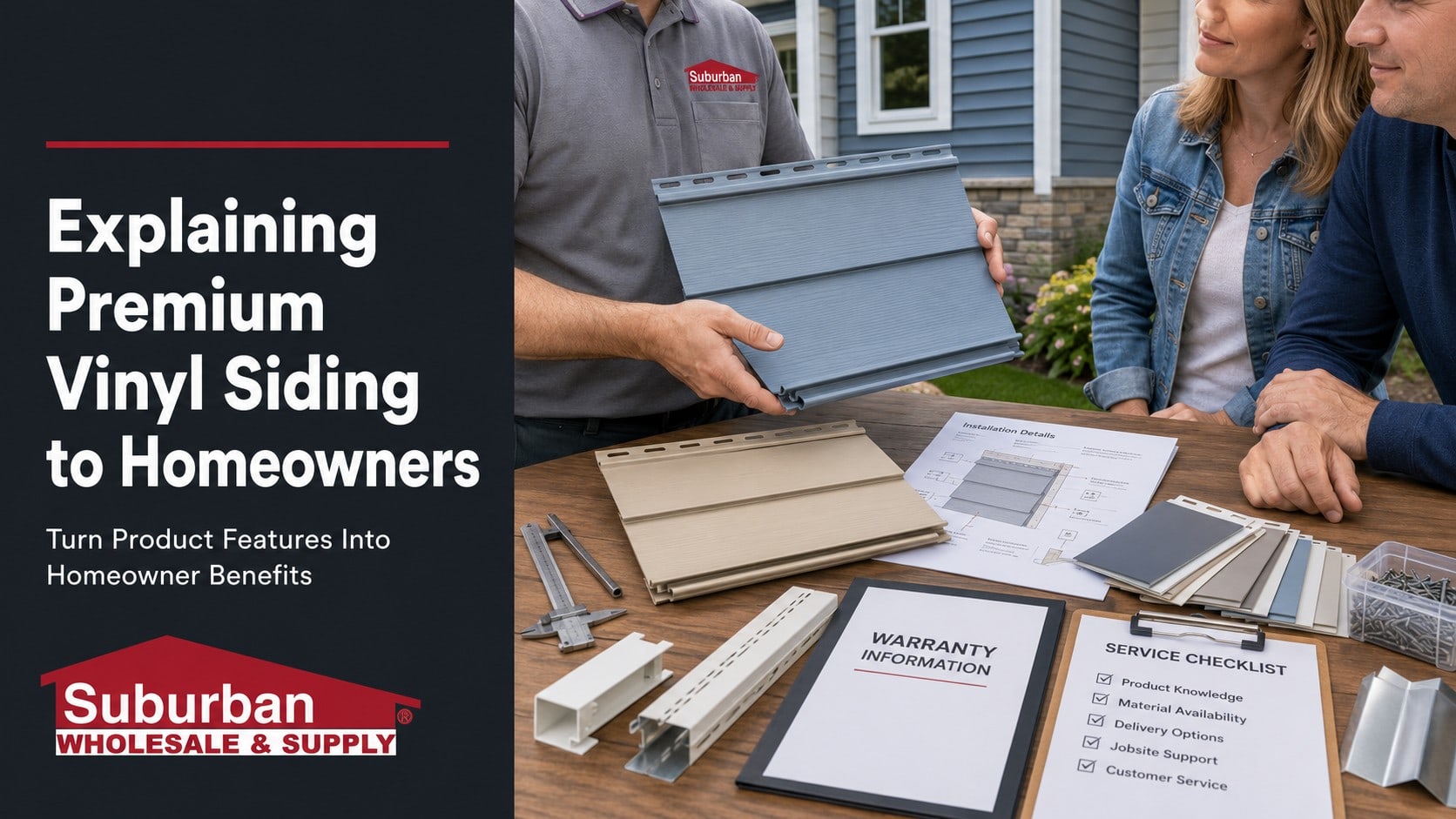
Contractor Education | Suburban Wholesale & Supply
Explaining Premium Vinyl Siding to Homeowners
Homeowners do not need a technical lecture about siding. They need a clear explanation of what makes one panel different, how those differences may affect the finished home, and what they receive for the additional investment.
Most homeowners begin a siding project thinking about color, price, and maintenance. Contractors think about panel thickness, rigidity, nailing hems, locking systems, profiles, accessories, fastening, flashing, and installation requirements.
A good contractor connects those two perspectives. The goal is not to overwhelm homeowners with product terminology or push them toward the most expensive choice. The goal is to translate meaningful product differences into language they can use to make a confident decision.
Contractors can begin by reviewing the available vinyl siding options from Suburban Wholesale & Supply and selecting a few product levels that create a fair comparison.
A Simple Way to Explain Premium Vinyl Siding
“Premium vinyl siding is generally designed with a more substantial panel, an upgraded profile, and additional appearance or performance features. Depending on the product, those differences may create a straighter-looking wall, deeper shadow lines, fewer visible seams, or more color and design choices. It still needs to be installed correctly, and it does cost more, so we will compare the exact differences before you decide.”
This explanation is specific enough to create interest but restrained enough to remain credible. It also makes clear that “premium” is not a substitute for proper installation.
What Does “Premium” Actually Mean?
Premium is not one universal technical classification. Manufacturers use the term to describe siding lines with upgraded combinations of panel construction, profiles, colors, textures, locking systems, nailing hems, panel lengths, warranties, or other features.
Two products described as premium may not offer identical benefits. Contractors should compare the exact product specifications instead of relying on the label alone.
A meaningful comparison may include:
- Published panel thickness
- Profile and exposure
- Butt or lap depth
- Nailing-hem construction
- Locking-system design
- Available panel lengths
- Texture and gloss level
- Color selection and color technology
- Matching trim and accessory options
- Manufacturer testing and warranty terms
1. Explain Panel Thickness Without Overselling It
Premium vinyl siding often has a heavier wall thickness than entry-level products. Homeowners can usually feel the difference when two samples are placed side by side.
A heavier panel may provide greater rigidity and a more substantial feel. When installed over a properly prepared wall, that added rigidity may contribute to a straighter, smoother-looking exterior.
“This panel is thicker and more rigid than the standard option. That does not mean the thinner product is automatically bad, but the heavier panel has a more substantial construction and may produce a more refined finished appearance.”
Avoid claiming that thickness alone guarantees wind resistance, impact resistance, energy savings, or a perfectly flat wall. Product design, testing, substrate condition, fastening, and installation all matter.
2. Describe Rigidity as Part of the Complete System
Rigidity describes how well a panel resists flexing and distortion. Thickness contributes to rigidity, but it is not the only factor. Profile geometry, butt depth, locking design, nailing hem, material formulation, wall support, and installation quality also affect how the siding behaves.
“The premium panel combines its wall thickness with the shape of the profile and its locking system. We look at the complete panel design, not just one number.”
3. Focus on How the Home Will Look
Homeowners are not buying a panel specification. They are buying the appearance of the finished house. Premium profiles may provide deeper laps, stronger shadow lines, lower-gloss textures, or proportions that more closely resemble traditional wood siding.
Discuss visual details such as:
- How the profile fits the home’s architecture
- The depth and consistency of shadow lines
- Texture and gloss level in natural light
- The size and proportion of each siding course
- How seams will appear from the street
- Trim width around windows and doors
- Coordination with roofing, stone, brick, and entry doors
Whenever possible, show complete project photographs and larger samples. Small color chips cannot communicate the way an entire elevation will respond to sunlight and shadow.
4. Explain Why the Siding Profile Matters
The profile determines the visible shape and proportion of the siding. Clapboard, Dutch lap, beaded, vertical, shake, and other profiles create different architectural effects.
Premium products may offer deeper profiles or more distinctive dimensions. The right choice should complement the scale and style of the home rather than simply being the most expensive profile available.
“This profile creates a deeper shadow line, which gives the wall more dimension. The other profile is flatter and more understated. Neither is automatically right or wrong—it depends on the look you want.”
5. Show the Value of Extended-Length Panels
Some premium siding lines are available in longer panel lengths. Depending on the dimensions of the house, longer panels can reduce the number of overlaps across broad wall sections.
Fewer overlaps can create a cleaner appearance, especially on highly visible front or side elevations. The actual benefit depends on wall length, openings, product availability, layout, and installation planning.
“The longer-panel option may reduce the number of visible seams across this large wall. Let’s use the measurements of your house to determine whether it creates a meaningful improvement.”
Do not promise a seamless exterior unless the actual wall dimensions and panel layout support that claim.
6. Explain the Locking System and Nailing Hem Simply
Premium siding may include an upgraded locking system, reinforced nailing hem, or other attachment features. Homeowners do not need every engineering detail, but they should understand that the edge design is part of how the panel connects and remains stable.
“The siding is not just a flat sheet. The top and bottom edges are engineered to fasten and lock together as a system. This premium panel includes an upgraded attachment design, but it still must be installed according to the manufacturer’s specifications.”
Use published manufacturer testing when discussing wind performance. Do not apply the highest tested result from one profile to every color, panel length, installation method, or project.
7. Treat Color as a Major Part of the Investment
Premium siding lines often provide expanded palettes, deeper colors, and coordinated exterior components. Color may be one of the strongest reasons a homeowner selects an upgraded product.
The siding color should be evaluated with the roof, brick, stone, windows, entry door, gutters, soffit, fascia, and neighborhood architecture. A color that looks attractive on a small chip may appear very different across an entire sunlit wall.
Help homeowners evaluate:
- Large samples in sun and shade
- Warm versus cool undertones
- Contrast with trim and corner posts
- Coordination with permanent masonry
- How the color changes throughout the day
- Availability of matching exterior accessories
8. Explain Low Maintenance Honestly
Vinyl siding is popular because it does not require the regular painting associated with many painted exterior surfaces. Its color runs through the material, and routine cleaning can usually remove common surface dust and dirt.
Low maintenance does not mean no maintenance or no possibility of damage. Homeowners should still inspect the exterior, clean it according to manufacturer instructions, keep heat sources away, and address loose or damaged panels promptly.
“Vinyl siding reduces the need for routine painting, but it should still be cleaned and inspected. I would describe it as low maintenance—not maintenance-free.”
9. Separate the Product Warranty From the Installation Warranty
Homeowners often hear “lifetime warranty” and assume every possible problem is covered. Contractors should provide the actual warranty and explain its scope, exclusions, transfer provisions, claim procedures, and maintenance requirements.
The manufacturer’s warranty generally applies to the product under its written terms. The contractor’s workmanship warranty applies to the installation under a separate agreement.
Review these questions:
- What product conditions are covered?
- What exclusions or limitations apply?
- Is coverage transferable?
- Are labor or accessory costs included?
- What maintenance is required?
- Who handles a future service request?
- What does the contractor guarantee in writing?
10. Make It Clear That Premium Siding Still Depends on Installation
A premium panel cannot compensate for damaged sheathing, poor flashing, overdriven fasteners, insufficient expansion clearance, crooked starter strip, or careless seam placement.
Homeowners should understand that the product and installation are inseparable. A stronger panel can only deliver its intended appearance and performance when it is installed as part of a complete wall system.
A professional installation should address:
- Inspection and preparation of the substrate
- Water-resistive barrier and flashing details
- Manufacturer-approved fasteners and spacing
- Expansion and contraction clearances
- Proper panel locking and alignment
- Thoughtful seam and overlap placement
- Compatible corners, trim, soffit, and accessories
- Final inspection and cleanup
Standard and Premium Vinyl Siding: How to Explain the Difference
| Comparison Point | Standard Option | Premium Option |
|---|---|---|
| Primary goal | Dependable, low-maintenance exterior at a lower investment | Upgraded construction, appearance, or available features |
| Panel feel | Product-specific standard construction | Often heavier or more rigid, depending on the product |
| Appearance | Traditional profiles and practical color options | May offer deeper profiles, richer texture, or wider color choices |
| Panel lengths | Standard lengths based on product availability | Some lines offer longer panels to reduce visible overlaps |
| Accessories | Core matching components | May provide additional coordinated trim and design choices |
| Price | Lower material investment | Higher investment based on the upgraded product package |
Exact differences vary by manufacturer and product line. Compare current specifications rather than assuming every premium panel includes the same features.
Questions Homeowners Should Be Encouraged to Ask
A confident contractor welcomes comparison. Encourage homeowners to ask specific questions instead of deciding from a generic product label.
- What is the exact manufacturer and product line?
- What makes this panel different from the standard option?
- Which differences will be visible on my home?
- Are longer panels available for my wall dimensions?
- What accessories are included in the siding system?
- How will windows, doors, corners, soffit, and fascia be finished?
- How will the wall be prepared and flashed?
- What are the written product and workmanship warranties?
- What is the exact installed-price difference?
- Which option would the contractor choose for this particular home—and why?
Claims Contractors Should Avoid
A strong explanation does not need exaggeration. Avoid promises that cannot be supported by current manufacturer documentation or the exact project conditions.
- “This panel will never buckle.”
- “Thicker siding cannot be damaged by hail.”
- “Premium siding will eliminate your energy bills.”
- “The siding is completely waterproof.”
- “You will recover the entire upgrade cost at resale.”
- “This wind rating applies to every installation.”
- “The warranty covers everything forever.”
- “Premium siding does not require maintenance.”
Explain documented benefits and relevant limitations. Credibility is more persuasive than an absolute promise.
Homeowner-Friendly Ways to Explain the Upgrade
When introducing the options
“All three of these products are legitimate options. The differences are in panel construction, appearance, available features, and price. Let’s compare the parts that matter for your home.”
When discussing thickness
“The premium panel is heavier and more rigid. That may help create a straighter-looking finished wall, but we still need to prepare the surface and install it correctly.”
When discussing appearance
“The biggest difference you may notice is the deeper profile and stronger shadow line. Let’s take both samples outside so you can see them in natural light.”
When discussing price
“The premium package adds $2,500 to the complete project. Here are the exact product and design differences you receive for that amount.”
When the standard option is sufficient
“If keeping the project within this budget is your first priority, the standard panel is a reasonable choice. I would rather help you select the right option than push you into an upgrade you do not value.”
Who Is Premium Vinyl Siding Best For?
A premium panel may be worth considering when the homeowner:
- Plans to remain in the home for many years
- Places a high value on exterior appearance
- Wants deeper profiles or stronger shadow lines
- Prefers colors unavailable in standard product lines
- Wants to reduce visible seams where longer panels fit
- Values a more substantial panel construction
- Wants coordinated premium trim and accessories
- Understands and accepts the additional investment
It may be less important when the budget is strict, the project is a limited repair, the premium features will not be visible, or the homeowner simply does not value the differences.
Explain the Difference and Let the Homeowner Decide
Premium vinyl siding should be explained through verified differences, visible samples, complete-home design, installation quality, warranty terms, and an exact price comparison.
Some homeowners will decide that added rigidity, deeper profiles, longer-panel options, expanded colors, or upgraded accessories are worth the investment. Others will select a standard product that better fits their budget.
The contractor’s job is not to force the premium option. It is to make the differences understandable enough that the homeowner can choose without second-guessing the decision.
Compare Vinyl Siding Options for Your Next Project
Suburban Wholesale & Supply helps contractors compare siding profiles, panel construction, colors, textures, accessories, warranties, and availability. We serve contractors throughout Davenport, Bettendorf, Moline, Rock Island, East Moline, and the surrounding Quad Cities.
Explore our vinyl siding products and contact our team for help building an understandable standard, upgraded, and premium comparison.
Better product knowledge helps contractors answer questions clearly and helps homeowners make better exterior decisions.
Part of: Selling Siding & Windows
More in Selling Siding & Windows
- How to Help Homeowners Compare Vinyl Siding Quotes
- Selling Vinyl Siding Quality Instead of Price
- How to Explain the ROI of Premium Vinyl Siding
- Questions to Ask Before Buying Vinyl Siding
Sample books, color decks, demo kits and cutaways are available at the counter, and most are free.
Share This Post
Share it on Facebook or X, or send it through your device share sheet for Instagram.