Contractors do not win quality-focused siding projects by defending a higher price. They win by making product construction, installation, flashing, accessories, warranties, and service visible enough for homeowners to understand the difference.
Contractor Sales Education | Suburban Wholesale & Supply
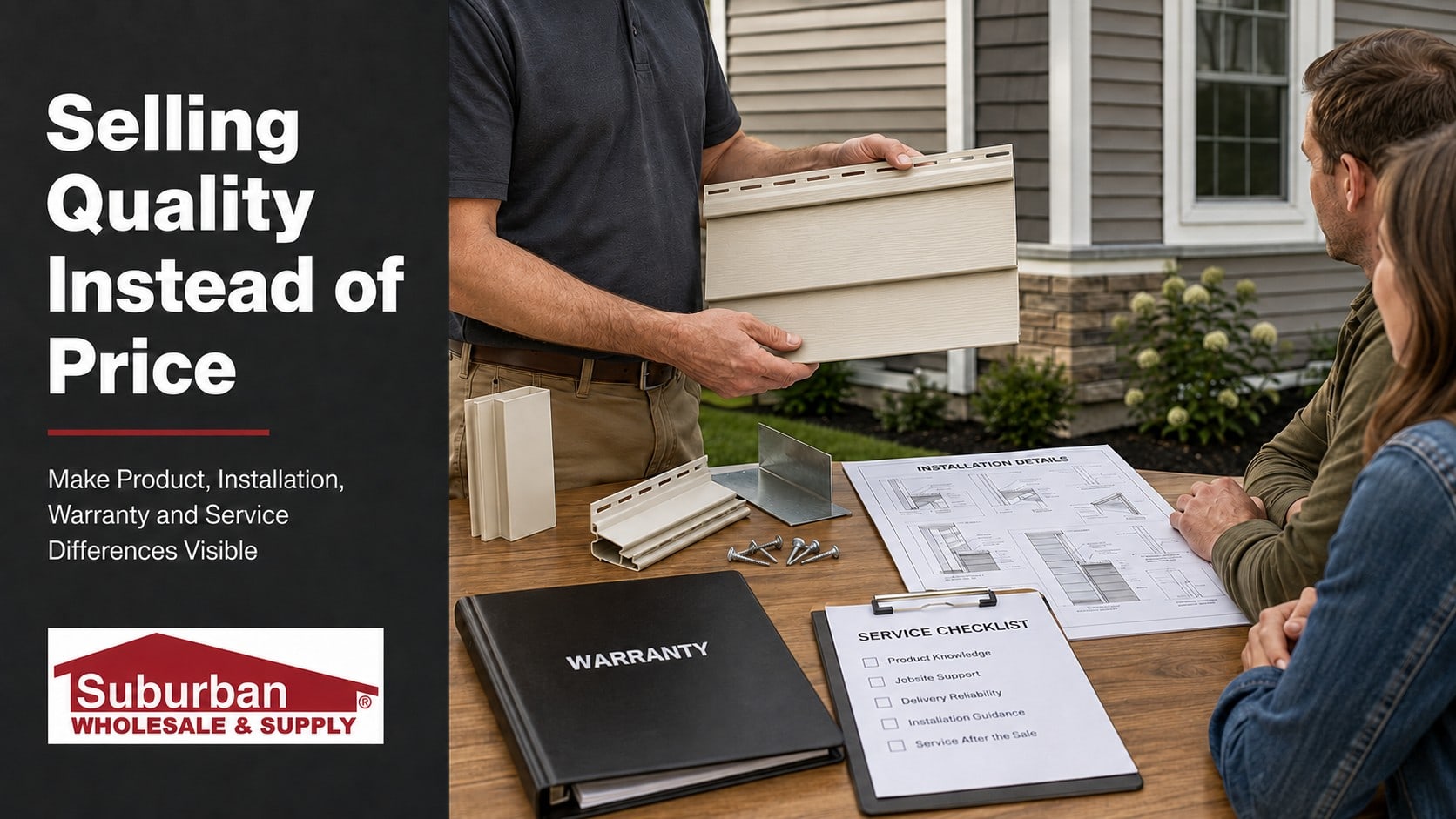
Selling Quality Instead of Price
When homeowners believe every vinyl siding proposal is the same, price becomes the only obvious difference. Contractors earn better projects by making product quality, installation, service, and long-term value easy to see.
Many siding contractors become frustrated when a homeowner says, “Another company is cheaper.” The instinct is often to defend the price, criticize the competitor, or immediately offer a discount.
None of those responses solves the real problem. If the homeowner cannot identify meaningful differences between the proposals, choosing the lower number is rational.
Contractors must make the differences understandable before asking a homeowner to pay more. That starts with clearly defined products, physical samples, a complete installation scope, written warranties, and a proposal that shows where the money goes.
Review the available vinyl siding products from Suburban Wholesale & Supply and build your sales presentation around specific, verifiable product differences.
The Hard Truth About Price Objections
“Your price is too high” does not always mean the homeowner cannot afford the project. It often means the contractor has not demonstrated enough additional value to justify the difference.
A higher price is not proof of higher quality. Contractors must earn that conclusion with documented products, a stronger scope, qualified installation, clear accountability, and dependable service.
If your proposal looks the same as the cheaper proposal, expect the homeowner to choose the cheaper proposal.
Define What Quality Means
Quality is too vague to sell by itself. A contractor should break it into specific parts the homeowner can see, verify, and compare.
A quality siding project includes:
- An identified manufacturer and product line
- A product appropriate for the home and budget
- Complete matching accessories
- Inspection and preparation of the wall
- Effective water-resistive barrier and flashing details
- Manufacturer-compliant fastening and clearances
- Thoughtful seams, trim, and exterior design
- Trained installers and project supervision
- Property protection and thorough cleanup
- Written product and workmanship warranties
- A clear service process after installation
These details turn “we do better work” into a claim the homeowner can evaluate.
1. Discover What Quality Means to the Homeowner
Quality has different meanings for different customers. One homeowner may care about a premium dark color. Another may value reduced seams, stronger warranty support, careful flashing, or a contractor who will answer the phone after installation.
Ask:
- How long do you plan to remain in the home?
- What do you dislike about the current exterior?
- How important is the appearance from the street?
- Have you had problems with leaks or loose siding?
- Are there specific colors or profiles you prefer?
- How important is service after the project?
- Are you comparing products, installation scopes, or only prices?
- What would make you feel confident choosing a contractor?
Once the priorities are clear, the presentation can focus on relevant value rather than generic features.
2. Name the Exact Product
A proposal that says only “premium vinyl siding” forces the homeowner to trust a vague label. A quality-focused proposal identifies the manufacturer, product line, profile, color, wall thickness, panel length, texture, and included accessories.
Provide current product literature, specifications, installation instructions, and written warranty information. Specificity builds credibility and makes price-only competitors easier to compare.
“I do not want you to buy something described only as premium siding. This proposal names the exact product, profile, color, accessories, and warranty so you can verify everything we are discussing.”
3. Use Physical Samples to Make Quality Tangible
Homeowners may struggle to understand panel thickness, rigidity, lap depth, texture, nailing hems, and locking systems from a brochure. Side-by-side samples can make those differences easier to grasp.
Compare:
- Panel thickness and rigidity
- Profile and shadow-line depth
- Texture and gloss level
- Nailing-hem construction
- Locking-system design
- Available panel lengths
- Color and matching accessory options
Do not use theatrical bending or impact demonstrations to imply performance the sample cannot prove. Connect every claim to current manufacturer documentation.
4. Translate Features Into Homeowner Outcomes
| Product or Project Detail | Homeowner-Friendly Explanation |
|---|---|
| Heavier panel construction | “The panel has a more substantial feel and may create a straighter-looking wall when properly installed.” |
| Deeper profile | “This creates stronger shadow lines and gives the exterior more dimension.” |
| Extended-length panels | “Longer panels may reduce visible overlaps on broad walls.” |
| Complete flashing scope | “We address how water moves around windows, doors, roof lines, and penetrations before the siding covers the wall.” |
| Matching accessories | “The corners, trim, soffit, fascia, and mounting blocks are planned as one complete exterior.” |
| Workmanship warranty | “You have written terms explaining who is responsible if an installation concern appears later.” |
| Local service | “You know who to contact for questions, storm inspections, or future service.” |
5. Make the Hidden Work Visible
Some of the most important siding work disappears behind the finished panels. If contractors do not explain it, homeowners may assume every company handles it the same way.
Show how your scope addresses:
- Existing siding removal
- Inspection of the substrate
- Sheathing damage and repair authorization
- Water-resistive barrier continuity
- Window and door flashing
- Roof-to-wall and kick-out flashing
- Deck and porch connections
- Mounting blocks around penetrations
- Fastener selection and penetration
- Expansion and contraction clearances
Photographs, diagrams, checklists, and a documented scope help the homeowner understand why careful preparation costs more than simply covering the wall.
6. Sell the Complete Exterior Design
Homeowners do not experience siding as a thickness number. They experience the way the house looks when they pull into the driveway.
Show how the siding profile, color, seams, corners, window trim, soffit, fascia, gutters, stone, brick, shutters, and entry door work together. Quality becomes easier to appreciate when the homeowner can see a complete design rather than one isolated sample.
Discuss:
- Profile proportions
- Shadow-line depth
- Trim width around openings
- Seam placement on visible elevations
- Standard versus extended-length panels
- Accent colors and architectural features
- Coordination with permanent masonry and roofing
7. Compare Scopes Before Comparing Prices
A $7,000 price difference may represent excessive markup—or it may represent different products, accessories, wall preparation, flashing, labor, warranties, and service. Do not assume. Compare line by line.
| Comparison | Your Proposal | Competing Proposal |
|---|---|---|
| Exact siding product | Manufacturer, line, profile, and color listed | Verify exact product |
| Existing siding | Removal and disposal defined | Verify inclusion |
| Wall preparation | Inspection and repair process defined | Verify scope and pricing |
| Water management | Barrier and flashing scope listed | Verify details |
| Accessories | Complete matching package listed | Verify manufacturers and colors |
| Workmanship warranty | Written coverage included | Request written terms |
| Service | Local process and contact identified | Verify who handles future concerns |
If the competing proposal is genuinely equal and substantially cheaper, confront that reality. Do not invent differences that do not exist.
8. Improve the Proposal Before Improving the Sales Pitch
A polished presentation cannot rescue a vague proposal. The document should make quality visible after the salesperson leaves.
Include:
- Exact product specifications
- Color, profile, texture, and panel length
- All included accessories
- Removal and disposal scope
- Wall-preparation process
- Flashing and water-management details
- Installation methods and quality-control steps
- Property-protection and cleanup procedures
- Product and workmanship warranty documents
- Service process after installation
- Complete price, exclusions, and change-order terms
9. Offer Good, Better, and Best Choices
Quality selling does not require forcing every homeowner into the most expensive product. Offer multiple products you would confidently install and explain where each one fits.
| Option | Best For | Presentation Focus |
|---|---|---|
| Good | Budget-conscious homeowner | Dependable product and professional installation |
| Better | Homeowner seeking added rigidity or design choices | Product construction, appearance, and value |
| Best | Long-term owner prioritizing premium aesthetics | Premium profile, colors, longer panels, and accessories |
Keep the installation quality consistent. The homeowner is choosing a product level—not deciding whether your crew will flash the windows correctly.
10. Respond to “Your Price Is Higher” Without Becoming Defensive
“You are right—our proposal is higher. Before deciding whether that difference is justified, let’s compare the exact siding product, wall preparation, flashing, accessories, warranties, and service included in both proposals. If the scopes are truly equal, then price should carry more weight. If they are different, you should know what the difference buys.”
This response acknowledges reality, avoids attacking the competitor, and moves the conversation back to evidence.
11. Isolate the Price Difference
Do not speak only in total project prices. Identify the exact difference and explain what changes for that amount.
“The competing project is $24,000 and ours is $28,500, so the difference is $4,500. Our proposal includes the identified premium panel, removal and disposal, this flashing scope, matching mounting blocks, the written workmanship warranty, and the service process shown here. Let’s verify which of those items are included in the other bid.”
Do not imply that every difference is automatically worth the money. Give the homeowner enough information to judge.
12. Do Not Discount Before Diagnosing the Objection
Immediate discounting teaches the homeowner that the original price was flexible or inflated. First determine whether the objection is about budget, value, cash flow, distrust, or an apparently equivalent lower proposal.
Ask:
- Is the total investment outside the budget?
- Is the homeowner unsure the quality difference is meaningful?
- Does the other proposal appear to include the same scope?
- Is financing or payment timing the actual concern?
- Is one optional upgrade making the project unaffordable?
If the budget is the problem, adjust the product or optional scope transparently. Do not quietly remove essential flashing, accessories, or wall preparation.
13. Sell Accountability After Installation
A siding project does not end when the final payment clears. Homeowners may need help after a storm, impact, utility repair, remodeling project, or future warranty concern.
Explain who answers service calls, how records are maintained, how the original product is identified, and who helps with manufacturer claims.
“Part of our price is accountability. You will have written records of the product and installation, a defined workmanship warranty, and a company to contact if you need service later.”
14. Replace Claims With Proof
Every contractor says they provide quality. Evidence separates a real process from sales language.
Useful proof includes:
- Current manufacturer specifications
- Physical product samples
- Detailed project photographs
- Completed homes using the proposed product
- Installer training records or credentials
- Written installation checklists
- Photographs of flashing before concealment
- Complete product and labor warranties
- Relevant customer reviews
- A documented service process
Language That Weakens a Quality Presentation
| Avoid Saying | Say This Instead |
|---|---|
| “We are the best.” | “Here is our documented product, process, warranty, and service scope.” |
| “The other contractor uses junk.” | “Let’s compare the exact products and scopes.” |
| “You get what you pay for.” | “Here is what the price difference includes.” |
| “Our siding will never have problems.” | “Here are the product features, installation requirements, and warranty terms.” |
| “This price is good only today.” | “This proposal is valid through the date shown because material pricing can change.” |
| “It is only a little more.” | “The exact difference is $4,500.” |
| “The project will pay for itself.” | “Let’s determine whether the documented benefits justify the investment.” |
Complete Quality-Focused Sales Script
“Before we discuss price, I want to understand what matters most to you about this project. Is your priority controlling the initial cost, improving curb appeal, reducing maintenance, or finding a contractor who will provide long-term service?”
“I am going to show you the exact siding product, the accessories, and how we handle the wall behind it. That way, you can compare our proposal with any other bid using the same questions.”
“This is the proposed panel. Here is its manufacturer, product line, profile, color, and current technical information. You can compare the thickness, texture, profile, nailing hem, and locking system with the other options.”
“The visible siding is only part of our scope. We also define removal, wall inspection, repair authorization, the water-resistive barrier, flashing around openings, mounting blocks, accessories, fastening, cleanup, and final inspection.”
“Our proposal is higher than the other number you received. I am not asking you to assume that higher means better. Let’s compare the products and scopes line by line and determine what the difference actually buys.”
“If the proposals are truly equal, price deserves more weight. If they are different, you should decide whether our added product, process, warranty, and service are worth the additional investment.”
“Which parts of that difference matter most to you?”
Quality-Selling Checklist
- Ask what quality means to the homeowner.
- Identify the exact manufacturer and product line.
- Verify every claim with current documentation.
- Use side-by-side samples.
- Translate specifications into practical outcomes.
- Make hidden wall preparation and flashing visible.
- Present the complete exterior design.
- Compare competing scopes line by line.
- Provide good, better, and best choices.
- Keep installation quality consistent across options.
- Isolate and explain the exact price difference.
- Diagnose objections before discounting.
- Use proof rather than unsupported superlatives.
- Provide written warranties and service procedures.
- Acknowledge when the lower-priced option is the better fit.
Quality Must Be Demonstrated Before It Can Be Sold
Contractors cannot escape price competition by repeatedly saying they offer better quality. They must show what quality means through specific products, complete scopes, trained installation, flashing details, warranties, documentation, and service.
When those differences are visible, homeowners can decide whether the higher proposal offers greater value. When they remain vague, the lowest price usually wins.
Sell with evidence, acknowledge the real cost, and be willing to recommend the less expensive option when it fits. That is how a contractor moves the conversation from price to trust.
Build a Better Vinyl Siding Presentation
Suburban Wholesale & Supply helps contractors compare vinyl siding profiles, panel construction, colors, textures, panel lengths, accessories, warranties, and availability. We serve Davenport, Bettendorf, Moline, Rock Island, East Moline, and surrounding Quad Cities communities.
Explore our vinyl siding product options and ask our team to help you build an accurate, quality-focused comparison for your next homeowner presentation.
Better product knowledge gives contractors something stronger than a discount: a defensible reason to choose them.
Part of: Selling Siding & Windows
More in Selling Siding & Windows
- How to Help Homeowners Compare Vinyl Siding Quotes
- How to Explain the ROI of Premium Vinyl Siding
- Questions to Ask Before Buying Vinyl Siding
- Explaining Premium Vinyl Siding to Homeowners
Sample books, color decks, demo kits and cutaways are available at the counter, and most are free.
Share This Post
Share it on Facebook or X, or send it through your device share sheet for Instagram.