Before buying vinyl siding, homeowners should compare more than color and price. These questions cover panel construction, profiles, installation, flashing, warranties, contractor qualifications, and the complete installed scope.
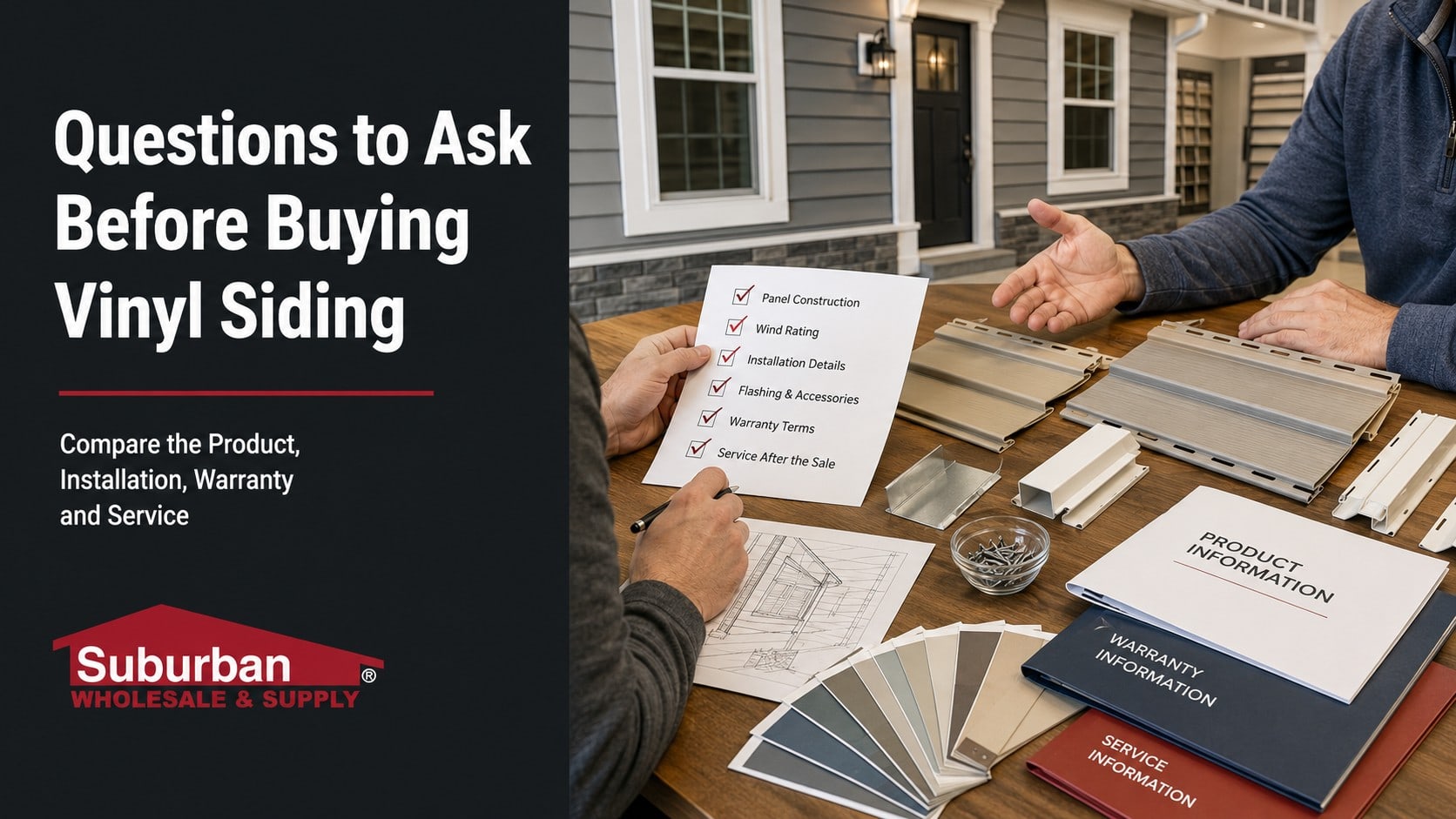
Vinyl Siding Homeowner Guide
Questions Every Homeowner Should Ask Before Buying Vinyl Siding
Choosing vinyl siding involves more than finding an attractive color and comparing the bottom line. The product, wall preparation, flashing, accessories, installation, and written warranties all affect the finished project.
New siding can transform a home’s appearance and reduce the routine maintenance associated with many painted exterior surfaces. However, homeowners often receive proposals that are difficult to compare because they describe products and installation details differently.
One contractor may quote a standard vinyl panel. Another may propose premium siding, longer panels, upgraded trim, additional wall preparation, or a more complete water-management system. If the proposals do not identify those differences, the lowest price can appear to be the best value even when the scopes are not equal.
Before requesting estimates, homeowners can review available vinyl siding products from Suburban Wholesale & Supply to become familiar with common styles, colors, profiles, and product choices.
Ask for Specific Names and Written Details
Terms such as “premium,” “heavy duty,” “lifetime,” and “high performance” can mean different things. A strong proposal identifies the manufacturer, exact product line, profile, color, accessories, installation scope, warranties, and total price.
If a contractor cannot tell you exactly what product is being installed, you cannot make a meaningful comparison or confirm what will arrive at your home.
1. What Is the Exact Manufacturer and Product Line?
“Vinyl siding” is a product category, not a complete specification. Manufacturers offer several lines with different profiles, thicknesses, colors, textures, locking systems, panel lengths, accessories, testing, and warranty terms.
Ask the contractor to list the manufacturer and exact product line in the proposal. Request the current brochure, technical information, installation instructions, and written warranty.
2. Is This Standard, Upgraded, or Premium Vinyl Siding?
These labels are useful only when the contractor explains the actual differences. Premium siding may include a heavier panel, deeper profile, upgraded locking system, reinforced nailing hem, longer panels, expanded colors, or additional design options.
Ask which features are included in the proposed product and which benefits will be visible or relevant on your home.
3. What Is the Published Panel Thickness?
Panel thickness is one useful comparison point. A heavier panel may provide greater rigidity and a more substantial feel, but thickness alone does not determine total quality.
Profile geometry, locking design, nailing hem, material formulation, wall support, accessories, and installation quality also affect the finished siding system.
Ask to see physical samples side by side. Compare their construction, profile, texture, and rigidity rather than relying on a single number.
4. Which Siding Profile Best Fits My Home?
Clapboard, Dutch lap, beaded, vertical, shake, and other profiles create different architectural effects. The right profile should complement the home’s scale and style.
Ask the contractor to explain:
- The width and exposure of each course
- The depth of the butt or lap
- The resulting shadow lines
- How the profile works with the home’s architecture
- Whether accent profiles will be used in gables or entries
5. Are Longer Panels Available?
Some vinyl siding lines offer extended-length panels. Longer panels may reduce the number of visible overlaps on broad wall sections, creating a cleaner appearance.
The benefit depends on the home’s measurements, window and door locations, product availability, installation planning, and which elevations are most visible.
Ask the contractor to show where seams will appear with standard and extended-length panels before paying for the upgrade.
6. How Will the Color Look on the Entire House?
Small color chips can be misleading. Exterior colors change in direct sunlight, shade, overcast conditions, and reflected light. Undertones may also become more noticeable when the siding is placed next to brick, stone, roofing, windows, and trim.
Before making a final decision:
- Request the largest available color sample.
- View the sample in sun and shade.
- Compare it directly with permanent masonry.
- Review matching and contrasting trim options.
- Look at completed homes using the same product and color.
- Confirm that the selected color is available in the chosen profile.
7. What Texture and Gloss Level Does the Siding Have?
Texture and gloss influence how natural or refined the siding appears. Some homeowners prefer a subtle, low-gloss cedargrain. Others want a cleaner or more defined pattern.
Evaluate the panel from several feet away rather than looking only at a close-up sample. The finished exterior will be viewed from the driveway, sidewalk, and street.
8. What Matching Accessories Are Included?
A siding project requires more than wall panels. Corners, starter strip, J-channel, utility trim, mounting blocks, soffit, fascia, vents, trim coil, and other components affect appearance and performance.
Ask whether the proposal includes manufacturer-compatible accessories and whether colors will match or intentionally contrast.
A lower siding price may be less attractive if the proposal omits necessary trim or substitutes accessories that do not create the desired finished appearance.
9. What Happens to My Existing Siding?
Some projects involve removing the existing exterior before installing new siding. Others may involve an approved installation over existing materials. The correct approach depends on the current wall condition, product instructions, building codes, and project scope.
Ask whether the contractor will:
- Remove and dispose of the existing siding
- Inspect the sheathing after removal
- Identify rot, insects, or water damage
- Provide pricing for unexpected repairs
- Remove or work around existing insulation
- Document hidden conditions before covering them
10. How Will the Wall Be Prepared?
Vinyl siding follows the surface beneath it. Premium siding cannot hide severely uneven sheathing, loose material, protruding fasteners, or poorly installed foam.
Ask how the contractor will create a flat, secure fastening surface and what happens if the crew discovers damaged sheathing.
The proposal should identify what wall preparation is included and how additional repairs will be authorized and priced.
11. What Water-Resistive Barrier Will Be Used?
Vinyl siding is an exterior cladding, not the wall’s primary water-resistive barrier. Some incidental water can reach the area behind the siding, so the wall needs a continuous drainage plane.
Ask what water-resistive barrier will be installed, how seams and damage will be treated, and how it will integrate with flashing around openings and penetrations.
12. How Will Windows, Doors, and Penetrations Be Flashed?
Windows, exterior doors, roof intersections, decks, vents, lights, faucets, utility boxes, and mechanical lines are common water-entry locations.
Ask the contractor to explain:
- Window and door head-flashing details
- How sill and jamb flashing will be handled
- Roof-to-wall and kick-out flashing
- Deck and porch connections
- Mounting blocks around exterior fixtures
- How water will drain from behind the siding
J-channel and surface caulk should not be presented as substitutes for a complete flashing system.
13. Will Insulation Be Added Behind the Siding?
Some projects include fan-fold material, rigid foam, insulated siding, or another continuous-insulation strategy. These products are not interchangeable and should not be described as providing the same thermal benefit.
Ask for the product name, published R-value where applicable, thickness, attachment method, seam treatment, and explanation of how windows, doors, trim, and penetrations will be extended or integrated.
Do not accept a vague promise that any material behind the siding will dramatically lower utility bills. Energy performance depends on the complete home and wall assembly.
14. How Will the Siding Be Fastened?
Vinyl siding expands and contracts as temperatures change. It should be securely attached while remaining free to move laterally within its nailing slots.
Fasteners should meet the siding manufacturer’s requirements for type, length, head size, spacing, and penetration. They should not clamp the panels tightly against the wall.
Ask whether the crew follows current manufacturer specifications and how supervisors check for overdriven fasteners and adequate panel movement.
15. How Will Expansion and Contraction Be Managed?
Panels need product-specific clearance where they enter corner posts, J-channel, window trim, door trim, and mounting accessories.
The proper allowance may depend on panel length, product line, accessory, and temperature during installation. A panel installed during an Iowa winter begins in a different condition from one installed during summer heat.
Ask how the contractor adjusts installation details for temperature without leaving panels too short or pinning them too tightly.
16. Where Will the Seams Be Located?
Panel seams affect the appearance of the finished exterior. A thoughtful installer plans seam locations, staggers joints, avoids unnecessarily short pieces, and directs overlaps away from primary viewing angles when practical.
Ask how seams will be handled on the front of the house and other broad, highly visible elevations. If extended-length panels are proposed, ask how many overlaps they are expected to eliminate.
17. Is the Product Tested or Certified?
Ask for current documentation supporting product claims. Avoid assuming that one test result applies to every profile, panel length, color, fastener schedule, wall assembly, or installation.
Product certification and testing help establish whether the siding is manufactured to defined requirements. Field performance still depends on correct installation, substrate conditions, accessories, and maintenance.
If wind performance is important, ask for documentation covering the exact product and installation method proposed for your home.
18. What Does the Manufacturer’s Warranty Actually Cover?
The phrase “lifetime warranty” should never be the end of the conversation. Ask for the complete written warranty and review its definitions, exclusions, transfer terms, claim procedures, maintenance requirements, and available remedies.
Important warranty questions include:
- Which product conditions are covered?
- How does the warranty define excessive fading?
- What hail or impact limitations apply?
- Are labor and accessory costs included?
- Is the warranty prorated?
- Can it transfer to a future owner?
- What documentation must the homeowner retain?
- Who begins and manages a future claim?
19. What Workmanship Warranty Does the Contractor Provide?
The manufacturer’s product warranty and the contractor’s workmanship warranty are different. Product coverage does not automatically pay to correct an installation mistake.
Ask for the workmanship warranty in writing. It should identify the coverage period, covered work, exclusions, service process, and company responsible for future repairs.
A verbal promise from a salesperson is not a substitute for written warranty terms.
20. Who Will Actually Install the Siding?
Find out whether the work will be completed by employees, subcontractors, or a combination of crews. The employment arrangement alone does not determine quality, but the contractor should explain how installers are trained, supervised, and held accountable.
Ask about:
- Vinyl siding installation experience
- Manufacturer or industry training
- Crew supervision and quality-control inspections
- Responsibility for flashing and wall repairs
- Insurance and applicable licensing
- Cleanup and property protection
- The process for handling concerns during installation
21. Can I See Similar Completed Projects?
Ask to see homes using the proposed profile, color, trim combination, and installation style. Photos should show complete elevations as well as details around windows, doors, corners, utility blocks, and roof intersections.
Reviews are helpful, but relevant project examples reveal whether the contractor’s finished work matches the look you expect.
22. What Is Included in the Total Price?
A siding estimate should explain the complete scope. A low number may exclude removal, disposal, sheathing repairs, flashing, insulation, soffit, fascia, trim, shutters, permits, or other necessary work.
Confirm whether the price includes:
- Existing siding removal and disposal
- Wall preparation and minor repairs
- Water-resistive barrier
- Window, door, roof, and penetration flashing
- Siding panels and all required accessories
- Soffit, fascia, and trim coil where applicable
- Removal and reinstallation of fixtures
- Permits and inspections if required
- Delivery, labor, cleanup, and disposal
- Product registration and warranty documents
23. How Are Unexpected Repairs Priced?
Hidden rot or sheathing damage may not be visible until the existing siding is removed. The contract should explain how additional work will be documented, authorized, and priced.
Ask whether repairs use unit pricing, hourly rates, material costs, or a separate written change order. Do not accept an open-ended agreement that gives no method for approving additional charges.
24. What Is the Payment Schedule?
The contract should identify the deposit, progress payments, final payment, accepted payment methods, financing terms where applicable, and conditions for substantial completion.
Avoid large unexplained upfront payments. Do not rely on verbal financing promises, monthly-payment language, or an estimate that omits the total financed cost.
25. How Will the Contractor Protect My Property?
Siding replacement involves ladders, cutting equipment, fasteners, demolition debris, long panels, and repeated movement around the home.
Ask how the crew will protect landscaping, driveways, decks, windows, outdoor equipment, pets, and neighboring property. The contractor should also explain cleanup and magnetic fastener collection where appropriate.
How to Compare Vinyl Siding Proposals
| Proposal Detail | Strong Proposal | Warning Sign |
|---|---|---|
| Siding product | Names manufacturer, line, profile, and color | Says only “premium vinyl siding” |
| Wall preparation | Defines inspection, preparation, and repair process | Assumes the wall can simply be covered |
| Water management | Identifies the barrier and flashing scope | Relies primarily on J-channel and caulk |
| Accessories | Lists corners, channels, trim, and mounting blocks | Leaves accessory quality unspecified |
| Warranties | Provides separate written product and labor terms | Promises a vague “lifetime guarantee” |
| Total price | Clearly defines inclusions, exclusions, and change orders | Uses one total with an incomplete scope |
Vinyl Siding Sales Claims That Deserve More Questions
Be cautious when a proposal relies on absolute promises rather than written specifications and a detailed installation scope.
- “This siding will never fade.”
- “It cannot be damaged by hail.”
- “This will eliminate your energy bills.”
- “The siding makes the wall completely waterproof.”
- “This wind rating applies to every installation.”
- “The lifetime warranty covers everything.”
- “You do not need to inspect the wall underneath.”
- “The lowest bid uses exactly the same material.”
- “You must sign today to receive this price.”
Ask for documentation. A trustworthy contractor should be comfortable explaining both the benefits and limitations of the proposed system.
Quick Checklist to Take to Every Siding Estimate
- Exact manufacturer and product line
- Profile, thickness, color, and texture
- Standard or extended-length panels
- Matching trim and accessory package
- Existing siding removal and disposal
- Wall inspection and sheathing repairs
- Water-resistive barrier
- Window, door, roof, deck, and penetration flashing
- Insulation product and documented R-value, if included
- Manufacturer-compliant fastening and clearances
- Crew training and project supervision
- Written product warranty
- Written workmanship warranty
- Complete price and payment schedule
- Process for authorizing hidden repairs
- Property protection and cleanup
Buy the Complete Siding System—Not Just the Panel
Vinyl siding quality matters, but the panel is only one part of the project. Wall preparation, water management, fastening, expansion clearances, trim, accessories, workmanship, and service after the sale determine whether the complete exterior performs as intended.
The lowest estimate may be the right choice, but only after confirming that the products and scopes are genuinely comparable. A detailed proposal gives homeowners a better basis for evaluating value than the total price alone.
Ask specific questions, request written answers, review physical samples, and choose the combination of product and contractor that gives you the greatest confidence in the finished home.
Compare Vinyl Siding Products Before You Decide
Suburban Wholesale & Supply helps contractors and homeowners compare vinyl siding profiles, colors, panel construction, accessories, warranties, and product availability. We serve Davenport, Bettendorf, Moline, Rock Island, East Moline, and surrounding Quad Cities communities.
Explore our vinyl siding product options and use the questions in this guide to compare your choices more confidently.
A better siding decision begins with knowing exactly what product and installation you are buying.
Part of: Selling Siding & Windows
More in Selling Siding & Windows
- How to Help Homeowners Compare Vinyl Siding Quotes
- Selling Vinyl Siding Quality Instead of Price
- How to Explain the ROI of Premium Vinyl Siding
- Explaining Premium Vinyl Siding to Homeowners
Sample books, color decks, demo kits and cutaways are available at the counter, and most are free.
Share This Post
Share it on Facebook or X, or send it through your device share sheet for Instagram.