Summer heat can significantly affect vinyl siding during installation. Learn how panel temperature, expansion clearances, fastening, storage, cutting, and sun exposure should be managed using manufacturer specifications, VSI guidance, and applicable ASTM standards.
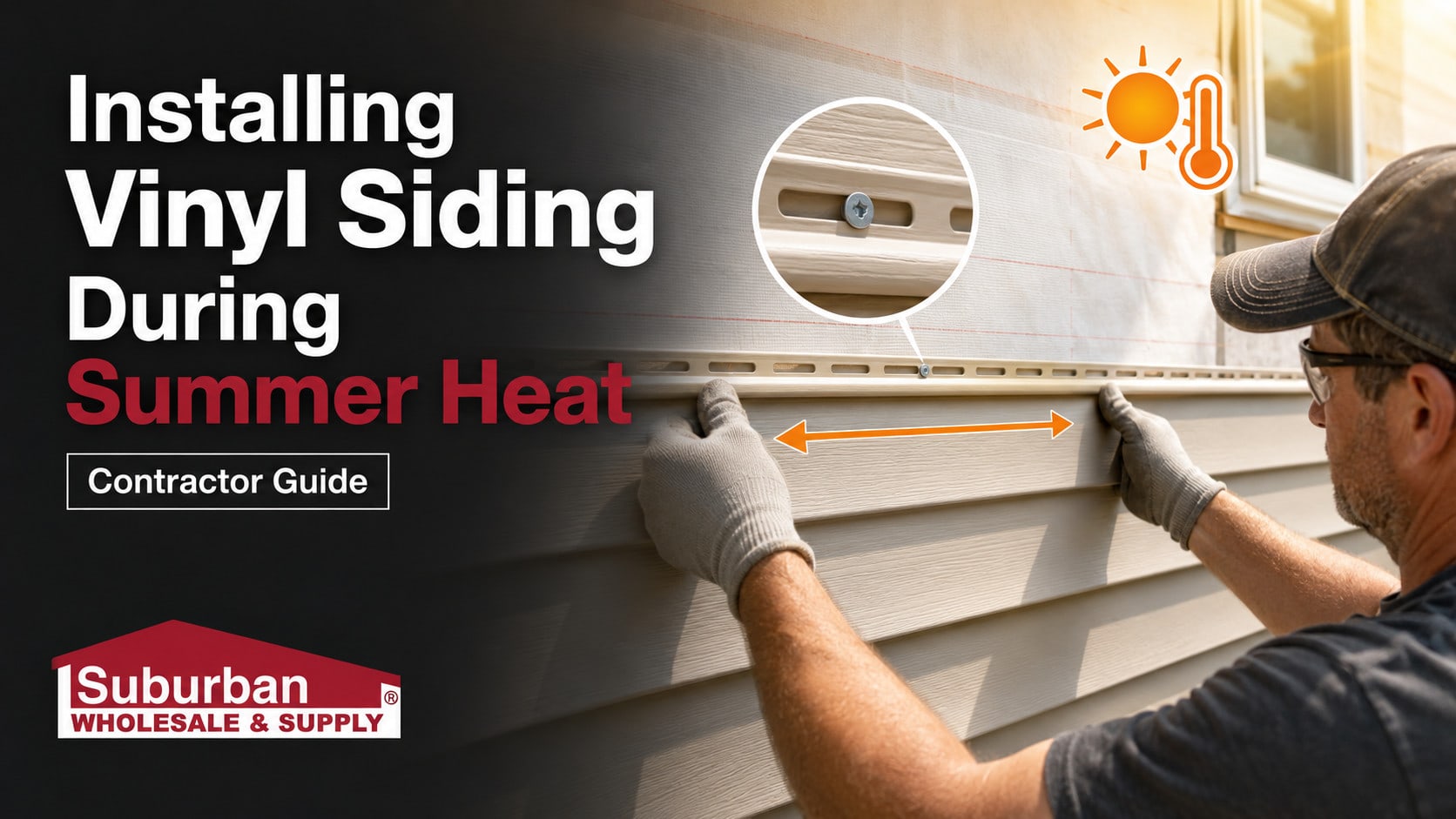
Hot-Weather Vinyl Siding Installation Guide
Installing Vinyl Siding During Summer Heat
Vinyl siding can be successfully installed during hot summer weather, but heat changes the size, flexibility, and handling characteristics of every panel. Contractors must install for the panel’s current condition while allowing for future cold-weather contraction.
Summer is one of the busiest seasons for exterior remodeling, but it can also be one of the most demanding times to install vinyl siding. Direct sunlight can raise the surface temperature of a siding panel well above the surrounding air temperature, especially on southern and western exposures.
As vinyl siding warms, it expands. A panel installed during intense heat may already be near the warmer end of its normal movement range. When winter arrives, that same panel will contract. The installation must accommodate both conditions.
Correct summer installation requires more than leaving a random gap at each end. Panel temperature, fastener placement, receiving-channel engagement, overlaps, accessories, wall preparation, and manufacturer specifications all work together.
Can Vinyl Siding Be Installed in Hot Weather?
Yes, provided the siding manufacturer permits installation under the actual conditions and the crew follows the product-specific requirements for handling, fastening, clearances, overlaps, and accessories.
Contractors should not rely only on the reported air temperature. The siding panel itself may be much hotter after sitting in direct sunlight, inside an enclosed trailer, under clear plastic, or against a dark surface.
There is no responsible universal maximum installation temperature for every vinyl siding product. Always consult the current instructions for the exact manufacturer, product line, profile, color, and application.
Follow Product Requirements in Every Temperature
Hot weather does not change the need to follow accepted installation requirements. It increases the importance of understanding them.
- Manufacturer specifications: Current installation instructions establish product-specific requirements for fasteners, spacing, penetration, end clearances, panel overlaps, accessories, and temperature-related installation details.
- VSI installation guidance: VSI education emphasizes centered fasteners, freedom of panel movement, proper wall preparation, water management, receiving-channel clearances, and careful accessory installation.
- ASTM D3679: This specification addresses rigid PVC siding and directs installers to the applicable installation practice and the manufacturer’s instructions for the specific product.
- ASTM D5206: This test method evaluates the wind-load resistance of rigid plastic siding under prescribed fastening conditions. Actual installed performance also depends on the substrate, fasteners, spacing, accessories, and workmanship.
- Applicable building codes: Local requirements may govern attachment, water-resistive barriers, flashing, wind resistance, and other elements of the wall assembly.
Installation instructions should be available to the crew on the jobsite. Measurements and practices remembered from another product should never replace the requirements for the siding currently being installed.
How Summer Heat Affects Vinyl Siding
Vinyl siding is primarily made from polyvinyl chloride, or PVC. Like many building materials, PVC changes dimension as its temperature changes. A warmer panel becomes slightly longer, while a cooler panel becomes slightly shorter.
Hot conditions can affect:
- Panel length: Warm panels are in a more expanded condition than cold panels.
- Panel flexibility: Hot siding may become more flexible and easier to distort during handling.
- Cutting accuracy: Poor support can allow a warm panel to flex during measurement or cutting.
- Receiving-channel engagement: The panel must remain adequately engaged after future cold-weather contraction.
- Fastener settings: Pneumatic tools and wall materials may respond differently as jobsite conditions change.
- Crew safety: Heat stress can reduce concentration and increase installation mistakes.
1. Consider Panel Temperature, Not Just Air Temperature
An afternoon forecast may report a temperature in the 80s or 90s, but a siding panel sitting in direct sunlight can become considerably hotter. Panel temperature may also vary between the package, cutting station, shaded wall, and sun-exposed elevation.
That variation matters because measurements taken while the material is shaded may no longer reflect the panel’s condition after it heats up on the wall.
Do not estimate required clearances by touch or air temperature alone. Follow the manufacturer’s installation chart or instructions for the product and conditions.
2. Store Siding Flat, Supported, and Away From Excessive Heat
Vinyl siding cartons should be stored according to the manufacturer’s instructions on a flat, properly supported surface. Excessive heat and uneven support can contribute to distortion before the panels ever reach the wall.
Avoid storing siding:
- Inside an excessively hot enclosed trailer
- Under clear plastic exposed to direct sunlight
- On asphalt or another hot surface
- Across narrow or uneven supports
- Beneath heavy materials that can distort the cartons
- Near equipment that produces concentrated heat
Protecting the cartons does not mean sealing them into an improvised solar enclosure. Provide protection in a manner consistent with the manufacturer’s storage directions.
3. Support Warm Panels During Handling
A hot siding panel may feel more flexible than the same panel under moderate conditions. Carry long panels with adequate support and avoid allowing them to sag, twist, or drag across rough surfaces.
A panel distorted during handling may be difficult to lock properly and may create uneven shadow lines after installation. The crew should inspect locks, nail hems, and panel faces before placing damaged material on the wall.
Do not attempt to correct a heat-distorted panel by fastening it tightly. That can trap the distortion and create a larger visible problem when temperatures change.
4. Measure and Cut on a Stable Surface
Warm panels should be properly supported during measurement and cutting. If the panel bows or stretches across an improvised cutting station, the completed piece may not match the intended dimension once it lies flat.
Use sharp, manufacturer-approved tools and cutting methods. Inspect each cut for damage to the locking edge, nailing hem, or visible face.
Measurements should account for the panel’s present temperature and the manufacturer’s required clearance for future movement.
5. Leave the Correct Clearance for the Current Conditions
Because hot vinyl siding is already expanded, its summer installation clearance may differ from what is required during cold-weather installation. The exact clearance must come from the manufacturer’s current instructions.
Too little clearance can still create problems if the panel becomes hotter after installation. Too much clearance may allow the panel to pull out of a corner post, J-channel, or other receiving accessory as it contracts in winter.
Check clearances around:
- Outside and inside corner posts
- Windows and exterior doors
- J-channel and utility trim
- Mounting blocks and exterior penetrations
- Roof-to-wall intersections
- Transitions between cladding materials
6. Maintain Enough Engagement for Winter Contraction
A hot-weather panel should not be cut so short that it becomes inadequately engaged within the receiving channels. The panel will contract when temperatures fall, and its ends must remain properly concealed and secured.
The installer must balance present expansion with future contraction. This is one reason exact product instructions matter more than a generic rule of thumb.
7. Center Fasteners and Never Clamp the Panel
Elongated nail slots allow vinyl siding to move horizontally as its temperature changes. Unless the manufacturer provides a different instruction for a particular accessory or condition, fasteners are generally placed near the center of these slots.
Fasteners should be driven straight into the approved fastening base. Their heads should secure the panel without pressing the nailing hem tightly against the wall.
Avoid these fastening mistakes:
- Driving fasteners at the end of the nail slots
- Angling fasteners upward or downward
- Clamping the nailing hem to the substrate
- Using the wrong fastener length or head size
- Exceeding the permitted fastener spacing
- Face-nailing through the visible siding surface
After fastening a course, gently test whether the panel can move from side to side. A hot panel that is tightly pinned may distort further as its surface temperature rises.
8. Monitor Pneumatic Nailer Settings
Compressor pressure, hose performance, tool temperature, substrate hardness, and installer technique can change during a long summer day. Settings that worked in the morning may begin overdriving fasteners in the afternoon.
Test the nailer before production begins and inspect fastener depth throughout the day. Recheck the tool when moving to a different wall assembly or after equipment changes.
Productivity is valuable, but a faster nailer does not save time if the crew must later remove buckled siding.
9. Engage Panel Locks Without Stretching the Siding
Each panel should be fully engaged with the course below. Once locked, allow the panel to hang naturally rather than pulling it upward under tension before fastening.
Warm, flexible panels may be easier to stretch or distort without the installer realizing it. Excessive upward tension can create inconsistent reveals and uneven shadow lines.
Check courses regularly with a level. Do not wait until the wall reaches a window head, soffit, or gable to discover that the layout has drifted.
10. Follow Product Requirements for Panel Overlaps
Panel overlaps must remain effective through both summer expansion and winter contraction. If the overlap is inadequate, a joint may become exposed when the siding cools.
Follow the manufacturer’s required overlap and avoid fastening through both panels in a way that locks the joint together. The panels must retain their intended ability to move.
Plan seam locations and overlap direction before cutting. Whenever possible, orient overlaps away from the home’s primary viewing angle to create a cleaner finished elevation.
11. Allow Trim and Accessories to Move as Designed
Corner posts, J-channel, utility trim, starter strip, mounting blocks, soffit accessories, and other components have product-specific fastening and clearance requirements.
An otherwise well-installed siding panel may buckle if it is trapped by a tightly fastened accessory, an improperly placed screw, excessive sealant, or a mounting block without sufficient clearance.
Treat accessories as functional components of the siding system—not merely decorative trim.
12. Do Not Let Heat Encourage Rushed Water Management
Vinyl siding is an exterior cladding, not the home’s primary water-resistive barrier. Summer production pressure is not a reason to rush flashing around windows, doors, penetrations, decks, and roof-to-wall intersections.
Complete the water-resistive barrier and integrate flashing so incidental water is directed down and out. Preserve drainage paths and use sealant only where the wall-system design and product instructions require it.
Tapes, membranes, and sealants may also have maximum application or surface-temperature limits. Review the technical data for every temperature-sensitive component.
Reflected Sunlight Is Different From Normal Summer Heat
Some siding damage is associated with concentrated reflected sunlight rather than ordinary outdoor temperatures. Certain windows or nearby reflective surfaces can redirect solar energy onto a relatively small area of siding.
This concentrated heat may produce localized distortion that does not resemble normal thermal movement across the wall. Potential sources can include neighboring windows, highly reflective glazing, metal surfaces, pavement, roofing, or temporary construction materials.
If one small area becomes unusually hot while the surrounding wall remains normal, investigate the heat source rather than assuming the siding installation is the only cause.
Dark Siding Colors Still Require Approved Installation
Darker exterior colors can absorb more solar energy than lighter colors. Premium manufacturers engineer approved dark-color siding systems to handle expected exposure, but those products still depend on correct installation.
Do not substitute unapproved paint, accessories, or installation methods simply because a panel is marketed as a premium product. Confirm that every component is compatible with the selected siding line and color.
Premium material does not eliminate thermal movement. It makes product-specific installation even more important.
Heat Safety Is Also Installation Quality Control
Crew safety and workmanship are closely connected. Heat stress, dehydration, fatigue, and sun exposure can reduce concentration and increase measuring, cutting, fastening, and ladder mistakes.
A sensible hot-weather plan may include:
- Starting earlier when site rules permit
- Scheduling demanding elevations strategically
- Providing water and regular recovery breaks
- Creating a shaded cutting and staging area
- Rotating high-exposure tasks when practical
- Monitoring workers for signs of heat illness
- Stopping when conditions become unsafe
Contractors should follow current OSHA guidance, employer safety programs, and applicable jobsite requirements for heat exposure.
Summer Installation: Better Practice Versus Risky Practice
| Installation Detail | Better Practice | Risky Practice |
|---|---|---|
| Material storage | Flat, supported, shaded, and manufacturer compliant | Enclosed in extreme heat or stored unevenly |
| Temperature | Consider actual panel and surface conditions | Rely only on the reported air temperature |
| End clearance | Follow the product’s hot-weather requirement | Use one memorized gap for every job |
| Fastening | Secure the panel while preserving movement | Clamp the nailing hem to the wall |
| Panel length | Preserve receiving-channel engagement for winter | Cut the hot panel unnecessarily short |
| Crew pace | Use breaks and quality checks throughout the day | Rush through fatigue and heat stress |
When Should Hot-Weather Installation Pause?
There are times when continuing the work creates more risk than value. Installation should pause when conditions prevent safe work or compliance with product requirements.
- Panels are becoming visibly distorted during normal handling.
- The manufacturer does not permit installation under the conditions.
- Tapes, sealants, or flashing products are outside their approved range.
- Strong wind makes long panels difficult to control safely.
- The crew shows signs of heat illness or cannot work accurately.
- The substrate or wall surface is unsuitable for proper installation.
Summer Vinyl Siding Installation Checklist
- Review the current instructions for the exact siding product.
- Check temperature limits for tapes, membranes, and sealants.
- Store cartons flat, supported, and protected from excessive heat.
- Consider panel temperature instead of air temperature alone.
- Support warm panels during carrying, measuring, and cutting.
- Inspect panels for heat distortion or handling damage.
- Follow the manufacturer’s hot-weather clearance requirements.
- Preserve adequate receiving-channel engagement for winter contraction.
- Use the correct fasteners, spacing, and penetration.
- Center fasteners in nail slots where required.
- Confirm fastener heads do not clamp the panel to the wall.
- Test each course for lateral movement.
- Engage locks without stretching the panels upward.
- Follow manufacturer requirements for overlaps and accessories.
- Complete flashing and water-management details carefully.
- Protect the crew from heat stress and stop when conditions are unsafe.
Summer Workmanship Will Be Tested in Winter
Hot-weather siding may look straight on installation day but reveal problems after it contracts. Panels that were cut too short may pull out of receiving channels. Inadequate overlaps may open. Distorted panels may develop uneven shadow lines.
The finished wall should be evaluated for more than its immediate appearance. Contractors should ask whether every panel can expand a little more if heated and remain engaged when winter temperatures arrive.
A professional installation anticipates the complete seasonal cycle. That is how a clean summer installation remains attractive through years of Iowa and Illinois weather.
Install for Today’s Heat and Tomorrow’s Cold
Vinyl siding can be installed successfully during summer heat when the crew understands how elevated panel temperatures affect measurement, handling, clearances, fastening, overlaps, and accessory engagement.
Hot panels must remain free to move without being cut so short that they disengage during winter contraction. That balance comes from following the current product instructions—not guesswork.
Manufacturer specifications, VSI installation guidance, applicable ASTM standards, building-code requirements, and careful jobsite quality control should guide every summer siding project.
Get Product-Specific Installation Support
Suburban Wholesale & Supply serves siding contractors throughout Davenport, Bettendorf, Moline, Rock Island, East Moline, and the surrounding Quad Cities. Our team can assist with premium vinyl siding, compatible accessories, manufacturer information, ordering, and jobsite delivery.
When hot-weather installation details are unclear, verify the exact product requirements before measuring, cutting, or fastening the siding.
Part of: Installation
More in Installation
- Why Vinyl Siding Starter Strip Matters | Davenport, Iowa
- Why Proper House Wrap Matters Behind Vinyl Siding
- Vinyl Siding Flashing Details Every Installer Should Know
- Installing Vinyl Siding During Iowa Winters | Contractor Guide
We host VSI and manufacturer training at our Davenport training center. Ask the counter about upcoming classes.
Share This Post
Share it on Facebook or X, or send it through your device share sheet for Instagram.