Identifying siding exposure is one of the first steps in matching or repairing old aluminum siding. Learn how contractors can measure visible exposure, distinguish Double 4 from Double 5 and wider profiles, and avoid common profile-matching mistakes.
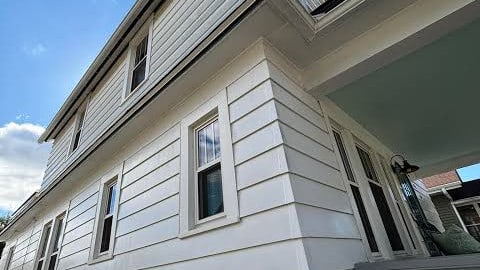
How to Identify the Exposure of Existing Aluminum Siding
One of the first things contractors should identify when trying to match old aluminum siding is the exposure.
Exposure is simply the visible height of each siding course after the panels are installed.
That measurement helps determine whether the existing siding is a Double 4, Double 5, 8-inch profile or another configuration.
At Suburban Wholesale & Supply, we encourage contractors to identify exposure before comparing color or ordering replacement material. A close color match does not help if the profile is wrong.
What Does Siding Exposure Mean?
Exposure is the portion of the siding panel that remains visible once the panel above it is installed.
In homeowner language:
"Exposure is the height of each visible siding course on the wall."
That is the measurement you need when identifying an existing profile.
Start by Measuring One Visible Course
Place a tape measure vertically across one complete siding course.
Measure from the bottom edge of one course to the bottom edge of the course directly above it.
That distance is the visible exposure.
Measurement Tip: Measure from repeated reference points—such as butt edge to butt edge—instead of guessing from the middle of the panel.
What Does Double 4 Mean?
Double 4-inch siding creates two 4-inch exposures in one panel.
Each visible course should measure approximately 4 inches.
Double 4 = two 4-inch siding courses per panel.
Do not confuse that with the total manufactured height of the panel, which includes the nailing hem and locking system.
What Does Double 5 Mean?
Double 5-inch siding creates two 5-inch visible courses per panel.
Each exposure should measure approximately 5 inches.
Double 5 = two 5-inch siding courses per panel.
What About an 8-Inch Profile?
An 8-inch single profile creates one broad visible siding course.
Instead of two smaller exposures stacked within one panel, the siding creates one larger horizontal face.
That can make the siding look broader and reduce the number of horizontal lines across the elevation.
Measure More Than One Course
Do not rely on one measurement.
Measure several courses in different areas of the wall.
This helps confirm that:
- You are measuring from the correct reference points.
- The siding profile is consistent.
- The wall does not contain previous repair sections.
- The siding has not been distorted or installed unusually.
Count the Courses Over a Larger Distance
Another way to verify exposure is to measure a larger section of wall.
For example, measure from one butt edge to another butt edge several courses above it.
Then divide the total distance by the number of courses.
Example:
20 inches across 5 visible courses = approximately 4-inch exposure.
This can be useful when one individual course is difficult to measure accurately.
Don't Measure the Entire Panel and Call That the Exposure
This is one of the most common mistakes.
Total panel height and visible exposure are not the same measurement.
The total panel includes hidden areas such as the nailing hem and locking edge.
Exposure tells you what the wall shows. Total panel height tells you how the panel itself is manufactured.
Look for a Center Break on Double Profiles
Double profiles have a visible break between the two courses formed into one panel.
That break helps confirm whether you are dealing with a Double 4, Double 5 or another multi-course profile.
Measure from the lower butt to the center break, then from the center break to the next butt.
The two measurements should help confirm the profile.
Exposure Is Only the First Step
Two panels can have the same exposure and still not be compatible.
After identifying exposure, also check:
- Butt depth
- Locking edge
- Nailing hem
- Panel geometry
- Texture
- Total panel height
Exposure gets you into the correct family of profiles. It does not prove the replacement panel will lock into the existing siding.
Double 4 Does Not Automatically Mean It Will Match Another Double 4
This deserves emphasis.
Different manufacturers may make Double 4 siding with different butt depths, locking systems or panel geometry.
Even products from the same manufacturer can change over time.
Same exposure does not guarantee same lock.
Identify the Texture at the Same Time
While measuring exposure, document whether the siding is smooth or woodgrain.
A profile match with the wrong texture can still create an obvious visual difference.
Record:
- Smooth
- Woodgrain
- Embossed
- Other visible texture
Compare the Exposure With Current Gentek Aluminum Products
Once the existing exposure is identified, compare it with current Gentek aluminum siding options.
Examples include:
- Deluxe Aluminum: Double 4-inch and 8-inch clapboard options.
- Woodgrain Series 2000: Double 4-inch clapboard.
- Cedarwood Aluminum: Double 5-inch clapboard.
That can help narrow the comparison quickly, but full profile compatibility still needs to be checked.
Use a Profile Sample When Possible
Measurements are useful.
Physical comparison is better.
If you have a current sample available, place it next to the existing siding and compare:
- Exposure
- Butt depth
- Texture
- Lock geometry
- Overall shape
Photograph the Tape Measure on the Wall
This is a simple field habit that can prevent confusion later.
Take a close-up photograph showing the tape measure across the visible course.
Then take another photograph showing the full elevation so the measurement has context.
Record the Exposure Clearly
Do not write:
"Looks like D4."
Write:
Measured visible exposure: approximately 4 inches per course.
Double-profile panel observed.
Further lock and butt-depth verification required.
Good notes make the next step much easier.
Build a Simple Exposure Identification Chart
| Measured Exposure | Possible Profile | Next Step |
|---|---|---|
| Approximately 4 inches per course | Double 4 | Verify butt depth, texture and lock |
| Approximately 5 inches per course | Double 5 | Verify butt depth, texture and lock |
| Approximately 8 inches per course | 8-inch single profile | Verify full panel geometry and lock |
Watch for Mixed Profiles on Older Homes
Older homes may not have the same siding on every wall.
Different profiles may appear because of:
- Previous storm repairs
- Additions
- Garage construction
- Partial re-siding
- Older remodeling projects
Measure the exact elevation being repaired instead of assuming the whole home matches.
A Simple Field Process
- Photograph the wall.
- Choose a clear, undamaged section.
- Measure one visible course.
- Measure several additional courses.
- Count courses across a larger distance as a cross-check.
- Determine whether the profile is single or double.
- Document smooth or woodgrain texture.
- Measure butt depth.
- Inspect the locking edge.
- Photograph the measurement.
- Record the result.
- Compare with current product specifications.
- Physically test compatibility when possible.
A Better Counter Explanation
"The first thing we're going to identify is the exposure—the height of each siding course you actually see on the wall. If it measures about 4 inches, we may be looking at a Double 4 profile. If it's about 5 inches, it may be Double 5. But that is only the first step. We still need to verify the butt depth and locking system before we call it a match."
Don't Stop at Exposure
Exposure is a sorting tool.
It helps narrow the possibilities quickly.
It does not confirm compatibility by itself.
Exposure first. Profile second. Lock third. Color last.
Get Help Identifying Aluminum Siding at Suburban Wholesale & Supply
Suburban Wholesale & Supply works with professional siding contractors throughout Davenport, Bettendorf, Moline, Rock Island and the surrounding Quad Cities, Eastern Iowa and Western Illinois.
If you're trying to identify an existing aluminum siding profile, bring the most complete sample possible along with measurements and photographs from the project.
Our team can help compare the existing exposure and profile with current Gentek aluminum siding options and determine the next practical step.
Sources & Additional Resources
- Gentek Building Products — Deluxe Aluminum Siding: Current profile information including Double 4-inch and 8-inch clapboard options.
- Gentek Building Products — Woodgrain Series 2000 Aluminum Siding: Current Double 4-inch clapboard profile and product information.
- Gentek Building Products — Cedarwood Aluminum Siding: Current Double 5-inch profile and product information.
- Gentek Building Products — Product Directory: Current siding profile, specification and color information for Gentek aluminum products.
- The Aluminum Association — Building & Construction: Industry information regarding aluminum exterior building products and construction applications.
- Vinyl Siding Institute: General siding terminology and installation resources useful for understanding exposure and siding-course layout.
Part of: Aluminum & Trim
More in Aluminum & Trim
- Why Custom-Bent Aluminum Is Better Than Making Stock Trim Fit
- Gentek Aluminum Coil Matching Guide | Bettendorf, Iowa
- Five Brake Buddy Details That Can Make Aluminum Trim Look Better | Suburban Wholesale & Supply
- Why Matching an Old Aluminum Siding Color Can Be Difficult | Suburban Wholesale & Supply
We stock 50 trim coil colors, soffit and fascia, along with Malco tools and Tapco brakes. We keep limited quantities of Gentek aluminum siding on hand.
Share This Post
Share it on Facebook or X, or send it through your device share sheet for Instagram.