Learn how contractors can present premium vinyl siding as a practical homeowner choice without sounding pushy. Use better questions, side-by-side comparisons, samples, and clear upgrade language to build value and trust.
Contractor Sales Education | Suburban Wholesale & Supply
How Contractors Can Upsell Premium Vinyl Siding Without Sounding Pushy
The best siding upgrade conversation does not feel like an upsell. It feels like a contractor helping a homeowner understand what changes as they move from a basic panel to a premium vinyl siding system.
Most homeowners do not know the differences between vinyl siding product lines. They may recognize colors and profiles, but they are less likely to understand panel thickness, rigidity, nailing hems, locking systems, lap height, extended-length options, accessory packages, or warranty differences.
That knowledge gap gives contractors an opportunity—but it also creates a responsibility. The goal should not be to pressure the homeowner into the highest-priced product. The goal is to explain the choices clearly enough that the homeowner can decide whether the upgrade is valuable for their home, priorities, and budget.
Contractors can begin by reviewing the available vinyl siding options from Suburban Wholesale & Supply and selecting a few product levels that create an honest, understandable comparison.
Stop Trying to Sell the Upgrade
Homeowners become defensive when they feel a contractor is steering them toward a more expensive product before understanding what they want. They become interested when the contractor connects a product difference to something they already care about.
Instead of beginning with, “You should upgrade to our premium siding,” begin by learning what the homeowner hopes to improve.
Ask first, listen carefully, and recommend only after the homeowner’s priorities are clear.
Why Homeowners Resist an Upsell
Resistance is not always about price. Homeowners may hesitate because they do not understand the difference, worry that they are being manipulated, or suspect the salesperson earns more by pushing a certain product.
Common reasons homeowners pull back include:
- The contractor recommends an upgrade before asking questions.
- The explanation relies on vague words such as “better” or “premium.”
- The homeowner cannot see or feel a meaningful difference.
- The proposal hides the upgrade inside one large total.
- The contractor exaggerates energy savings, wind performance, or ROI.
- The homeowner feels embarrassed for considering the lower-priced option.
- The contractor keeps selling after the homeowner has made a decision.
A stronger presentation replaces pressure with specificity. Show what changes, explain why it may matter, state the added investment, and give the homeowner room to decide.
1. Begin With Better Questions
The right questions reveal whether premium siding is genuinely relevant. A homeowner focused only on completing an affordable repair may have different priorities from someone improving a long-term residence.
Useful questions include:
- How long do you expect to remain in the home?
- What do you dislike most about the existing exterior?
- Are straight walls and deeper shadow lines important to you?
- Is there a particular color or architectural style you want?
- Which elevations are most visible from the street?
- Has the home experienced wind, hail, or loose siding problems?
- Are you comparing proposals based only on price or also on product and installation details?
- Would you like to see a basic, upgraded, and premium option?
These questions make the recommendation personal. They also help the contractor recognize when an upgrade does not fit the customer.
2. Ask Permission to Show the Upgrade
A simple permission-based transition lowers resistance because the homeowner remains in control of the conversation.
“I can quote the standard siding we discussed. There is also a heavier premium option that creates a straighter appearance and gives you a few additional design choices. Would you like to see the difference and the added cost?”
If the homeowner says no, respect the answer. If they say yes, they have invited the comparison and are more likely to listen without feeling pressured.
3. Present Good, Better, and Best Options
A single proposal forces the homeowner into a yes-or-no decision. Three well-defined choices allow them to compare value without feeling trapped between accepting the contractor’s favorite product and rejecting the entire project.
| Option | Best Fit | Conversation Focus |
|---|---|---|
| Good | Budget-focused projects needing dependable, low-maintenance siding | Core performance, color, maintenance, and installed price |
| Better | Homeowners seeking added rigidity, style, or upgraded details | Appearance, wall thickness, profile, locking design, and value |
| Best | Long-term owners prioritizing premium aesthetics and available product features | Stronger visual presence, longer panels, deeper shadow lines, premium colors, and product-specific features |
Each option should be a product you would confidently install. The basic choice should never be described as cheap, flimsy, or embarrassing.
4. Translate Product Features Into Homeowner Outcomes
Contractors often talk about siding in technical language because those details matter to them. Homeowners usually need the feature translated into a visible or practical outcome.
| Product Feature | Homeowner-Friendly Explanation |
|---|---|
| Heavier wall thickness | “The panel has a more substantial feel and may create a straighter-looking finished wall when installed over a properly prepared surface.” |
| Deeper butt or lap | “This creates stronger shadow lines, so the exterior has more dimension from the street.” |
| Extended-length panels | “Longer panels can reduce the number of visible overlaps on broad wall sections.” |
| Upgraded locking system | “The panel connection is engineered to improve rigidity and stability when installed according to specifications.” |
| Premium texture | “The lower-gloss surface and more refined grain can give the siding a more natural appearance.” |
| Expanded color selection | “You have more flexibility to coordinate the siding with the roof, stone, windows, doors, and neighborhood architecture.” |
| Coordinated accessories | “The corners, soffit, fascia, trim, and rainware can be planned as one visual system.” |
Use careful language. Product performance varies by siding line, profile, wall assembly, installation method, and manufacturer testing. Verify every claim using the current product specifications.
5. Let the Samples Do Some of the Selling
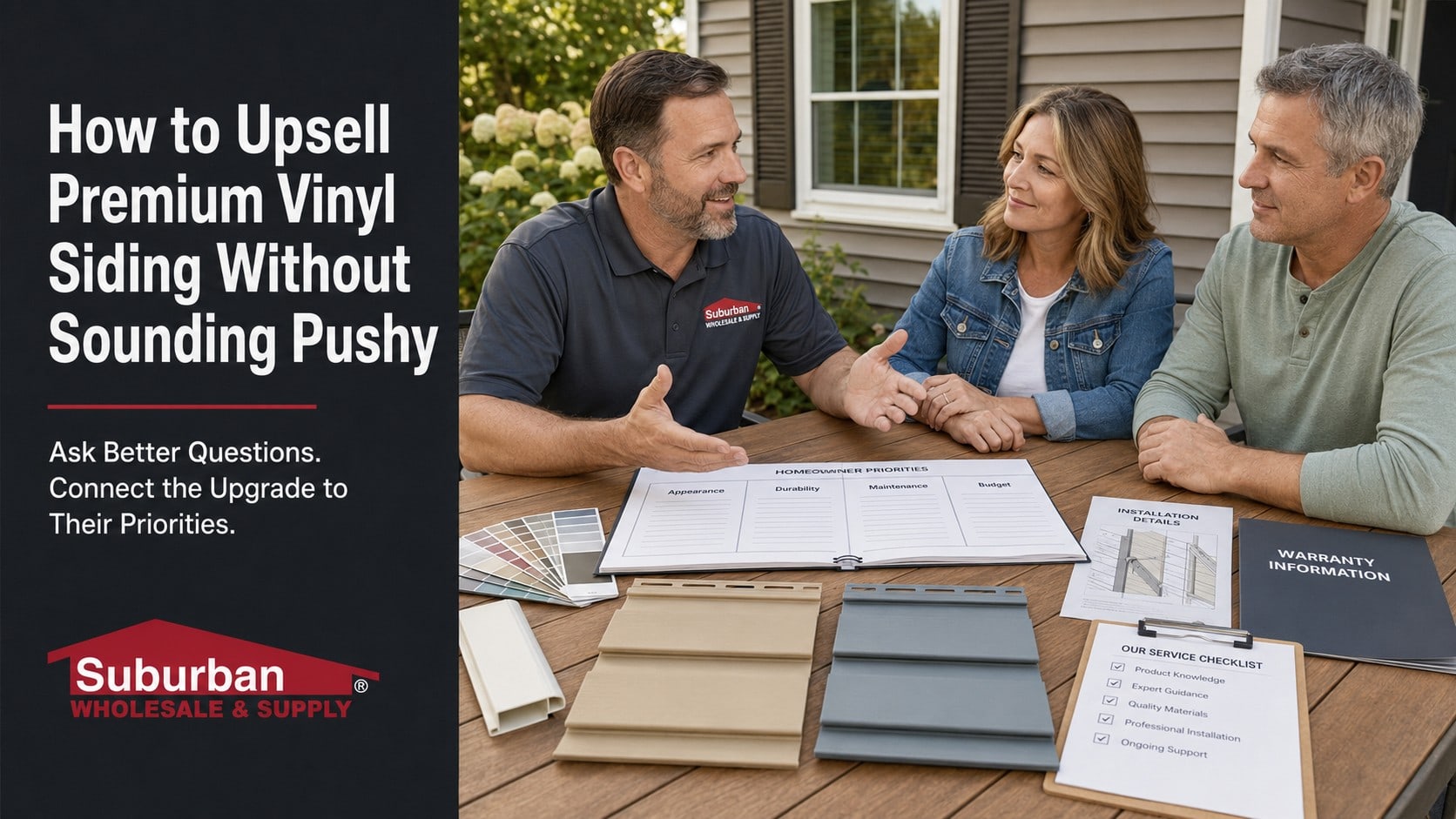
Premium siding is easier to understand when homeowners can place two panels side by side. A physical comparison can make differences in thickness, rigidity, texture, profile depth, color, and locking design more tangible.
A useful sample presentation should include:
- A standard panel and one or two premium alternatives
- Comparable profiles whenever possible
- Full-sized color samples rather than a small screen image
- Matching corner, soffit, fascia, and trim options
- Photographs showing complete homes—not only panel close-ups
- Written product specifications and warranty documents
Avoid dramatic bending demonstrations that misrepresent how siding performs after installation. Explain what the sample shows and what it cannot prove.
6. Sell the Finished Elevation, Not Just Panel Thickness
A homeowner is not purchasing a thickness measurement. They are purchasing the way the home will look every time they pull into the driveway.
Discuss how the siding profile, lap height, texture, seams, trim width, corner design, soffit, fascia, shutters, stone, windows, and entry door will work together. Premium siding becomes more compelling when the homeowner sees it as part of a complete exterior design.
Focus the visual conversation on:
- Straighter-looking wall planes
- Deeper and more consistent shadow lines
- Fewer visible overlaps where longer panels are available
- Balanced trim around windows and doors
- Coordinated accent colors and materials
- Proportions appropriate for the home’s architecture
7. Present the Upgrade as a Price Difference
A large project total can make any upgrade feel overwhelming. Show the complete price of each option, but also isolate the actual difference between them.
“The standard siding package is $24,800. The premium package is $27,300, so the difference is $2,500 for this home. That upgrade includes the heavier panel, the selected premium profile, and the matching accessory package. You can decide whether those differences are worth $2,500 to you.”
Use real project numbers and identify exactly what the additional amount includes. Never hide the upgrade inside financing language or reduce it to “only a few dollars per month” without also disclosing the total cost.
8. Use Long-Term Context Carefully
For homeowners planning to remain in the home, it can be reasonable to discuss the upgrade cost over the expected ownership period. This should provide perspective—not disguise the price.
“You mentioned that you expect to stay here for at least 15 years. The premium option is $2,500 more in total. That is about $167 per year over 15 years, but the important question is whether you value the upgraded appearance and product features enough to make that investment.”
Do not invent a service life, guaranteed return, resale premium, or energy savings. Base long-term statements on written manufacturer information and the homeowner’s actual plans.
9. Make Installation Quality Part of the Comparison
Premium siding cannot correct poor wall preparation or careless installation. A heavier panel may improve rigidity, but it still needs a suitable substrate, correct fastening, expansion clearance, proper flashing, thoughtful seam placement, and compatible accessories.
Be clear about what remains consistent across all proposal levels:
- Wall inspection and preparation
- Water-resistive barrier and flashing details
- Manufacturer-compliant fastening
- Proper expansion and contraction allowances
- Complete accessory packages
- Cleanup and project supervision
- Written product and workmanship warranty terms
The basic option should not depend on weaker workmanship. The upgrade should purchase a different product package—not permission for the contractor to care more.
10. State the Downside of the Upgrade
Trust grows when contractors acknowledge tradeoffs. Premium siding costs more. Certain profiles or colors may have different availability. Longer panels may require additional handling and jobsite planning. A specific feature may offer little practical benefit on a small or heavily broken elevation.
“The premium panel is the stronger aesthetic choice, but it adds $2,500 to the project. If keeping the project below your current budget matters more than the added rigidity and deeper profile, the standard option is still a reasonable product.”
This language does not weaken the sale. It shows the homeowner that your recommendation is based on fit rather than commission.
Phrases Contractors Can Use
To introduce the choice
“I’m going to show you three options. All three are products we can install confidently. The differences are panel construction, appearance, available features, and price.”
To explain a heavier panel
“This panel feels more substantial and is designed to provide added rigidity. That can contribute to a straighter finished appearance, but proper wall preparation and installation are still essential.”
To discuss longer panels
“The longer-panel option may reduce visible overlaps on the broad sections of your home. Let’s look at the front elevation and decide whether that visual difference matters to you.”
To present the added cost
“The premium package adds $2,500 to the complete project. Here is exactly what changes for that amount.”
To remove pressure
“There is no wrong choice among these options. My job is to make the differences clear so you can decide where your money creates the most value.”
When the upgrade is unnecessary
“Based on your budget and the limited size of this elevation, I do not think you need the most expensive panel. I would put that money into the trim and water-management details instead.”
To close without pushing
“Which option best matches what you want the home to look like and what you are comfortable investing?”
Phrases That Create Unnecessary Resistance
Certain phrases make the customer feel judged or manipulated. Replace them with specific, neutral explanations.
| Avoid Saying | Say This Instead |
|---|---|
| “You don’t want the cheap siding.” | “The standard option prioritizes budget. The premium option adds these specific features.” |
| “Everyone upgrades to this.” | “Homeowners who prioritize these features often select this option.” |
| “It’s only a little more.” | “The exact difference is $2,500.” |
| “This siding will never have a problem.” | “Here are the documented product features, warranty terms, and installation requirements.” |
| “It will pay for itself.” | “It costs more, so let’s decide whether the product and design differences justify that investment for you.” |
| “You’ll regret buying the basic option.” | “Both are legitimate choices. Here is what you gain and give up with each one.” |
Build the Upgrade Into the Written Proposal
A verbal explanation can be forgotten. The written proposal should make the product differences easy to revisit after the contractor leaves.
Each option should identify:
- Manufacturer and exact product line
- Profile and panel configuration
- Published wall thickness, if relevant
- Selected color and texture
- Matching accessories included
- Wall-preparation and flashing scope
- Manufacturer warranty information
- Contractor workmanship warranty
- Complete installed price
- Exact price difference between options
Avoid labels such as “Package A” and “Package B” without explaining what changes. Specificity makes a premium recommendation feel legitimate.
Protect the Margin by Building Real Value
Contractors sometimes discount premium siding too quickly because they have not made the differences understandable. If the customer sees only a higher price, the conversation will naturally move toward a discount.
Build value before discussing concessions. Show the product, compare the elevation, explain the accessory system, isolate the price difference, and document what the premium package includes.
If the homeowner still does not value the upgrade, return to the standard option. Do not destroy the project’s margin trying to force a premium product into a budget that does not support it.
Premium Siding Presentation Checklist
- Ask about the homeowner’s goals before recommending a product.
- Confirm whether they want to see multiple product levels.
- Present only products you would confidently install.
- Use physical samples and full-sized color references.
- Compare verified specifications rather than vague claims.
- Translate each feature into a homeowner-relevant outcome.
- Show how the complete exterior will look.
- Explain what remains consistent across every installation option.
- State the complete price and exact upgrade difference.
- Acknowledge the upgrade’s cost and relevant tradeoffs.
- Provide written product and warranty information.
- Avoid unsupported savings, performance, or resale claims.
- Give the homeowner time to choose without repeated pressure.
- Support their decision—even if they select the standard panel.
The Best Upsell Feels Like Good Advice
Premium siding should not be sold through fear, exaggerated claims, or criticism of the homeowner’s budget. It should be presented as a clear option with specific features, visible design differences, an exact price, and an honest explanation of who benefits from it.
When contractors ask better questions, compare products side by side, and give homeowners control over the decision, the upgrade conversation becomes easier for everyone.
Some homeowners will choose the premium panel. Others will not. Either way, a clear and respectful presentation strengthens trust—and trust is more valuable than forcing one larger sale.
Build a Better Good-Better-Best Siding Presentation
Suburban Wholesale & Supply helps contractors compare vinyl siding profiles, colors, panel construction, accessories, warranties, and product availability. Our team serves contractors throughout Davenport, Bettendorf, Moline, Rock Island, East Moline, and the surrounding Quad Cities.
Review our vinyl siding product options and ask our team to help you assemble a simple comparison for your next homeowner presentation.
Better product knowledge leads to clearer proposals, stronger customer confidence, and fewer price-only conversations.
Part of: Vinyl Siding
More in Vinyl Siding
- What Cheap Vinyl Siding Looks Like Five Years Later | Suburban Wholesale & Supply
- Hidden Costs of Builder-Grade Vinyl Siding | .038 vs .040 vs .042
- .040 vs .046 Vinyl Siding: What's the Real Difference? | Suburban Wholesale & Supply
- How to Replace Individual Vinyl Siding Panels | Suburban Wholesale & Supply
We stock all 29 colors of Gentek Sequoia Select D4 in our Davenport warehouse, and stocked items are usually ready same day or next day.
Share This Post
Share it on Facebook or X, or send it through your device share sheet for Instagram.