Learn how vinyl siding thickness affects wind resistance—and why panel locks, nail hems, fasteners, wall construction, ASTM testing and VSI installation practices ultimately determine performance.
Contractor Wind-Performance Guide
How Panel Thickness Affects Wind Resistance
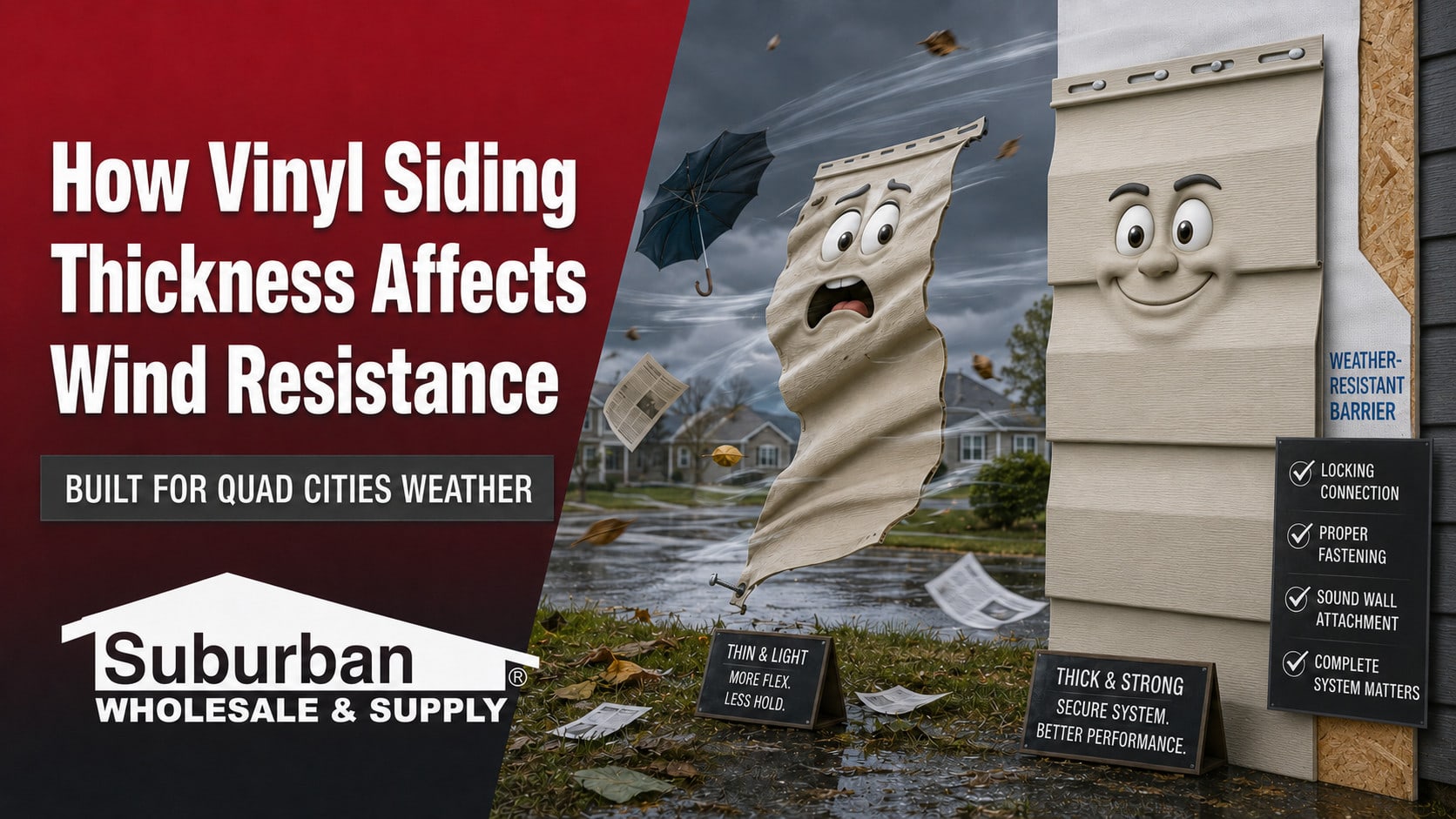
A thicker vinyl siding panel can provide greater rigidity and contribute to a stronger exterior system. However, panel thickness alone does not determine wind resistance. The nail hem, locking system, fasteners, substrate, wall design and installation method must all work together.
Strong winds place complicated pressure on a home’s exterior. Wind can push directly against one side of the building while creating suction on another. That suction, commonly described as negative pressure, can pull siding away from the wall if the complete system is not designed and installed correctly.
Contractors and homeowners often assume the thickest siding automatically has the highest wind resistance. A heavier panel can help, but that conclusion is incomplete. Wind performance depends on how the panel is shaped, how one course locks into the next, how the nail hem transfers force to the fasteners and how those fasteners connect to the supporting wall.
Gentek Sequoia Select® provides a useful premium example. Its horizontal profiles feature a nominal .046-inch thickness, full-roll nailing hem and Advantage Lock system. Contractors can review the Gentek Sequoia Select product information from Suburban Wholesale & Supply.
The Simple Answer
Increased panel thickness can improve rigidity and help the siding resist deformation under pressure. It may also strengthen the material surrounding the nail hem and panel lock.
Thickness cannot establish a wind-load rating by itself. The actual performance of a siding product must be supported by testing for the exact panel profile and installation configuration.
How Wind Acts on a Siding Wall
Wind does not apply one simple force evenly across a house. Pressure changes with wind direction, building height, roof shape, wall location, surrounding terrain and nearby structures.
A siding system may experience:
- Positive pressure: Wind pushes inward against the wall surface.
- Negative pressure: Wind creates outward suction that attempts to pull the siding away from the wall.
- Edge and corner pressure: Building corners and roof-to-wall areas can experience concentrated forces.
- Changing pressure: Gusts cause forces to increase, decrease and change direction rapidly.
Vinyl siding must transfer these forces through the panel, lock, nail hem, fasteners and supporting wall. Weakness at any connection can reduce the performance of the complete system.
What Panel Thickness Contributes
Vinyl siding thickness is usually stated as a nominal decimal measurement. Gentek Sequoia Select’s horizontal profiles have a nominal thickness of .046 inch, or forty-six thousandths of an inch.
Compared with a thinner entry-level panel, a .046-inch panel contains more material. That additional material can provide greater body and rigidity.
In a wind-resistant siding system, greater panel rigidity may help:
- Reduce excessive panel deflection under pressure
- Support the shape of the panel lock
- Reinforce the material surrounding the nail hem
- Help adjoining courses remain engaged
- Provide a more substantial panel during installation
Thickness contributes to wind performance, but it is not a substitute for a strong locking system, reinforced nail hem or correct installation.
Does Thicker Always Mean More Wind-Resistant?
| Product Factor | Possible Contribution | Important Limitation |
|---|---|---|
| Greater panel thickness | Can increase body and rigidity | Does not establish wind resistance by itself |
| Reinforced nail hem | Can strengthen the fastening area | Incorrect fasteners or spacing can undermine it |
| Strong panel lock | Helps adjoining courses remain engaged | The panel must be fully locked during installation |
| Closer fastener spacing | May increase the number of wall-attachment points | Must follow tested configurations, codes and manufacturer instructions |
| Strong substrate | Provides reliable fastener support | Deteriorated or unsuitable materials weaken the connection |
| Professional installation | Allows all components to work as designed | Poor workmanship can defeat premium product features |
A thinner panel with a strong lock, reinforced hem and tested installation may outperform a thicker panel with a weak connection design. Compare complete systems—not isolated thickness numbers.
Wind Resistance Depends on a Complete Load Path
Wind force must travel through several components before reaching the structure. Every part of this load path matters:
- The siding face receives the pressure. The panel must maintain its shape without excessive deformation.
- The panel lock connects the courses. A secure connection helps keep the wall assembly engaged.
- The nail hem transfers force to the fasteners. The hem must remain intact around the attachment points.
- The fasteners transfer force into the wall. Correct fastener type, length, penetration and spacing are essential.
- The substrate supports the connection. Fasteners need a suitable supporting material capable of resisting the applied forces.
If one link is weak, the entire system can become vulnerable. A thick panel cannot compensate for fasteners that do not penetrate an acceptable substrate.
ASTM D3679: The Core Vinyl Siding Specification
ASTM D3679 is the primary product specification for extruded, single-wall rigid PVC siding. It establishes requirements and test methods for several characteristics related to siding quality and performance.
The standard addresses areas that include:
- Material composition
- Panel dimensions
- Thickness
- Camber
- Heat shrinkage
- Impact resistance
- Linear expansion
- Surface appearance
- Weathering performance
- Wind-load resistance
ASTM D3679 treats thickness and wind resistance as related but distinct product characteristics. That is why contractors should never assign a wind rating based only on a panel’s nominal thickness.
ASTM D5206: How Siding Wind Resistance Is Tested
ASTM D5206 describes methods for testing the wind-load resistance of rigid plastic siding under a specified uniform static pressure difference. The procedure is designed to evaluate how a siding specimen responds to wind-related pressure.
During testing, the siding is installed in a defined configuration and subjected to controlled pressure. This allows the panel, lock, nail hem, fasteners and installation arrangement to be evaluated together.
Gentek states that Sequoia Select has been tested for negative wind-load resistance according to ASTM D5206 and meets or exceeds the applicable industry standard for wind-load performance.
Contractors should consult the current Gentek Product Directory for information applying to the exact profile. Wind-load performance can vary among profiles, even when they share the same nominal thickness.
A Wind-Test Result Is Not a Universal Storm Guarantee
Laboratory pressure testing is necessary for product evaluation, but real buildings experience more complicated forces. Building height, shape, terrain, wall location, openings and installation details can change the pressure placed on the siding.
Contractors should not convert a laboratory result into a claim that every installation will withstand a particular hurricane, tornado or wind speed. Use manufacturer data and project-specific code requirements accurately.
Gentek Sequoia Select Manufacturer Specifications
Sequoia Select combines its heavier horizontal panel with features designed to strengthen the complete siding system.
.046-inch nominal thickness
The horizontal siding profiles contain more material than many thinner, entry-level products, contributing to panel body and rigidity.
Full-roll nailing hem
The reinforced hem is designed to provide a stronger area for attaching the panel to the wall.
Advantage Lock system
The locking design securely connects adjoining courses and is intended to enhance rigidity and stability.
ASTM D5206 testing
Gentek reports that Sequoia Select has been evaluated for negative wind-load resistance using the recognized test method.
Why Profile Design Changes Wind Performance
Two siding panels can share the same nominal thickness and still produce different wind-load results. The bends, exposure, projection, lock geometry and overall shape of a panel influence how it responds to pressure.
A profile with a wider exposure may behave differently from one with a narrower exposure. Dutch-lap and clapboard profiles can also have different geometries even when manufactured from material with the same stated thickness.
This is why manufacturer wind information commonly includes a qualification that performance may vary by profile. Contractors must verify the data for the exact product code being installed.
The Nail Hem May Matter as Much as the Panel Face
When negative pressure pulls outward on siding, force must pass through the nail hem before reaching the fasteners. A reinforced hem can distribute that force over a stronger attachment area.
A heavy panel with a poorly designed or damaged nail hem can still lose its connection. Likewise, fasteners installed too far apart, driven at an angle or attached to an unsuitable substrate can weaken an otherwise strong product.
The contractor should inspect nail hems during installation and avoid using panels that have been cracked, torn or damaged during handling.
The Lock Keeps Individual Courses Working Together
The bottom of each siding course connects to the lock of the panel beneath it. If the course is only partially engaged, wind can exploit that weak connection.
Installers should verify that each course is fully connected along its entire length. The panel should be locked securely without being stretched upward or forced tightly against the course below.
Gentek’s Advantage Lock system supports panel engagement, but the installer must still use it correctly. Product design and workmanship remain inseparable.
ASTM D4756 and VSI Installation Practices
ASTM D4756 addresses practices for installing rigid PVC siding and soffit. ASTM D3679 also directs installers to follow ASTM D4756 and the installation instructions for the specific product.
The Vinyl Siding Institute has long supported professional installer education. Recognized VSI practices focus on secure attachment while preserving the siding’s ability to expand and contract.
Wind-conscious installation should include:
- A suitable substrate: Fasteners must penetrate an approved supporting material.
- Correct fasteners: Type, corrosion resistance, shank size, head size and length must meet the applicable requirements.
- Proper spacing: Fastener spacing must follow Gentek instructions, tested configurations and applicable codes.
- Accurate placement: Fasteners should be positioned correctly within the nail slots and driven straight.
- Room for movement: Fastener heads should not clamp the siding tightly against the wall.
- Required clearances: Panels need manufacturer-specified space at corners, trim and accessories.
- Fully engaged locks: Every course should be checked before the next course is installed.
- Secure accessories: Starter strips, corner posts and trim pieces must be installed according to the complete system requirements.
Why Tighter Fasteners Are Not Automatically Better
It may seem logical that driving fasteners tightly against the siding would improve wind resistance. Vinyl siding is designed to move laterally as temperatures change, so clamping it tightly can create a different set of problems.
Overtightening may restrict movement and contribute to buckling, distortion or stress around the nail slots. The goal is secure attachment—not immobilization.
Follow Gentek’s current instructions for fastener placement and clearance. Do not improvise fastening methods based on the assumption that tighter always means stronger.
Common Installation Problems That Reduce Wind Resistance
- Fasteners that do not penetrate a suitable substrate
- Fastener spacing that exceeds manufacturer requirements
- Improper fastener-head or shank dimensions
- Fasteners driven at an angle
- Damaged or torn nail slots
- Panels that are not fully locked together
- Starter strips that are loose, damaged or incorrectly installed
- Excessive panel tension caused by stretching during installation
- Substituting untested fastening patterns without technical support
Why Wind Resistance Matters in the Quad Cities
Homes in Davenport, Bettendorf, Moline, East Moline and Rock Island can experience thunderstorms, strong straight-line winds, seasonal temperature swings and exposed conditions near open fields or the Mississippi River.
A heavier panel can be a smart starting point, but local performance requires a complete installation. Contractors must consider wall height, exposure, corner conditions, fastener support and the requirements of the applicable building code.
The strongest siding proposal will identify both the product being installed and the workmanship practices used to secure it.
How Contractors Should Explain Wind Performance
Wind resistance is a valuable product benefit, but it must be presented accurately. Contractors should:
- Show the complete panel. Explain the thickness, nail hem and lock instead of discussing only one number.
- Reference standardized testing. Explain that ASTM D5206 evaluates an installed siding specimen under controlled pressure.
- Identify the exact profile. Do not assume all profiles have identical wind-load results.
- Explain the installation plan. Discuss fasteners, spacing, substrate and panel engagement.
- Avoid storm-proof claims. Do not promise that siding will withstand every severe-weather event.
- Use current documents. Verify manufacturer specifications and local code requirements before making performance claims.
Gentek Product and Installation Support in the Quad Cities
Suburban Wholesale & Supply is a Gentek building-products distributor serving contractors throughout Davenport, Bettendorf, Moline, East Moline, Rock Island and surrounding Quad Cities communities.
Contractors can receive help comparing panel thicknesses, profiles, nail hems, locks, accessories and current manufacturer specifications. Suburban Wholesale also offers takeoff assistance and next-day delivery on many stocked siding panels.
JR Girskis is a VSI Certified Trainer with more than 25 years of building-material experience. Contractors can speak with JR about recognized installation practices, Gentek product details and jobsite conditions that may affect siding performance.
The Bottom Line on Thickness and Wind Resistance
Greater panel thickness can improve rigidity and contribute to a stronger vinyl siding system. Gentek Sequoia Select’s .046-inch horizontal panel provides more body than many thinner, entry-level siding products.
Thickness does not create wind resistance by itself. The panel lock, nail hem, profile geometry, fasteners, substrate and installation configuration determine how effectively wind forces are transferred into the wall.
ASTM D3679 establishes broad product requirements, ASTM D5206 provides a recognized wind-load test method and ASTM D4756 addresses installation practices. VSI-recognized installation principles help contractors put those standards into practice on the jobsite.
The most defensible conclusion is simple: choose a well-engineered panel with documented testing, and install it exactly as the manufacturer and applicable building codes require.
Explore Gentek Sequoia Select .046 Vinyl Siding
Review Gentek Sequoia Select product information or contact Suburban Wholesale & Supply for samples, current specifications, contractor pricing, accessories and delivery options.
View Gentek Sequoia SelectTechnical References
- Gentek Building Products: Sequoia Select manufacturer specifications
- Gentek Building Products: Current Siding Product Directory and installation information
- ASTM D3679: Standard Specification for Rigid Poly Vinyl Chloride PVC Siding
- ASTM D5206: Standard Test Method for Wind-Load Resistance of Rigid Plastic Siding
- ASTM D4756: Standard Practice for Installation of Rigid PVC Siding and Soffit
- Vinyl Siding Institute installation and installer-training principles
Product specifications, profiles, test results, standards and installation instructions may change. Confirm the current Gentek literature, project requirements and applicable building codes before ordering or installing siding.
Part of: Vinyl Siding
More in Vinyl Siding
- What Cheap Vinyl Siding Looks Like Five Years Later | Suburban Wholesale & Supply
- Hidden Costs of Builder-Grade Vinyl Siding | .038 vs .040 vs .042
- .040 vs .046 Vinyl Siding: What's the Real Difference? | Suburban Wholesale & Supply
- How to Replace Individual Vinyl Siding Panels | Suburban Wholesale & Supply
We stock all 29 colors of Gentek Sequoia Select D4 in our Davenport warehouse, and stocked items are usually ready same day or next day.
Share This Post
Share it on Facebook or X, or send it through your device share sheet for Instagram.