Vinyl siding naturally expands in warm weather and contracts in cold weather. Learn how proper fastening, panel clearances, overlaps, and manufacturer specifications help prevent buckling, gaps, and distorted siding.
Vinyl Siding Installation Education
Vinyl Siding Expansion and Contraction Explained
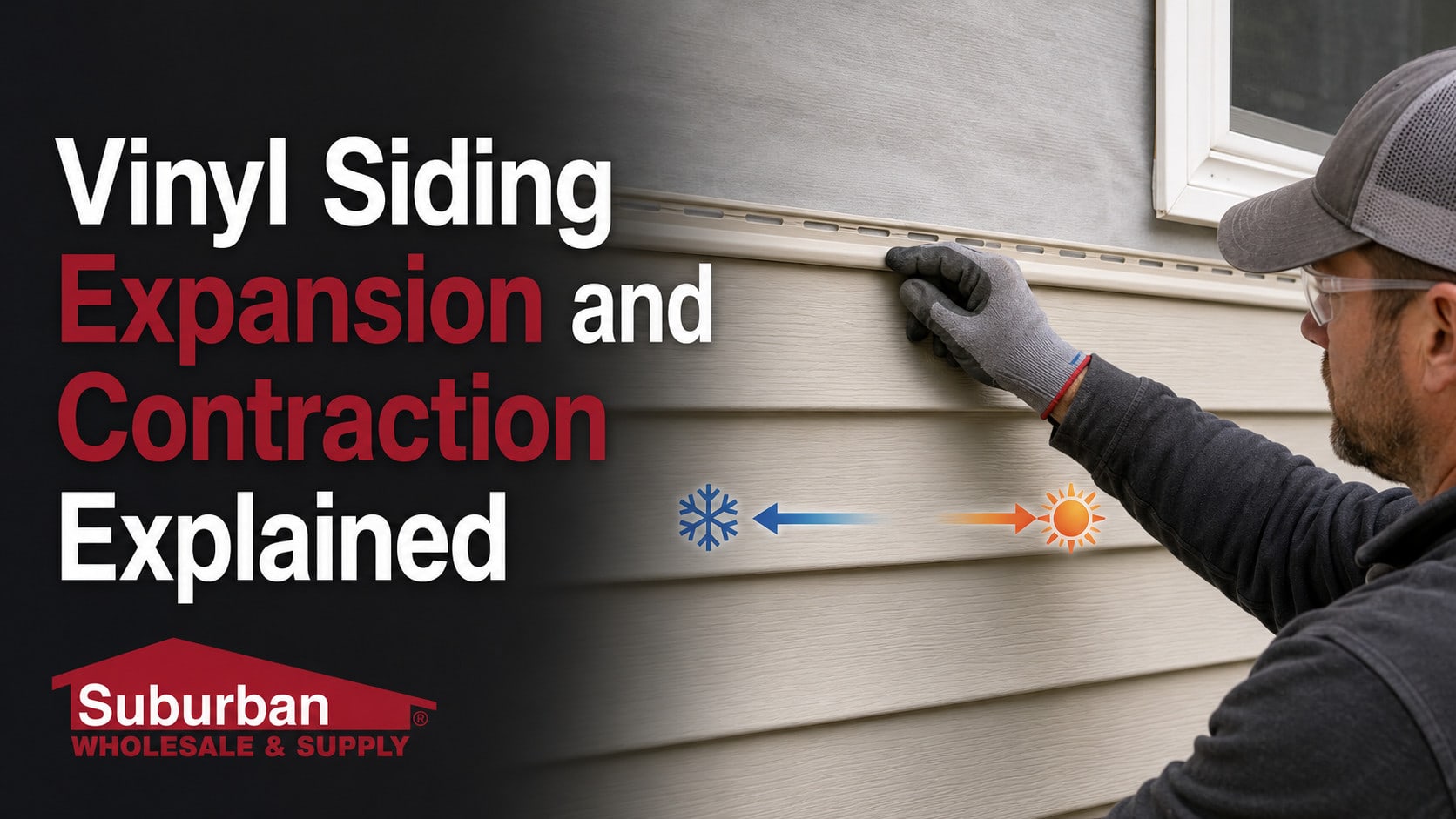
Vinyl siding expands as it becomes warmer and contracts as it becomes colder. A professional installation controls this movement without preventing it.
Expansion and contraction are normal characteristics of vinyl siding. They are not signs that the product is unstable or defective. Vinyl panels are designed with elongated nail slots, overlapping joints, and receiving accessories that allow predictable movement as temperatures change.
Problems begin when the installation prevents the siding from moving. Panels that are nailed tightly, cut too closely around trim, bonded with excessive sealant, or trapped by accessories may buckle or ripple as they warm.
The opposite problem can occur when panels are cut too short or inadequately overlapped. As the siding contracts in cold weather, panel ends or seams may become exposed. Successful installation requires the right balance between secure attachment and controlled movement.
Follow the Requirements for the Exact Product
Expansion clearances and fastening details should never be based solely on a crew’s habit or one remembered measurement. Requirements can vary by product, profile, panel length, accessory, application, and temperature during installation.
- Manufacturer specifications: Current installation instructions establish product-specific clearances, fastener spacing, fastener penetration, overlap dimensions, accessory details, and temperature-related requirements.
- VSI installation guidance: VSI education emphasizes centered fastening, freedom of panel movement, correct clearances, wall preparation, proper locks, water management, and approved accessory installation.
- ASTM D3679: This specification addresses rigid PVC siding and directs installers to applicable installation practices and the manufacturer’s instructions for the specific product.
- ASTM D5206: This test method evaluates wind-load resistance under prescribed fastening conditions. Installed performance also depends on the substrate, fastening pattern, accessories, panel engagement, and workmanship.
- Applicable building codes: Local code requirements may affect attachment, wind resistance, wall preparation, flashing, and water-resistive barriers.
Keep the current manufacturer instructions available on the jobsite. Product requirements take priority over generic shortcuts or assumptions.
What Are Expansion and Contraction?
Vinyl siding is primarily manufactured from polyvinyl chloride, commonly called PVC. Like many materials, PVC changes dimension as its temperature changes.
- Expansion: The panel becomes slightly longer as its temperature rises.
- Contraction: The panel becomes slightly shorter as its temperature falls.
This movement happens across the length of the panel. Longer pieces can experience more total dimensional change than shorter pieces exposed to the same temperature difference.
Panel Temperature Matters More Than Air Temperature Alone
The outdoor air temperature does not always represent the temperature of the siding. A panel exposed to direct afternoon sunlight may become much warmer than the surrounding air.
Panel temperature can be affected by:
- Direct sunlight
- South- and west-facing walls
- Siding color
- Nearby roofing and pavement
- Reflected sunlight from windows
- Storage inside an enclosed trailer
- Temporary plastic coverings
- Shade moving across an elevation
Two panels installed on the same day may begin at different temperatures depending on how they were stored and which wall receives them.
The Entire Siding System Manages Movement
Expansion and contraction are not controlled by one installation detail. Several components must work together.
Elongated nail slots
Allow panels to slide laterally behind properly positioned fastener heads.
End clearances
Provide space for panels to expand inside corners, channels, and other receiving accessories.
Panel overlaps
Keep joints covered as adjoining panels expand and contract.
Receiving accessories
Conceal panel ends while allowing the movement required by the manufacturer.
Panel locks
Keep siding courses engaged without requiring the panels to be stretched tightly.
Correct fastening
Secures the panels against wind while preserving horizontal movement.
Why Vinyl Siding Is Hung Rather Than Tightly Nailed
Vinyl siding needs secure attachment, but a fastener should not clamp the panel tightly against the wall. The siding must remain able to move horizontally within the nail slots.
Fasteners should be installed straight into the approved fastening base. Unless a manufacturer provides different instructions for an accessory or special condition, fasteners are generally positioned near the center of the elongated slots.
The objective is controlled movement: securely attached siding that can still slide as its temperature changes.
Why Centering the Fastener Matters
Part of: Vinyl Siding
More in Vinyl Siding
- What Cheap Vinyl Siding Looks Like Five Years Later | Suburban Wholesale & Supply
- Hidden Costs of Builder-Grade Vinyl Siding | .038 vs .040 vs .042
- .040 vs .046 Vinyl Siding: What's the Real Difference? | Suburban Wholesale & Supply
- How to Replace Individual Vinyl Siding Panels | Suburban Wholesale & Supply
We stock all 29 colors of Gentek Sequoia Select D4 in our Davenport warehouse, and stocked items are usually ready same day or next day.
Share This Post
Share it on Facebook or X, or send it through your device share sheet for Instagram.