Learn what .046-inch vinyl siding thickness means, how it compares with thinner panels, and why ASTM standards, VSI installation practices and Gentek’s complete panel design matter as much as thickness.
Contractor’s Guide to Vinyl Siding Thickness
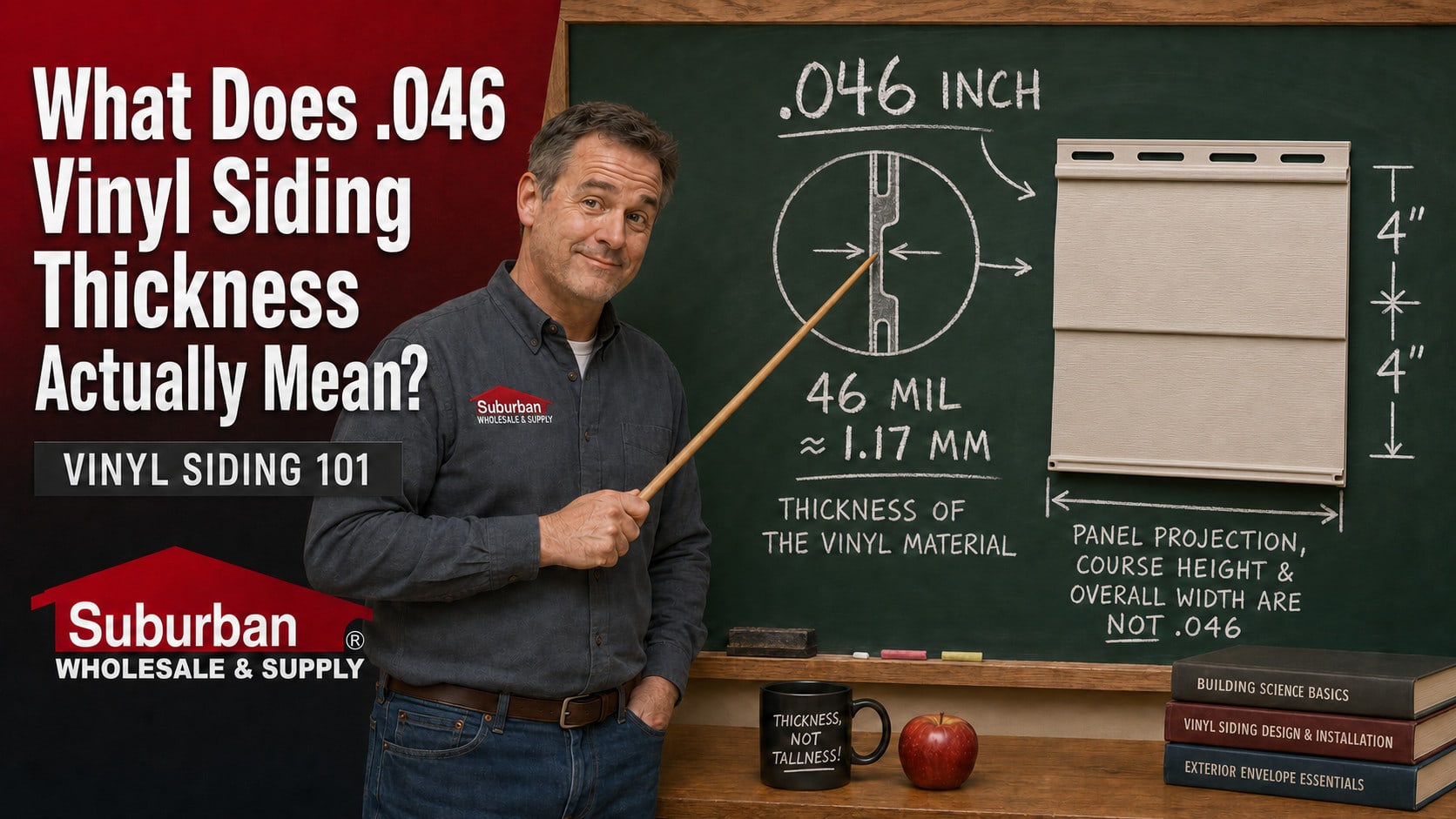
What Does .046 Vinyl Siding Thickness Actually Mean?
A .046-inch thickness identifies a heavier class of vinyl siding, but that single number does not tell the complete performance story. Contractors should understand what the measurement represents, how ASTM standards evaluate vinyl siding and why professional installation remains essential.
Vinyl siding thickness is one of the easiest product specifications for a homeowner to understand. A .046-inch panel is physically thicker than a .040-inch or .042-inch panel, so it is natural to assume that the heavier product will always be better.
There is truth in that comparison. A heavier panel can provide additional body, rigidity and handling strength. However, thickness is only one part of the siding system. Panel geometry, material formulation, nail-hem construction, locking design, wall preparation and installation technique all contribute to the finished exterior.
Gentek Sequoia Select® is an ultra-premium vinyl siding line with a nominal .046-inch thickness in its horizontal profiles. Contractors can review the available product features and specifications on the Gentek Sequoia Select product page .
The Simple Answer
A .046-inch vinyl siding panel has a manufacturer-stated nominal wall thickness of forty-six thousandths of an inch.
.046"
Decimal measurement
46
Thousandths of an inch
1.17 mm
Approximate metric equivalent
The metric conversion is approximate. Manufacturer literature generally expresses vinyl siding thickness in inches.
What Does “Nominal Thickness” Mean?
Manufacturers commonly describe siding using a nominal thickness. Nominal means the stated or designated thickness of the product rather than a promise that every microscopic point on every panel will measure precisely .046 inch.
Manufacturing processes require controlled dimensional tolerances. The applicable product specifications establish how thickness is measured and how a product demonstrates compliance.
Contractors should use the thickness stated in the current manufacturer specifications for the exact siding line and profile. Product families can contain profiles with different measurements, so a thickness associated with one panel should not automatically be applied to every product bearing the same brand name.
Is .046 Vinyl Siding the Same as 46-Gauge Siding?
Contractors and homeowners sometimes refer to vinyl siding thickness as “gauge,” but .046 inch is most accurately described as a decimal thickness measurement.
Metal gauge systems can be confusing because a larger gauge number may represent thinner material. That convention should not be used to interpret vinyl siding.
With vinyl siding, compare the actual decimal measurements: .046 inch is thicker than .044 inch, .042 inch and .040 inch.
How .046-Inch Siding Compares With Thinner Panels
| Nominal Thickness | General Product Position | Contractor Consideration |
|---|---|---|
| .040 inch | Commonly associated with lighter or economy-oriented products | May provide less body than heavier premium panels |
| .042 inch | Frequently used in value-oriented siding lines | Can perform well when properly manufactured and installed |
| .044 inch | Often positioned as an upgraded or premium product | Offers more material than many entry-level panels |
| .046 inch | Commonly positioned in the heavy-duty or premium category | Provides greater panel body than thinner alternatives |
These categories are general comparisons, not universal industry grades. Product quality must be determined from the exact manufacturer specifications, standardized test results, design and warranty.
What Are the Practical Benefits of a .046-Inch Panel?
More panel body
A .046-inch panel can feel more substantial during handling and installation than a thinner economy-grade product.
Greater rigidity
Heavier construction can help the panel maintain straighter-looking wall lines when installed over a properly prepared surface.
Premium appearance
Heavier products are often paired with deeper profiles, stronger shadow lines and more refined surface textures.
Stronger product story
Contractors can demonstrate a measurable material difference instead of relying only on general claims about quality.
What .046-Inch Thickness Does Not Guarantee
Thickness is valuable, but contractors should not present it as a guarantee of complete product performance. A .046-inch designation alone does not establish:
- The wind-load rating of every panel profile
- The quality of the nail hem or locking system
- The impact resistance of the complete product
- The siding’s color- and appearance-retention performance
- The depth of its profile or quality of its texture
- The terms and limitations of the manufacturer’s warranty
- The quality of the wall preparation or installation
A thicker panel installed over a severely uneven wall can still look wavy. The same panel can buckle when fasteners are driven too tightly or when insufficient room is left for expansion and contraction.
Why Gentek’s Complete Panel Design Matters
Gentek Sequoia Select supports its .046-inch horizontal panel thickness with additional design features. Together, these details create a more complete premium siding system.
Full-roll nailing hem
Gentek’s full-roll nailing hem provides a reinforced area for fastening the panel to the wall. The benefit still depends on correct fastener selection, spacing and placement.
Advantage Lock system
The Advantage Lock system is designed to secure adjoining courses and enhance panel rigidity and stability.
Full 3/4-inch lap height
The horizontal profiles use a deep lap to produce stronger shadow lines and a more dimensional, wood-inspired exterior.
Low-gloss cedar-grain texture
The restrained cedar-grain finish supports a natural appearance without relying on excessive surface gloss.
How ASTM D3679 Evaluates Vinyl Siding
ASTM D3679 is the principal product specification for extruded, single-wall rigid PVC siding. It establishes requirements and test methods addressing more than the number printed beside the word “thickness.”
The standard addresses areas that include:
- Materials and composition
- Product dimensions
- Thickness
- Camber and panel shape
- Heat shrinkage
- Impact resistance
- Linear expansion
- Surface appearance
- Weathering performance
- Wind-load resistance
This broader evaluation explains why contractors should not rank siding products using thickness alone. ASTM D3679 treats vinyl siding as an engineered exterior cladding rather than a simple sheet of plastic.
How ASTM D5206 Relates to Wind Performance
ASTM D5206 describes a laboratory method for evaluating the wind-load resistance of rigid plastic siding under a specified uniform static pressure difference.
Gentek states that Sequoia Select has been tested for negative wind-load resistance according to ASTM D5206 and meets or exceeds the applicable industry standard for wind-load performance.
Contractors should not convert a laboratory result into a blanket storm guarantee. Wind performance can vary by profile design, fastening schedule, substrate, building geometry and installation configuration.
A thicker panel may support a stronger overall design, but the exact wind-load performance must come from the current manufacturer data for the specific profile being installed.
Why ASTM D4756 and VSI Installation Practices Matter
ASTM D4756 covers recognized practices for installing rigid PVC siding and soffit. ASTM D3679 also directs installers to follow ASTM D4756 and the instructions supplied for the specific product.
The Vinyl Siding Institute has long supported professional installer education and widely recognized vinyl siding installation practices. One of the most important principles is that vinyl siding must be securely attached while remaining free to expand and contract.
A professional installation should include the following:
- Prepare the wall. Repair damaged sheathing, loose materials and significant surface irregularities before installation.
- Manage water correctly. Coordinate the siding with the weather-resistant barrier and properly integrated flashing.
- Establish a level starting point. A straight starter strip controls the appearance of every course above it.
- Fasten without restricting movement. Fasteners must secure the panel while allowing it to move as temperatures change.
- Maintain required clearances. Follow Gentek’s current instructions for trim, corners, penetrations and accessories.
- Engage every course fully. Panels should be completely locked without being stretched or pulled excessively tight.
Thickness and Color Retention Are Different Performance Questions
A thicker panel is not automatically more resistant to visible color change. Color performance depends on the siding’s formulation, pigments, capstock or color technology, weather exposure and manufacturer specifications.
ASTM D7856 establishes methods and requirements for evaluating the color and appearance retention of plastic siding products using controlled measurements and specified outdoor exposures.
Contractors should use Gentek’s current written warranty when discussing fade protection. The warranty—not an informal sales statement—determines the covered conditions, measurement process, exclusions and available remedies.
Does .046-Inch Siding Make Sense in the Quad Cities?
Homes in Davenport, Bettendorf, Moline, East Moline and Rock Island experience cold winters, humid summers, wind and frequent temperature changes. These conditions make correct product selection and installation especially important.
Gentek’s .046-inch horizontal siding provides a heavier panel than many entry-level alternatives. Its rigidity, reinforced nail hem and panel-locking design create a strong foundation for a Midwest exterior.
The installation must still allow for thermal movement and include appropriate flashing, fastening and water-management details. Midwest durability comes from combining a well-designed panel with disciplined installation—not from thickness alone.
How Contractors Can Explain .046 Thickness to Homeowners
The most persuasive explanation is usually the simplest one. Let the homeowner see and handle the product while you explain how the complete siding system works.
- Place a .046-inch sample beside a thinner entry-level panel.
- Let the homeowner feel the difference in panel body and rigidity.
- Show the full-roll nail hem instead of merely calling it stronger.
- Demonstrate how the Advantage Lock system connects adjoining courses.
- Point out the 3/4-inch lap and resulting shadow line.
- Explain that ASTM testing evaluates several aspects of performance.
- Connect the product specifications to your installation process.
- Review the current written warranty without promising coverage beyond its terms.
Gentek Product Support for Quad Cities Contractors
Suburban Wholesale & Supply is a Gentek building-products distributor serving contractors in Davenport, Bettendorf, Moline, East Moline, Rock Island and surrounding communities.
The Suburban Wholesale team can help contractors compare siding thicknesses, profiles, colors, accessories and manufacturer specifications. Next-day delivery is available on many stocked panels, helping contractors keep projects moving when additional material is needed.
JR Girskis is a VSI Certified Trainer with more than 25 years of building-material experience. Contractors can speak with JR about recognized installation practices, Gentek product details and how to present the value of premium .046-inch siding to homeowners.
The Bottom Line on .046 Vinyl Siding
A .046-inch designation means that the siding has a nominal thickness of forty-six thousandths of an inch. It is a meaningful specification because it identifies a heavier panel than common .040-inch, .042-inch and .044-inch alternatives.
That additional material can provide more body and rigidity, but thickness should never be evaluated in isolation. Contractors must also compare the nail hem, locking system, panel projection, texture, standardized testing, warranty and manufacturer instructions.
Gentek Sequoia Select strengthens its .046-inch horizontal panel with a full-roll nailing hem, Advantage Lock system, full 3/4-inch lap and low-gloss cedar-grain finish. When those features are paired with ASTM-informed and VSI-recognized installation practices, contractors have a complete premium siding story—not merely a larger number on a specification sheet.
See Gentek .046 Vinyl Siding for Yourself
Review Gentek Sequoia Select product information or contact Suburban Wholesale & Supply for samples, contractor pricing, current specifications, color availability, accessories and delivery options.
Explore Gentek Sequoia SelectTechnical References
- Gentek Building Products: Sequoia Select product information and current Siding Product Directory
- ASTM D3679: Standard Specification for Rigid Poly Vinyl Chloride PVC Siding
- ASTM D5206: Standard Test Method for Wind-Load Resistance of Rigid Plastic Siding
- ASTM D4756: Standard Practice for Installation of Rigid PVC Siding and Soffit
- ASTM D7856: Standard Specification for Color and Appearance Retention of Plastic Siding
- Vinyl Siding Institute installation and installer-training principles
Manufacturer specifications, test results, standards, warranties and installation instructions may change. Confirm Gentek’s current literature, the exact panel profile and all applicable building-code requirements before ordering or installing siding.
Part of: Vinyl Siding
More in Vinyl Siding
- What Cheap Vinyl Siding Looks Like Five Years Later | Suburban Wholesale & Supply
- Hidden Costs of Builder-Grade Vinyl Siding | .038 vs .040 vs .042
- .040 vs .046 Vinyl Siding: What's the Real Difference? | Suburban Wholesale & Supply
- How to Replace Individual Vinyl Siding Panels | Suburban Wholesale & Supply
We stock all 29 colors of Gentek Sequoia Select D4 in our Davenport warehouse, and stocked items are usually ready same day or next day.
Share This Post
Share it on Facebook or X, or send it through your device share sheet for Instagram.