Cheap vinyl siding can cost more over time when a low initial price comes with weaker product construction, incomplete accessories, poor wall preparation, rushed installation, limited service, or premature repairs. Learn how to compare total ownership cost—not price alone.
Vinyl Siding Value Guide | Suburban Wholesale & Supply
Why Cheap Vinyl Siding Can Cost More Over Time
The least expensive siding proposal may be the right choice—but only when the product, accessories, wall preparation, flashing, installation, warranty, and service are genuinely comparable.
Homeowners and contractors naturally pay attention to the initial price of vinyl siding. Material and labor costs matter, and not every project needs the most expensive product available.
The problem begins when a low price is treated as proof of good value. A cheaper panel, incomplete accessory package, minimal wall preparation, rushed installation, weak warranty, or nonexistent service plan can create additional costs after the original project is complete.
The smarter comparison considers the total installed system and the likely cost of owning it. Homeowners and contractors can begin by reviewing the available vinyl siding products from Suburban Wholesale & Supply and comparing exact product specifications rather than price labels.
Low Price and Poor Value Are Not the Same Thing
An affordable siding product can be a responsible choice when it comes from an established manufacturer, fits the project, includes the necessary accessories, and is installed correctly.
“Cheap” becomes expensive when the lower price is created by removing product quality, installation scope, water-management details, service, or accountability that the project actually needs.
Do not ask only, “Which bid costs less today?” Ask, “What has been removed to make it cost less?”
Think in Terms of Total Ownership Cost
Total ownership cost includes more than the original contract. It can include maintenance, service calls, repairs, replacement material, labor, disruption, lost time, and eventual replacement.
Total Ownership Cost = Initial Price + Maintenance + Repairs + Service Costs + Early Replacement Risk
This is a comparison framework—not a guarantee that a lower-priced product will fail or that a premium product will never need service. Actual results depend on the exact product, wall assembly, exposure, workmanship, maintenance, and events such as storms or impacts.
1. An Unspecified Product Is Difficult to Evaluate
A proposal that says only “vinyl siding” does not identify what the homeowner is buying. Manufacturers offer multiple product lines with different construction, profiles, thicknesses, colors, panel lengths, accessories, testing, and warranty terms.
Without the exact manufacturer and product line, the homeowner cannot confirm the product specifications, review the warranty, or verify that the delivered material matches the proposal.
“Before comparing these prices, let’s make sure both proposals name the exact manufacturer, product line, profile, color, accessories, and warranty. Otherwise, we are not comparing the same purchase.”
2. Lighter Construction May Be Less Forgiving
Lower-priced vinyl siding is often designed to meet a more economical price point. Depending on the product, it may have a lighter wall thickness, shallower profile, different nailing hem, or fewer upgraded construction features.
A lighter panel is not automatically defective. However, it may be less rigid and may show wall irregularities more readily than a heavier premium panel. It also demands careful handling, proper wall preparation, and precise installation.
Compare the complete panel design—not thickness alone. Profile geometry, locking system, nailing hem, material formulation, substrate support, fasteners, and installation all affect the finished system.
3. A Lower Price May Mean Giving Up Aesthetic Features
Entry-level siding may offer practical colors and traditional profiles, while premium lines may provide deeper laps, stronger shadow lines, lower-gloss textures, extended-length panels, or broader color choices.
If the homeowner later decides that the exterior looks too flat, has more visible seams than expected, or lacks the desired color, changing the appearance may require replacing installed material. Cosmetic disappointment can become expensive because siding is not easily upgraded one feature at a time after installation.
This does not mean every homeowner needs premium siding. It means the visual tradeoffs should be understood before the contract is signed.
4. Standard-Length Panels May Create More Visible Overlaps
Some premium product lines offer longer panels that can reduce the number of overlaps on broad wall sections. Standard-length siding may require more joints depending on the home’s dimensions.
Properly planned overlaps are normal and do not mean the installation is defective. However, homeowners who want the cleanest possible front elevation should compare the seam layout before selecting a product.
Paying to replace siding later because the homeowner dislikes the seams would be far more expensive than evaluating longer-panel options before installation.
5. The Cheapest Bid May Have the Smallest Scope
Two proposals with different prices may not include the same work. A low estimate may exclude removal, disposal, wall repairs, flashing, insulation, trim, mounting blocks, soffit, fascia, or other necessary components.
Compare whether each proposal includes:
- Removal and disposal of existing siding
- Inspection of the underlying wall
- A defined process for sheathing repairs
- A continuous water-resistive barrier
- Window, door, roof, and penetration flashing
- Manufacturer-compatible corners and trim
- Mounting blocks for lights, vents, faucets, and utilities
- Soffit, fascia, and trim coil where applicable
- Permits and inspections where required
- Cleanup, disposal, and warranty documentation
Missing work does not disappear. It becomes an extra charge, a shortcut, or a problem left behind the new siding.
6. Skipping Wall Preparation Can Create Visible Problems
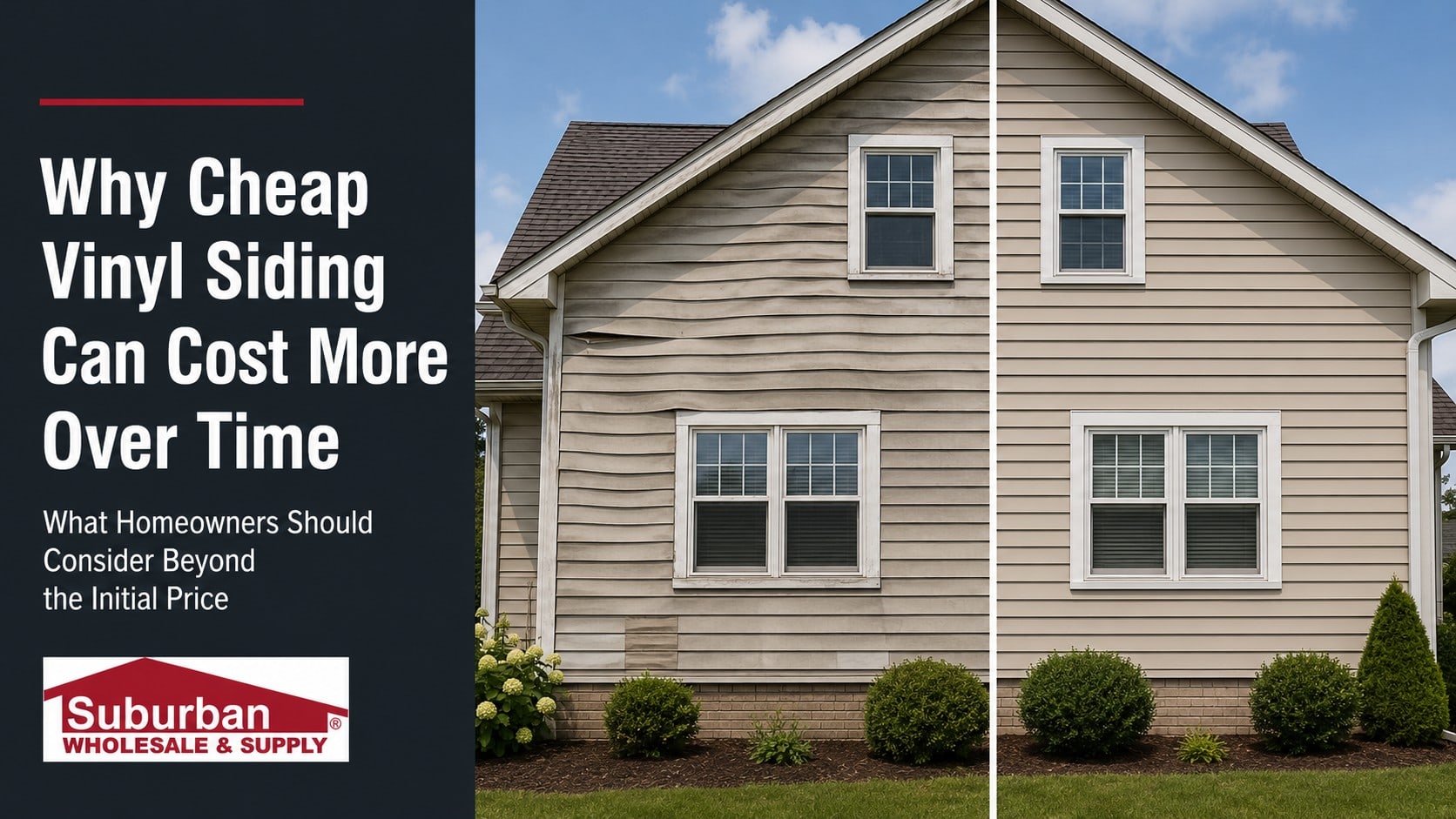
Vinyl siding follows the surface beneath it. A contractor who installs over loose material, damaged sheathing, protruding fasteners, or uneven foam may create a wavy finished wall.
A premium panel cannot correct major substrate problems, but a lighter panel may reveal them more readily. Either product needs a flat, secure, properly prepared fastening surface.
Correcting the wall after the siding has been installed often requires removing and reinstalling panels. That labor can quickly erase the original savings.
7. Cheap Water Management Can Become an Expensive Repair
Vinyl siding is an exterior cladding, not the wall’s primary water-resistive barrier. The wall behind it must manage incidental water around windows, doors, roofs, decks, penetrations, and material transitions.
J-channel and surface caulk do not replace a continuous drainage plane and properly integrated flashing. Hidden water entry can damage sheathing, insulation, framing, interior finishes, and nearby building components.
The siding panel may be the visible product, but the hidden water-management details can carry the greatest financial risk.
8. Rushed Fastening Can Cause Buckling and Waves
Vinyl siding expands and contracts as temperatures change. Panels should be securely attached while remaining free to move laterally within their nailing slots.
Overdriven fasteners, inadequate end clearance, incorrect nail spacing, angled fasteners, or panels stretched upward during installation can contribute to buckling, distorted courses, open joints, and loose siding.
Correcting widespread fastening problems may require removing and rehanging substantial sections of the wall. The quality of the installation can matter more than a small difference in material price.
9. Inexpensive or Mismatched Accessories Can Weaken the Result
Corners, starter strip, J-channel, utility trim, mounting blocks, vents, soffit, fascia, and trim pieces are part of the siding system. They affect drainage, movement, appearance, and the ability to finish openings correctly.
A proposal may lower its price by using narrow corners, incomplete mounting details, generic accessories, or colors that do not coordinate well with the siding.
Replacing accessories after installation often requires disturbing the surrounding siding. Choose the complete system before work begins.
10. Material Is Only Part of the Project Cost
Siding replacement is labor intensive. Crews must remove or prepare the existing exterior, repair the wall, flash openings, install accessories, measure elevations, cut panels, manage seams, work around utilities, and clean the property.
If a low-cost product needs premature replacement, the homeowner does not pay only for new panels. They may pay for removal, disposal, new accessories, flashing work, delivery, labor, and property disruption again.
This is why a modest material upgrade can deserve consideration when labor represents a large share of the complete project.
11. A Warranty Is Valuable Only Within Its Written Terms
Two siding products may both advertise a lifetime warranty while providing different definitions, exclusions, transfer provisions, claim procedures, and remedies.
Compare:
- Which product conditions are covered
- How excessive fading is defined
- Hail or impact provisions
- Proration
- Transferability
- Labor and accessory limitations
- Required maintenance
- Claim documentation and available remedies
The contractor’s workmanship warranty should also be provided separately. A product warranty generally does not correct poor installation.
12. No Service After the Sale Can Make Every Problem More Expensive
Even a good siding product may need inspection after a storm, impact, utility repair, remodeling project, or unusual event. Homeowners should know who will answer the phone and how service requests are handled.
A contractor who has disappeared, refuses service, or provides no records may force the homeowner to hire another company to investigate. Matching the original product and color may also become more difficult without proper documentation.
Local product support, accurate records, written warranties, and a clear service process add value even when they are not the lowest-cost line item.
13. Low Maintenance Does Not Mean No Maintenance
Vinyl siding generally eliminates the regular painting associated with many painted exterior surfaces. It still requires periodic inspection and cleaning according to the manufacturer’s instructions.
Homeowners should address loose panels, storm damage, unusual heat exposure, failed accessories, or building movement promptly. Ignoring a small issue can allow it to affect a larger area.
Maintenance claims should be compared honestly. If the standard and premium options have similar cleaning needs, do not pretend that premium siding creates savings that it does not.
14. Early Replacement Multiplies the Original Cost
The most expensive siding project is often the one a homeowner has to complete twice. Premature replacement can involve demolition, disposal, new materials, new accessories, new labor, potential repairs, and disruption to landscaping and daily life.
Premium siding does not guarantee that replacement will never be needed. Storms, impacts, fire, remodeling, unusual heat, building movement, and installation defects can affect any exterior product.
The responsible argument is that an established product, complete system, documented installation, and dependable service can reduce avoidable risk—not eliminate every possible future cost.
Initial Price Versus Long-Term Value
| Comparison Area | Low-Price Risk | Better Value Question |
|---|---|---|
| Product | Manufacturer or product line is unspecified | What exact siding and specifications are included? |
| Appearance | More visible seams or a flatter profile than expected | How will the complete elevation look? |
| Wall preparation | Damaged or uneven substrate is covered | What inspection and repairs are included? |
| Water management | Flashing and drainage details are omitted | How will openings and penetrations be flashed? |
| Accessories | Necessary components become change orders | Is the complete accessory package listed? |
| Installation | Rushed fastening or poor expansion allowances | How is manufacturer compliance inspected? |
| Warranty | Vague promises without written coverage | What do the product and labor warranties actually cover? |
| Service | No accountable company after installation | Who handles future inspections and repairs? |
A Better Way to Explain the Price Difference
Isolate the upgrade cost and explain exactly what the homeowner receives for it.
“The standard package is $24,800. The premium package is $27,300, so the difference is $2,500. That additional amount includes the heavier panel, deeper profile, selected premium color, longer panels on the front elevation, and the matching accessories listed here.”
Do not argue that the premium option will automatically save more than $2,500. Show the differences, acknowledge the cost, and let the homeowner decide whether those features justify the investment.
Where Homeowners Should Be Most Reluctant to Cut Costs
If the budget is limited, protect the parts of the project that are hardest to correct later.
- Repair active damage. Do not cover rotten or deteriorated wall materials.
- Complete water management. Preserve the drainage plane and flash vulnerable openings properly.
- Use all necessary accessories. Do not improvise around windows, doors, fixtures, and penetrations.
- Hire competent installation. Correct fastening, expansion clearance, alignment, and seam planning matter.
- Obtain written warranties. Know who is responsible for the product and the labor.
- Then select the panel level. A correctly installed standard product is usually a better investment than premium siding installed over a compromised wall.
Questions to Ask Before Accepting the Lowest Bid
- What is the exact manufacturer and product line?
- What is the profile and published panel thickness?
- Which matching accessories are included?
- Will the existing siding be removed?
- How will the underlying wall be inspected?
- How are sheathing repairs priced?
- What water-resistive barrier is included?
- How will windows, doors, roofs, and penetrations be flashed?
- How will expansion and contraction be managed?
- Where will panel seams be located?
- Who will install and supervise the project?
- What product warranty is provided?
- What workmanship warranty is provided?
- Who handles service after installation?
- What is excluded from the quoted price?
The Best Value Is Not Always the Most Expensive Option
Premium siding is not automatically the correct answer. A homeowner may have a firm budget, a limited repair, or little interest in premium-only aesthetic features.
A standard panel from a reputable manufacturer, installed over a properly prepared and flashed wall by a competent contractor, can be a sound choice.
The mistake is not choosing the lower-priced product. The mistake is choosing an incomplete or poorly defined project because the initial number is attractive.
Compare the Complete Exterior System
Cheap vinyl siding can cost more over time when the original savings lead to visible disappointment, repairs, service calls, water damage, warranty problems, or early replacement.
Homeowners should compare the exact product, complete installation scope, wall preparation, flashing, accessories, warranties, and service plan—not simply the final price at the bottom of the proposal.
The lowest responsible price can be an excellent value. The lowest incomplete price usually is not.
Compare Vinyl Siding Products Before Ordering
Suburban Wholesale & Supply helps contractors and homeowners compare vinyl siding profiles, panel construction, colors, textures, lengths, accessories, warranties, and availability. We serve Davenport, Bettendorf, Moline, Rock Island, East Moline, and surrounding Quad Cities communities.
Explore our vinyl siding product options and ask our team to help you compare the complete value of each product line.
A clear product comparison helps prevent price-driven decisions that leave important details out of the project.
Part of: Vinyl Siding
More in Vinyl Siding
- What Cheap Vinyl Siding Looks Like Five Years Later | Suburban Wholesale & Supply
- Hidden Costs of Builder-Grade Vinyl Siding | .038 vs .040 vs .042
- .040 vs .046 Vinyl Siding: What's the Real Difference? | Suburban Wholesale & Supply
- How to Replace Individual Vinyl Siding Panels | Suburban Wholesale & Supply
We stock all 29 colors of Gentek Sequoia Select D4 in our Davenport warehouse, and stocked items are usually ready same day or next day.
Share This Post
Share it on Facebook or X, or send it through your device share sheet for Instagram.