Learn why heavier vinyl siding panels can maintain straighter-looking wall lines—and how panel rigidity, wall preparation, ASTM standards, VSI practices and Gentek specifications affect long-term appearance.
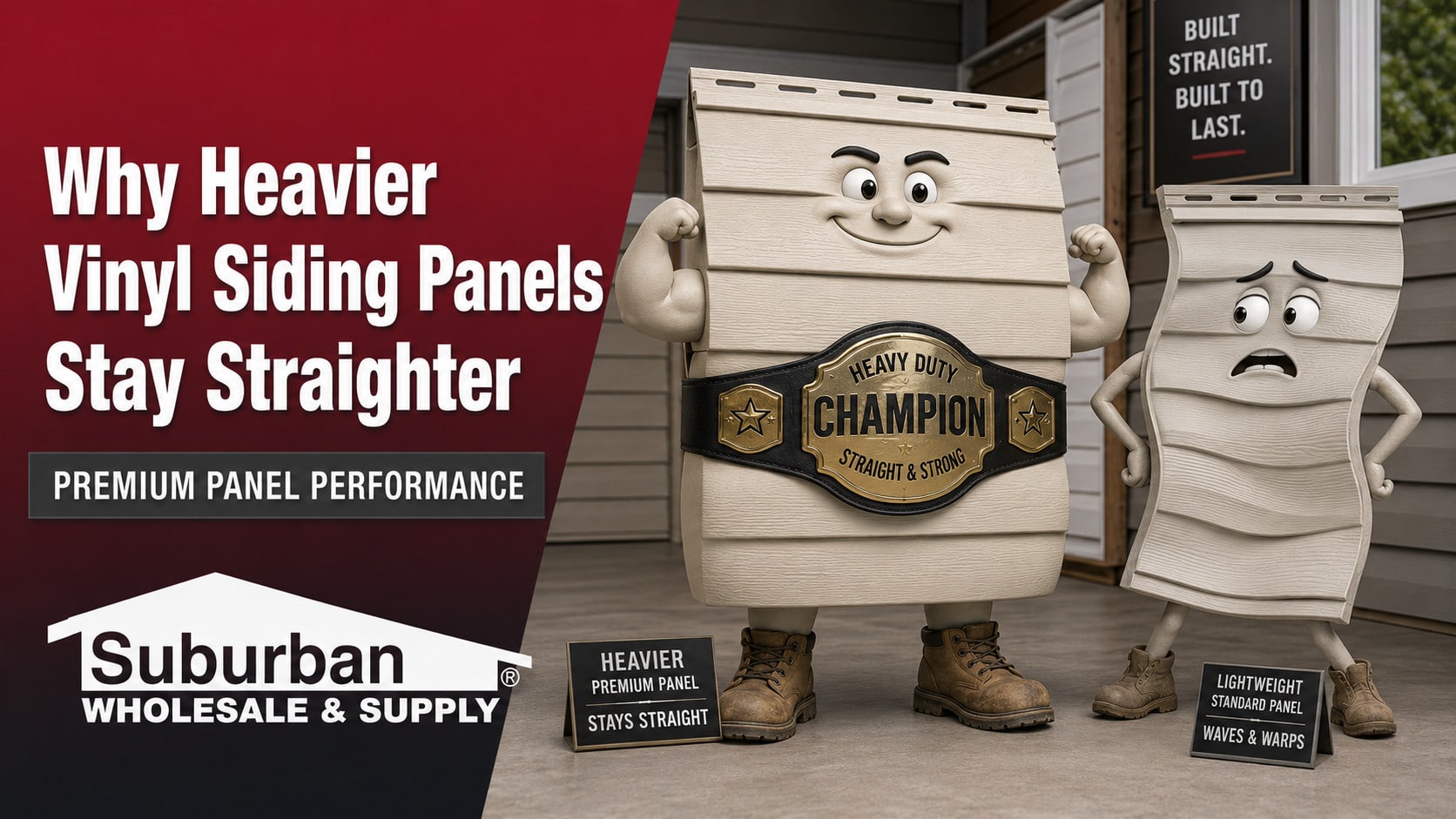
Contractor Appearance and Performance Guide
Why Heavier Vinyl Panels Stay Straighter Over Time
Heavier vinyl siding panels generally have more body and rigidity than thinner alternatives. That added stiffness can help maintain straighter-looking courses, but long-term appearance still depends on the wall beneath the siding and the quality of the installation.
Homeowners expect new siding to create clean, consistent wall lines. When an exterior develops waves, ripples or buckled areas, the siding itself often receives all the blame.
Panel construction is important, but visible waviness can have several causes. Uneven sheathing, bowed framing, overtightened fasteners, insufficient expansion clearance and concentrated heat can all affect the finished wall.
A heavier premium panel provides the contractor with a stronger starting point. Gentek Sequoia Select® horizontal siding has a nominal .046-inch thickness, giving it greater material body than many thinner, entry-level panels.
Contractors can review the available profiles, colors and product features on the Gentek Sequoia Select product page from Suburban Wholesale & Supply.
Do Heavier Panels Always Stay Perfectly Straight?
No siding thickness can guarantee perfectly flat walls. A heavier panel can resist minor deflection better than a thinner one, but it cannot correct severely bowed framing, damaged sheathing or improper installation.
The defensible claim is that greater panel thickness can improve rigidity and help support straighter-looking wall lines when the siding is installed over a properly prepared surface.
Thickness Gives the Panel More Body
Vinyl siding thickness is typically stated as a nominal decimal measurement. A .046-inch panel is forty-six thousandths of an inch thick according to the manufacturer’s designated measurement.
Compared with a .040-inch, .042-inch or .044-inch panel, a .046-inch panel contains more material. All other design factors being equal, that additional material can increase stiffness and reduce the panel’s tendency to flex.
Greater rigidity can be useful on large wall sections where long horizontal courses make small surface variations more visible. It can also provide a more substantial panel during handling, cutting and installation.
A heavier panel can resist minor irregularities better, but it should never be used to hide a wall that needs repair or preparation.
Heavier and Thinner Panels Compared
| Comparison Point | Heavier Premium Panel | Thinner Entry-Level Panel |
|---|---|---|
| Material body | More material and a more substantial feel | Less material and commonly more flexibility |
| Rigidity | Can resist minor deflection more effectively | May follow small wall irregularities more visibly |
| Handling | Often feels firmer during carrying and installation | May flex more during handling |
| Large-wall appearance | Can support straighter-looking horizontal courses | May reveal substrate variations more readily |
| Installation requirements | Requires correct fastening and thermal clearance | Requires the same installation discipline |
These are general tendencies. Panel geometry, lock design, nail-hem construction, substrate and installation quality can be as important as nominal thickness.
Panel Geometry Adds Structural Stiffness
Thickness is not the only feature that helps a siding panel maintain its shape. The panel’s bends, exposure, projection and locking edges create a three-dimensional profile that can increase stiffness.
Gentek Sequoia Select’s horizontal profiles feature a full 3/4-inch lap height. That deeper projection contributes to the shape of the panel while creating more noticeable shadow lines across the wall.
Two products can have the same nominal thickness and still behave differently because their profiles are engineered differently. Contractors should compare the complete manufacturer specifications—not thickness alone.
A Reinforced Nail Hem Helps Maintain Consistent Attachment
The nail hem connects each siding panel to the wall. If that attachment area is weak, damaged or inconsistently fastened, the siding may not remain aligned as intended.
Gentek Sequoia Select uses a full-roll nailing hem designed to reinforce the fastening area. This provides the contractor with a stronger connection point along the upper edge of the panel.
The hem still depends on appropriate fasteners, proper spacing, adequate substrate penetration and correct placement within the nail slots. A reinforced hem cannot correct weak fastener support.
The Panel Lock Keeps Courses Properly Engaged
Each horizontal siding course connects to the panel below it. A secure lock helps the courses remain engaged and supports consistent alignment across the wall.
Gentek’s Advantage Lock system is designed to enhance panel rigidity and stability. When the lock is fully engaged, individual courses work together more effectively.
A partially connected panel can sag, loosen or respond differently to wind and temperature changes. Installers should confirm that every course is fully locked along its complete length.
Panels should not be stretched upward during installation. Excessive upward tension can distort the profile and interfere with normal thermal movement.
Straight Siding Begins With a Straight Wall
Vinyl siding follows the plane of the wall beneath it. Premium panels can resist minor surface variations better than lighter products, but no siding can make severely uneven framing disappear.
Before installation, contractors should inspect for:
- Bowed or twisted framing
- Loose, swollen or deteriorated sheathing
- Uneven transitions between wall materials
- Protruding nails, screws or old siding components
- Improperly installed underlayment
- Damaged areas around windows and doors
- Inconsistent wall depth at additions or repairs
Correcting these conditions before siding installation improves both appearance and long-term performance. Covering defects without addressing them only makes future problems harder to diagnose.
Thermal Movement Is Often Mistaken for Weak Siding
Vinyl expands as temperatures rise and contracts as temperatures fall. This movement is normal and must be accommodated during installation.
Elongated nail slots allow panels to move laterally when fasteners are positioned correctly. Clearance around corners, windows, doors and accessories gives the siding room to change length.
If fasteners clamp the siding tightly against the wall, the panel cannot move freely. As it expands, the material may bow outward between attachment points and create visible waves.
Heavier siding can still buckle when it is fastened too tightly. Proper movement is more important than attempting to hold the panel rigidly against the wall.
ASTM D3679 Evaluates Dimensional Performance
ASTM D3679 is the principal product specification for extruded, single-wall rigid PVC siding. It establishes requirements and test methods for several characteristics that can influence long-term appearance.
ASTM D3679 addresses areas that include:
- Material composition
- Length and width
- Panel thickness
- Camber
- Heat shrinkage
- Impact resistance
- Linear expansion
- Surface distortion
- Appearance and weathering
- Wind-load resistance
Camber, heat shrinkage, expansion and surface distortion are especially relevant to the visual consistency of an installed siding wall. Thickness is only one part of the dimensional-performance evaluation.
What Is Panel Camber?
Camber describes an unintended curve or deviation from straightness along a panel. Excessive camber can make siding more difficult to align and may affect the appearance of long horizontal courses.
ASTM D3679 includes dimensional requirements and test methods related to camber. This provides a standardized way to evaluate panel straightness before installation.
Contractors should store and handle siding according to manufacturer instructions. Improper storage, excessive heat or unsupported stacking can damage panels before they ever reach the wall.
Wind Pressure Can Affect Panel Alignment
Wind places both inward pressure and outward suction on exterior walls. A rigid panel with a strong lock and reinforced nail hem is better equipped to transfer those forces through the fasteners and into the supporting wall.
ASTM D5206 describes a laboratory method for evaluating the wind-load resistance of rigid plastic siding under a specified uniform static pressure difference.
Gentek states that Sequoia Select has been tested for negative wind-load resistance according to ASTM D5206 and meets or exceeds the applicable industry standard for wind-load performance.
Wind-load performance varies by profile and installation configuration. Contractors should verify current data for the exact panel rather than assuming all .046-inch siding has the same result.
Long-Term Appearance Includes More Than Straightness
A wall can remain physically straight but still lose visual appeal if the siding experiences unacceptable color or appearance changes.
ASTM D7856 establishes requirements and test methods for evaluating the color and appearance retention of solid and variegated plastic siding products.
Contractors should use Gentek’s current written warranty when discussing fade protection. The warranty determines covered conditions, measurement methods, exclusions and available remedies.
VSI Standards and ASTM D4756 Protect Long-Term Appearance
ASTM D4756 addresses practices for installing rigid PVC siding and soffit. ASTM D3679 also directs installers to follow ASTM D4756 and the manufacturer’s instructions for the exact product.
The Vinyl Siding Institute has long supported product certification and professional installer education. Recognized VSI installation principles help siding remain aligned while allowing necessary thermal movement.
Important practices include:
- Prepare a flat substrate. Correct major wall irregularities before covering them.
- Install a level starter strip. The first course establishes the alignment of the wall.
- Position fasteners correctly. Fasteners should be placed in the appropriate portion of the nail slots.
- Avoid clamping the panel. Maintain the manufacturer-required space beneath fastener heads.
- Provide required clearances. Follow Gentek instructions around trim, openings and accessories.
- Fully engage each lock. Confirm the connection along the complete length of every course.
- Avoid stretching panels. Pulling siding tightly upward can distort its natural profile.
- Check alignment frequently. Correct small variations before they become visible across the elevation.
Common Causes of Wavy Vinyl Siding
Uneven wall construction
Bowed framing or irregular sheathing can transfer visible waves through the siding.
Overtightened fasteners
Clamping panels against the wall prevents normal thermal movement.
Insufficient clearance
Panels can buckle when they expand into tightly fitted trim or accessories.
Partially engaged locks
Incomplete connections can create loose or irregular courses.
Improper panel tension
Stretching siding upward during installation can distort its profile.
Concentrated heat
Grills, flames or reflected sunlight can expose siding to damaging temperatures.
Heavier Siding Is Not Immune to Concentrated Heat
Vinyl siding can soften or distort when exposed to excessive heat. Common sources include grills placed too close to the wall, open flames and concentrated sunlight reflected from certain windows.
Increased thickness should not be presented as protection against every heat-related condition. Homeowners should keep grills, fire features and other significant heat sources a safe distance from vinyl siding.
Contractors should investigate the heat source before replacing distorted panels. Installing new siding without correcting the cause may lead to repeated damage.
Gentek Features That Support Straighter Wall Lines
.046-inch horizontal panel
The heavier nominal thickness provides additional panel body and rigidity.
Full-roll nailing hem
The reinforced fastening area supports consistent wall attachment.
Advantage Lock system
The locking design helps adjoining courses remain securely engaged.
Full 3/4-inch lap
Deeper panel geometry supports visual dimension and pronounced shadow lines.
Contractor Checklist for Straighter Siding
- Inspect framing and sheathing before covering the wall.
- Correct loose, swollen or deteriorated materials.
- Confirm that underlayment is installed flat and consistently.
- Use a level starter strip and verify it around the building.
- Plan laps to reduce visibility from primary viewing areas.
- Follow Gentek’s current fastener-spacing requirements.
- Leave the specified room beneath fastener heads.
- Maintain temperature-appropriate clearances.
- Check that every course moves freely after fastening.
- Step back regularly and inspect the elevation from several angles.
Why Panel Rigidity Matters in the Quad Cities
Homes in Davenport, Bettendorf, Moline, East Moline and Rock Island experience cold winters, humid summers, wind and rapid temperature changes.
These seasonal cycles repeatedly expand and contract vinyl siding. A heavier, well-engineered panel provides a strong foundation, while correct fastening and clearance allow the siding to move without becoming distorted.
Midwest performance is not created by thickness alone. Product selection, wall preparation and installer training must work together.
Gentek Installation Support for Quad Cities Contractors
Suburban Wholesale & Supply is a Gentek building-products distributor serving contractors throughout Davenport, Bettendorf, Moline, East Moline, Rock Island and surrounding communities.
Contractors can compare panel thicknesses, profiles, locks, nail hems, colors and accessories before ordering. The Suburban Wholesale team also assists with product selection, takeoffs and next-day delivery on many stocked panels.
JR Girskis is a VSI Certified Trainer with more than 25 years of building-material experience. Contractors can speak with JR about Gentek specifications, wall preparation, thermal movement and recognized vinyl siding installation practices.
The Bottom Line on Heavier Vinyl Panels
Heavier vinyl siding panels generally provide more body and rigidity than thinner alternatives. This can help them resist minor deflection and support straighter-looking courses over a properly prepared wall.
Gentek Sequoia Select combines its .046-inch horizontal panel with a full-roll nailing hem, Advantage Lock system and deep 3/4-inch lap. These features support both structural stability and a more dimensional exterior.
ASTM D3679 addresses thickness, camber, expansion, surface distortion and other product characteristics. ASTM D4756 and recognized VSI principles guide the installation practices needed to preserve the panel’s appearance.
The honest conclusion is that heavier siding helps—but straight walls are the result of premium material, careful preparation and disciplined installation working together.
Explore Gentek Sequoia Select .046 Vinyl Siding
Review Gentek Sequoia Select product information or contact Suburban Wholesale & Supply for samples, current manufacturer specifications, contractor pricing, accessories and delivery options.
View Gentek Sequoia SelectTechnical References
- Gentek Building Products: Sequoia Select manufacturer specifications
- Gentek Building Products: Current Siding Product Directory, installation information and written warranty
- ASTM D3679: Standard Specification for Rigid Poly Vinyl Chloride PVC Siding
- ASTM D5206: Standard Test Method for Wind-Load Resistance of Rigid Plastic Siding
- ASTM D4756: Standard Practice for Installation of Rigid PVC Siding and Soffit
- ASTM D7856: Standard Specification for Color and Appearance Retention of Plastic Siding
- Vinyl Siding Institute installation and installer-training principles
Product specifications, profiles, test results, standards, warranties and installation instructions may change. Confirm current Gentek literature and applicable building-code requirements before ordering or installing siding.
Part of: Vinyl Siding
More in Vinyl Siding
- What Cheap Vinyl Siding Looks Like Five Years Later | Suburban Wholesale & Supply
- Hidden Costs of Builder-Grade Vinyl Siding | .038 vs .040 vs .042
- .040 vs .046 Vinyl Siding: What's the Real Difference? | Suburban Wholesale & Supply
- How to Replace Individual Vinyl Siding Panels | Suburban Wholesale & Supply
We stock all 29 colors of Gentek Sequoia Select D4 in our Davenport warehouse, and stocked items are usually ready same day or next day.
Share This Post
Share it on Facebook or X, or send it through your device share sheet for Instagram.