Vinyl siding expands and contracts as temperatures change. Learn why proper fastening, panel clearances, nail placement, and manufacturer specifications are essential for preventing buckling and waves.
Vinyl Siding Contractor Education
Why Vinyl Siding Must Move During Temperature Changes
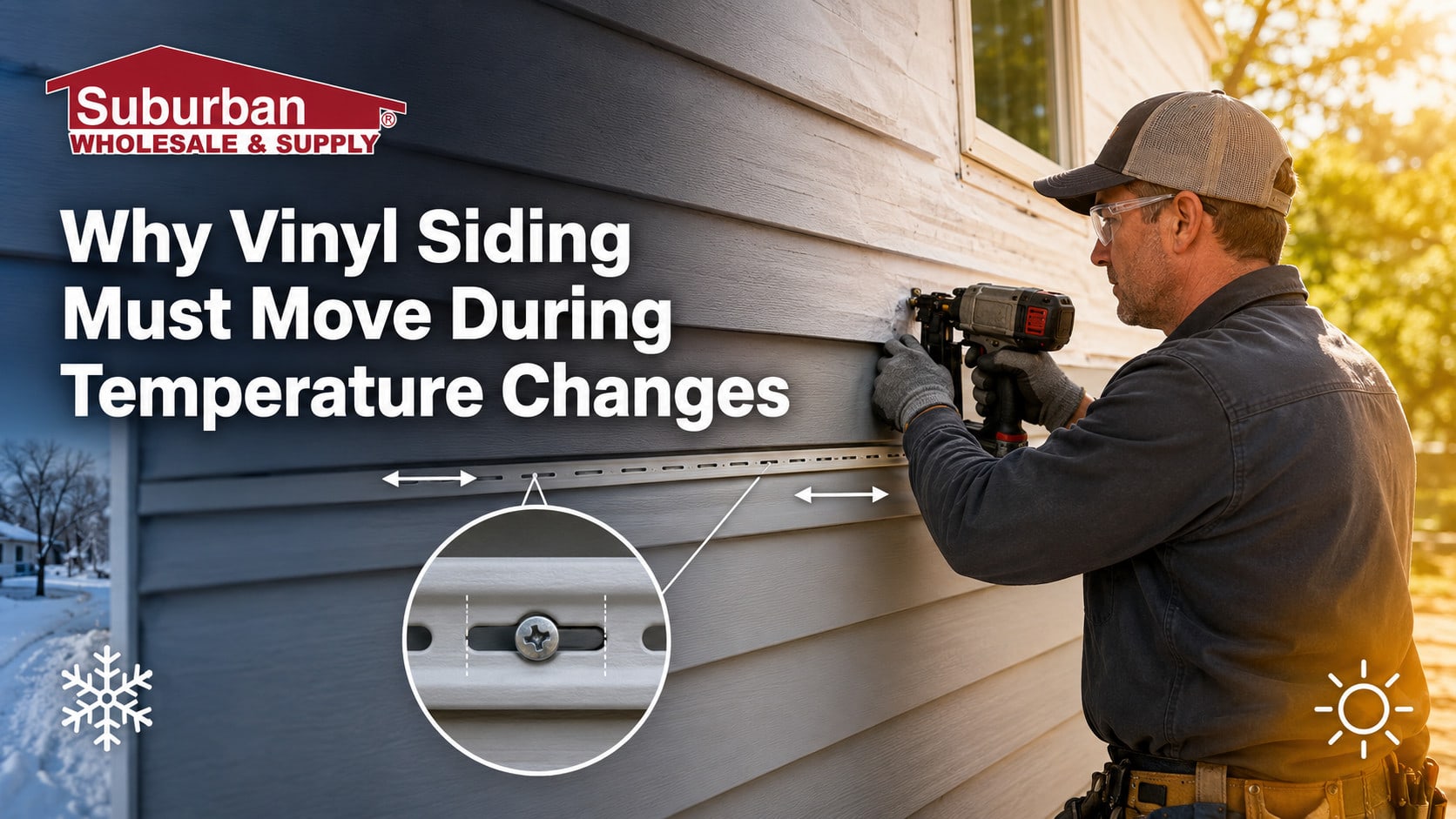
Vinyl siding is designed to expand when it becomes warm and contract when it becomes cold. A professional installation secures the siding to the home while preserving the freedom each panel needs to move.
Movement is not a defect in vinyl siding. It is a normal physical response to changing temperatures. Every vinyl siding panel becomes slightly longer as it warms and slightly shorter as it cools.
This movement is especially important in the Quad Cities, where exterior temperatures can change dramatically between winter and summer. A panel installed during cold weather may later be exposed to intense summer sunlight. A panel installed on a hot afternoon may contract significantly during a cold Iowa or Illinois winter.
The siding system must be installed with enough freedom to accommodate those changes. When movement is restricted, panels may buckle, ripple, separate, rattle, or push against trim and accessories.
Installation Must Follow More Than a Rule of Thumb
Thermal movement should be addressed using the instructions and requirements that apply to the exact siding product and wall assembly.
- Manufacturer specifications: The current installation manual establishes product-specific requirements for fastener placement, spacing, panel clearances, accessories, overlaps, and temperature-related installation details.
- VSI installation guidance: VSI training emphasizes proper fastening, centered nail placement, panel movement, wall preparation, water management, and correct use of receiving accessories.
- ASTM D3679: This specification addresses rigid PVC siding and directs installers to the applicable installation practice and the manufacturer’s instructions for the specific product.
- ASTM D5206: This test method evaluates the wind-load resistance of rigid plastic siding under prescribed fastening conditions. Installed performance also depends on the substrate, fasteners, accessories, and workmanship.
- Applicable building codes: Local code requirements may affect attachment, wind resistance, wall preparation, flashing, and the water-resistive barrier.
Expansion clearances and fastening requirements can vary by manufacturer, panel profile, panel length, accessory, application, and installation temperature. Always consult the current instructions for the exact product.
What Causes Vinyl Siding to Expand and Contract?
Vinyl siding is primarily manufactured from polyvinyl chloride, commonly called PVC. Like many building materials, PVC changes dimension as its temperature changes.
Sunlight can warm the surface of a siding panel well above the surrounding air temperature. Darker colors, southern and western exposures, reflected sunlight, limited shade, and nearby heat sources can all affect panel temperature.
The longer the siding panel, the more noticeable its total dimensional change may become. That is why the panel’s nailing slots, end clearances, overlaps, and receiving accessories must work together as a complete movement system.
Movement Does Not Mean the Siding Should Be Loose
Allowing movement does not mean leaving panels unsecured. Vinyl siding must be properly attached to an approved fastening base using the fasteners, spacing, and penetration required by the manufacturer and applicable code.
The goal is controlled movement. The panels should remain locked, aligned, and securely attached while retaining the ability to slide laterally within the elongated nail slots.
Proper installation balances two needs: resistance to wind and freedom to expand and contract.
Why Vinyl Siding Has Elongated Nail Slots
The long slots in a vinyl siding nailing hem are intentional. They allow the panel to move behind the fastener head as its temperature changes.
Unless the manufacturer provides a different instruction for a specific accessory or special condition, fasteners are generally positioned near the center of these slots. Centered placement leaves room for movement in both directions.
A fastener placed at the end of a slot may restrict movement in one direction. Driving through the solid section of the nailing hem can restrict movement even more severely and may damage the panel.
Why Fasteners Must Not Be Driven Too Tightly
A fastener driven tightly against the nailing hem can clamp the panel to the wall. The elongated slot cannot perform its intended function if the panel is trapped beneath the fastener head.
Overdriven fasteners may contribute to:
- Buckled or bowed panels
- Ripples near the nailing hem
- Uneven shadow lines
- Panels pushing against corner posts
- Locks separating between courses
- Visible waves during hot weather
The fastener head should secure the siding without pinching it tightly against the substrate. The manufacturer’s instructions determine the appropriate fastening detail.
End Clearance Is Just as Important as Nail Placement
Even correctly fastened siding may buckle if the panel is cut too tightly between corner posts, J-channel, window trim, door trim, or other receiving accessories.
Panel ends need adequate space to move inside those channels. If a warm panel expands and contacts a rigid obstruction, it may bow outward because it has nowhere else to go.
Too much clearance can also create a problem. An excessively short panel may expose a cut edge, reduce engagement within the receiving channel, or pull free during cold weather.
Use the clearance specified by the manufacturer for the product, accessory, panel length, and temperature at the time of installation.
Installation Temperature Changes the Starting Point
A siding panel installed during cold weather begins in a relatively contracted condition. It must have enough room to expand when warmer weather arrives.
A panel installed during hot weather begins in a more expanded condition. It must remain adequately engaged in its receiving channels when it contracts during colder weather.
This is why one memorized clearance should not be applied blindly to every job. Installers must consider the temperature and follow the product-specific instructions.
Longer Panels Require Greater Attention
Thermal movement accumulates across the length of a panel. A long uninterrupted piece may experience more total dimensional change than a shorter piece of the same material exposed to the same temperature difference.
Installers should pay close attention to fastening, end clearance, seam placement, and accessory engagement when using long panels. A minor restriction at one point can affect a much larger section of the wall.
Accessories Must Also Accommodate Movement
Corner posts, J-channel, utility trim, starter strip, soffit accessories, mounting blocks, and other components are part of the complete siding system. Incorrectly installed accessories can restrict the movement of otherwise properly fastened panels.
Common accessory-related problems include:
- Corner posts installed without their required movement allowance
- Siding panels cut tightly into J-channel
- Utility trim that does not securely engage a cut panel
- Mounting blocks that trap or pinch the surrounding siding
- Excess sealant bonding movable panels to rigid trim
- Improper accessory overlaps that restrict expansion
Sealant Should Not Lock Movable Panels in Place
Caulk has important uses within an exterior wall system, but it should not be applied indiscriminately. Sealant can unintentionally bond a siding panel to a corner, channel, penetration, or mounting block.
That bond may prevent the panel from moving and may also block drainage paths behind the cladding. Contractors should understand the purpose of each joint before applying sealant.
Proper flashing and a correctly integrated water-resistive barrier should manage water behind the siding. Caulk is not a substitute for those systems.
Sun Exposure Can Create Different Conditions on the Same House
Not every wall experiences the same surface temperature. A shaded north wall may remain relatively cool while a west-facing wall absorbs strong afternoon sun.
Darker siding colors may also absorb more solar energy than lighter colors. Modern premium siding products are engineered for their approved color ranges, but they still require correct installation and freedom of movement.
Reflected sunlight from certain window configurations, nearby roofs, pavement, or neighboring buildings can create concentrated heat. Any unusual heat source should be evaluated rather than dismissed as normal weather exposure.
What Movement Problems Can Look Like
| Visible Condition | Possible Installation Cause | What to Inspect |
|---|---|---|
| Buckling near a corner | Insufficient end clearance | Panel length and space inside the corner post |
| Ripples along the wall | Overdriven or angled fasteners | Fastener depth, placement, and panel movement |
| Panel separates in winter | Inadequate overlap or receiving-channel engagement | Seam overlap, panel length, and cold-weather contraction |
| Panel bows around a fixture | Siding trapped by a mounting block or sealant | Clearance and movement around the penetration |
| Waves appear only in hot weather | Restricted thermal expansion | Fasteners, clearances, heat sources, and substrate |
| Siding rattles excessively | Inadequate attachment or improper engagement | Fastener spacing, penetration, locks, and substrate |
A visible symptom does not prove a single cause. Inspect the complete wall assembly before recommending repairs.
Not Every Wave Is Caused by Thermal Movement
It is tempting to blame every uneven siding panel on expansion and contraction, but several other conditions can create a similar appearance.
- Uneven or damaged sheathing
- Poorly installed insulation or furring
- A starter strip that is not level
- Panels stretched upward during installation
- Improperly engaged locks
- Structural movement in the wall
- Concentrated heat from reflected sunlight
- Incorrect accessories or trim details
A careful inspection should determine whether the panel is trapped, overfastened, inadequately supported, exposed to unusual heat, or following an uneven surface.
Thermal-Movement Installation Checklist
Before completing each elevation, verify that:
- Current manufacturer instructions are available to the crew.
- Fasteners are positioned in the designated nail slots.
- Fasteners are centered where required by the installation instructions.
- Fastener heads do not clamp the siding tightly to the wall.
- Panels can move freely from side to side.
- Required end clearances have been maintained.
- Panel overlaps meet product specifications.
- Panels remain adequately engaged in receiving channels.
- Accessories have been installed to allow required movement.
- Sealant has not bonded movable siding to rigid components.
- Panels are fully locked without being stretched upward.
- The crew has accounted for installation temperature.
Does Premium Vinyl Siding Still Need to Move?
Yes. A premium or heavier-gauge vinyl panel may offer greater rigidity and a more substantial appearance, but it is still a vinyl product that responds to temperature.
Greater thickness does not justify tight nailing, reduced clearances, or ignoring the manufacturer’s instructions. Premium siding performs best when the installation respects its engineered movement system.
Contractors should sell the entire system: a quality panel, compatible accessories, a properly prepared wall, effective water management, and installation that follows established requirements.
Controlled Movement Protects Long-Term Appearance
Vinyl siding must move because temperature changes alter the dimensions of every panel. The nailing slots, fastener placement, end clearances, overlaps, and accessories are designed to manage that movement without sacrificing secure attachment.
When siding is pinned tightly or cut too closely, normal expansion can become visible buckling and distortion. When siding is inadequately attached, it may become noisy or vulnerable to wind.
The professional balance comes from following VSI installation principles, applicable ASTM standards, current manufacturer specifications, building-code requirements, and careful jobsite quality control.
Get Product-Specific Installation Support
Suburban Wholesale & Supply supports siding contractors throughout Davenport, Bettendorf, Moline, Rock Island, East Moline, and the surrounding Quad Cities. Our team can assist with premium vinyl siding, compatible accessories, manufacturer specifications, ordering, and jobsite delivery.
When an installation detail is unclear, confirm the product requirement before cutting or fastening the siding.
Part of: Vinyl Siding
More in Vinyl Siding
- What Cheap Vinyl Siding Looks Like Five Years Later | Suburban Wholesale & Supply
- Hidden Costs of Builder-Grade Vinyl Siding | .038 vs .040 vs .042
- .040 vs .046 Vinyl Siding: What's the Real Difference? | Suburban Wholesale & Supply
- How to Replace Individual Vinyl Siding Panels | Suburban Wholesale & Supply
We stock all 29 colors of Gentek Sequoia Select D4 in our Davenport warehouse, and stocked items are usually ready same day or next day.
Share This Post
Share it on Facebook or X, or send it through your device share sheet for Instagram.