Builder-grade and premium vinyl siding can both be appropriate products, but they are not necessarily equivalent. Contractors can help homeowners understand the difference by comparing actual siding samples, nominal thickness, rigidity, nail-hem construction, locking systems, profile depth, texture, color options, warranties, and installation requirements instead of relying on vague labels.
Suburban Wholesale Siding Sales Academy
How to Explain the Difference Between Builder-Grade and Premium Vinyl Siding
A homeowner asks a simple question:
“What is the difference between builder-grade siding and premium vinyl siding?”
This is one of the best opportunities in a siding presentation.
It is also one of the easiest opportunities to mishandle.
The weak answer is:
“Builder-grade is cheap siding. Premium siding is much better.”
That sounds like a sales pitch because it is one.
A better approach is to put the actual products in the homeowner's hands and demonstrate the differences that can be documented.
Do not sell the labels.
Compare the products.
First: “Builder-Grade” Is Not One Official Siding Standard
This distinction matters.
“Builder-grade” is commonly used to describe a more value-focused or entry-level product, but it is not one universal technical classification that automatically identifies a specific thickness, construction, warranty, or performance level.
“Premium” is not enough information by itself either.
Two manufacturers may use different terminology for their product families.
That is why a professional contractor should compare:
- Exact manufacturer
- Exact product line
- Nominal panel thickness
- Panel geometry
- Nailing-hem construction
- Locking design
- Profile and projection
- Texture and appearance
- Available colors and accessories
- Published testing or certification information
- Written manufacturer warranty
- Installation requirements
The name on the category matters less than the specifications of the product inside it.
Do Not Tell the Homeowner Builder-Grade Siding Is “Bad”
This is an important sales discipline.
A value-focused vinyl siding product is not automatically a bad product.
It may be exactly what a particular homeowner needs.
For example, a homeowner may tell you:
“We need to replace the siding, but we're planning to sell the house in two years and keeping the project affordable is our biggest priority.”
That homeowner may make a different decision than someone who says:
“This is our forever home. We want a substantial-looking siding system and we're willing to invest more in the exterior.”
Neither homeowner is wrong.
Your job is not to make the lower-priced product sound terrible. Your job is to make the differences understandable.
Put Both Siding Samples on the Kitchen Table
The easiest way to explain builder-grade versus premium siding is not with a brochure.
Use two comparable physical samples.
Hand them to the homeowner.
Then ask:
“Before I explain anything, what differences do you notice between these two?”
They may immediately notice differences in:
- Weight
- Rigidity
- Thickness
- Profile
- Texture
- Shadow line
- Nailing hem
- Locking system
Let the homeowner discover the difference before you describe the difference.
Use Gentek's Product Lineup as a Real-World Example
Gentek provides contractors with a useful example because its vinyl siding portfolio includes products at multiple construction levels.
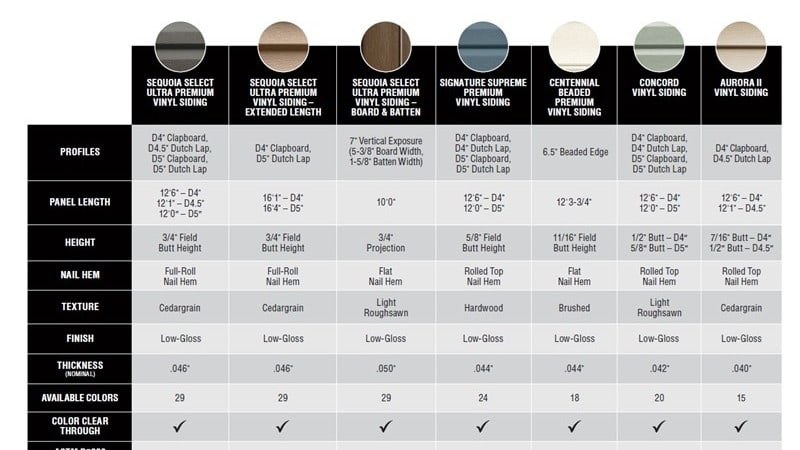
Current and recent Gentek product literature identifies Sequoia Select horizontal profiles at a nominal .046-inch thickness. Gentek has also offered other product families at lighter nominal thicknesses, including .044-inch, .042-inch, and .040-inch products depending on the exact line and profile.
That gives the contractor something concrete to demonstrate.
| Product Characteristic | Value-Focused Product | Premium Product |
|---|---|---|
| Thickness | May use a lighter nominal panel | May use heavier nominal construction |
| Rigidity | Designed for its product class | May provide additional panel body and rigidity |
| Nailing Hem | Product-specific design | May include reinforced or enhanced construction |
| Lock | Product-specific locking system | May include an enhanced locking design |
| Appearance | Traditional vinyl appearance | May add deeper projection, shadow lines, or refined texture |
| Design Choices | May have a more focused selection | May offer expanded profiles, colors, or architectural options |
Always verify the current specifications for the exact product and profile being proposed rather than assuming every product within a brand has the same construction.
Difference #1: Nominal Thickness
Thickness is probably the easiest specification for homeowners to understand.
A .046-inch nominal panel is physically thicker than a .040-inch nominal panel.
Numerically, .046 is 15% greater than .040 in nominal thickness.
But be careful with what you say next.
“.046 is 15% thicker than .040” is a mathematical comparison.
“.046 is 15% better siding” is not.
Performance cannot be reduced to thickness alone.
Panel geometry, formulation, nail hem, lock, substrate, accessories, installation, testing, and warranty also matter.
A Simple Way to Explain Thickness
You do not need to make the homeowner memorize decimal measurements.
Try this:
“This product uses a lighter panel and is designed as a more value-focused option. This premium product uses a heavier nominal panel. Thickness isn't the only difference, but it is one measurable difference you can actually see and feel.”
Then hand them both samples.
Show first. Explain second.
Difference #2: Rigidity
Rigidity is often easier for a homeowner to understand than thickness.
Use comparable sample sizes and let the homeowner gently flex each panel.
Ask:
“Do you notice how these two panels feel different?”
A heavier premium product may feel more substantial and can provide additional panel body and rigidity.
Gentek specifically describes Sequoia Select's .046-inch horizontal construction as providing increased rigidity.
But do not turn the demonstration into a circus trick.
Do not violently bend, twist, stomp on, or otherwise abuse one sample just to make the other product look superior.
A fair comparison creates credibility.
Difference #3: The Nailing Hem
Turn both samples over.
Show the homeowner where the siding is fastened.
Gentek Sequoia Select uses a full-roll nailing hem as part of its premium panel construction.
Keep the explanation simple:
“This is the portion of the siding that is fastened to the wall. Different siding products can use different nail-hem designs, so this is another area worth comparing instead of looking only at the front of the panel.”
Now the homeowner begins understanding that siding quality involves more than color and thickness.
Difference #4: The Locking System
Bring two short pieces of siding and connect them.
Show how one course locks into the course below it.
Gentek's Sequoia Select includes its Advantage Lock system as part of the panel design.
Tell the homeowner:
“The siding isn't just a flat sheet. Each course connects to the next, and manufacturers engineer those connections differently. This is one of the construction differences we're comparing.”
Difference #5: Profile Depth and Shadow Lines
Not every premium difference is hidden on the back of the panel.
Some are architectural.
Gentek Sequoia Select horizontal siding uses a full 3/4-inch lap, helping create stronger dimensional shadow lines.
Hold the samples vertically as they would appear on the wall.
Let light hit them from the side.
Then ask:
“Which profile gives you more of the exterior appearance you want?”
Now you are selling architecture—not thousandths of an inch.
Difference #6: Surface Appearance
Look closely at the texture and gloss level of both products.
Premium siding products may use surface treatments, embossing, or lower-gloss finishes intended to create a more refined exterior appearance.
Gentek describes Sequoia Select with a cedar-grain texture and low-gloss finish.
Do not tell the homeowner which one they are supposed to like.
Ask:
“Which surface looks more appropriate for your house?”
Difference #7: Color and Design Options
Homeowners do not buy siding specifications in isolation.
They buy an exterior.
A premium siding family may provide broader opportunities for colors, profiles, trim coordination, or architectural accents.
At Suburban Wholesale & Supply, contractors can compare Gentek siding colors, profiles, corner systems, soffit, fascia, trim, and other accessories rather than asking the homeowner to imagine the completed project from one small swatch.
Premium becomes more meaningful when it gives the homeowner design choices they actually value.
Difference #8: Warranty
Never explain the warranty by saying:
“The premium siding has a lifetime warranty.”
That is incomplete.
Pull out the written manufacturer warranty for each exact product being considered.
Compare:
- Who is covered
- What defects are covered
- Length and structure of coverage
- Fade provisions where applicable
- Hail provisions where applicable
- Transferability
- Exclusions
- Claim procedures
- Whether labor is included or excluded
Gentek publishes its siding warranty terms so contractors and homeowners can review the actual coverage rather than relying on a verbal summary.
Sell what the warranty says—not what you wish it said.
Premium Siding Still Moves
This is where contractors can accidentally create unrealistic expectations.
Premium vinyl siding is still vinyl siding.
It expands and contracts as temperatures change.
PEPA installation guidance specifically addresses this movement and instructs installers to center fasteners in slots, avoid fastening panels tightly, fully lock panels without stretching them, and provide required clearances at receiving channels and stops.
Rigidity is a product feature. Proper movement is an installation requirement. We want both.
Premium Siding Does Not Fix a Bad Wall
Another dangerous sales claim is:
“This heavier siding will hide everything underneath.”
Do not say that.
PEPA installation guidance emphasizes that siding needs a smooth, continuous, properly prepared surface and notes that siding can only be as straight and stable as what lies underneath it.
Explain it this way:
“A premium panel gives us a stronger starting product, but we still need to prepare the wall and install it correctly. I don't want you paying for premium siding and then ignoring what is underneath it.”
Installation Can Matter More Than the Label
Imagine two projects:
Project A
Premium vinyl siding installed over a poorly prepared surface, fastened too tightly, and detailed incorrectly around openings.
Project B
A quality value-oriented vinyl product installed over a properly prepared wall according to applicable manufacturer and industry installation requirements.
The word “premium” does not excuse poor installation.
A premium siding project requires more than a premium siding panel.
Do Not Compare Only Thickness
Thickness is useful because it is easy to demonstrate.
But if your entire premium presentation is:
“.046 is thicker than .040.”
you are leaving most of the product story untold.
Instead, use this sequence:
| Step | Demonstrate |
|---|---|
| 1 | Thickness |
| 2 | Rigidity |
| 3 | Nailing hem |
| 4 | Locking system |
| 5 | Profile and shadow line |
| 6 | Texture and appearance |
| 7 | Colors and accessories |
| 8 | Warranty |
| 9 | Installation requirements |
Use the Homeowner's House to Explain the Upgrade
Do not make premium siding an abstract product lesson.
Bring up the photographs you took during the exterior inspection.
Point to a large wall and say:
“This is one area where I would pay attention to panel appearance because you have a large uninterrupted wall that's very visible from the street.”
Or:
“You told me budget was your first priority. This value-focused siding still gives us the profile and color you liked, so you may decide the premium upgrade isn't necessary for you.”
Premium becomes easier to understand when you connect it to the homeowner's priorities instead of your commission.
Use Good-Better-Best Without Insulting Good
A three-package presentation can make these choices much easier.
| Package | How to Position It |
|---|---|
| Essential | A quality, value-focused siding system for homeowners prioritizing affordability. |
| Enhanced | A heavier or more feature-rich vinyl siding system for homeowners prioritizing appearance, rigidity, or additional design options. |
| Complete | Premium siding combined with appropriate insulation, architectural trim, accent products, or other project-specific upgrades. |
All three packages should be projects you are comfortable installing.
Good-better-best works when “good” is actually good.
Do Not Use Fear to Sell Premium
Avoid statements like:
- “Builder-grade siding will fall off.”
- “Thin siding always warps.”
- “Premium siding can never blow off.”
- “Builder-grade siding won't survive Midwest weather.”
- “You'll regret buying the cheaper siding.”
Those claims replace education with pressure.
A better statement is:
“Both products are legitimate options. The premium product adds specific features. Let me show you those differences, and then you can decide whether they're worth the additional investment for your house.”
Do Not Hide the Value Option
Some salespeople refuse to show a less expensive product because they are afraid the homeowner will choose it.
That misses the point.
The comparison itself helps establish the value of premium siding.
When homeowners can see both products, they can decide:
- Which feels more substantial
- Which profile they prefer
- Whether the premium appearance matters
- Whether additional colors or design choices matter
- Whether the price difference fits their priorities
If premium siding really provides additional value, you should not be afraid to put it beside the value product.
Present the Upgrade Price Last
Do not begin the demonstration by announcing the price difference.
First demonstrate what changes.
Use this order:
- Show the value-focused product.
- Show the premium product.
- Let the homeowner handle both.
- Compare thickness.
- Compare rigidity.
- Compare nail hems and locks.
- Compare profiles and appearance.
- Discuss color and trim options.
- Review applicable warranties.
- Then show the price difference.
Demonstrate the difference before asking the homeowner to value the difference.
The Price Conversation
Once the homeowner understands both products, say:
“Now that you've seen the differences, the premium siding package adds $X to your project. Do the additional construction and appearance features we just compared matter enough to you to keep that upgrade in the proposal?”
Then stop talking.
Let the homeowner choose.
A 5-Minute Builder-Grade vs. Premium Demonstration
| Time | What to Do |
|---|---|
| 0–1 Minute | Hand the homeowner both samples and ask what they notice. |
| 1–2 Minutes | Compare nominal thickness and rigidity. |
| 2–3 Minutes | Turn the panels over and demonstrate the nail hem and locking system. |
| 3–4 Minutes | Compare profile, shadow line, texture, colors, and trim options. |
| 4–5 Minutes | Review warranty differences and explain the upgrade price. |
A Kitchen-Table Script Contractors Can Use
“You'll hear terms like builder-grade, standard, premium, and ultra-premium siding. Those labels by themselves don't tell you very much.”
“So instead of asking you to take my word for it, I brought both products.”
“Hold these and tell me what you notice.”
“This product is the more value-focused option. This other product uses heavier nominal construction.”
“But thickness isn't the whole story.”
“Let's look at the rigidity, nailing hem, locking system, profile, texture, colors, and warranty.”
“Both are options I can quote. The premium product adds some features that you may or may not decide are important for your house.”
“Once you've seen the differences, I'll show you exactly what the upgrade adds to the project price, and you can decide which direction makes the most sense.”
What Not to Say
| Avoid Saying | Say This Instead |
|---|---|
| “Builder-grade siding is junk.” | “This is our more value-focused siding option.” |
| “.046 siding is automatically the best.” | “Thickness is one measurable difference. Let's compare the complete product.” |
| “Premium siding won't warp.” | “Premium construction can add rigidity, but vinyl still needs to be installed to accommodate movement.” |
| “Premium siding hides bad walls.” | “Wall preparation still matters regardless of which siding you choose.” |
| “The expensive one is obviously better.” | “The premium product adds these specific features. You can decide whether those features are worth the difference.” |
The Contractor's Comparison Checklist
Before presenting builder-grade and premium siding, be prepared to answer:
- What is the exact manufacturer?
- What is the exact product line?
- What is the nominal thickness of each product?
- How does the panel construction differ?
- How does rigidity differ?
- How do the nailing hems differ?
- How do the locking systems differ?
- How do the profiles and shadow lines differ?
- How do the textures differ?
- What colors are available?
- What compatible accessories are available?
- What published testing or certification applies?
- What does each written warranty actually cover?
- What installation requirements apply?
- What is the actual price difference for this house?
- Which differences relate to priorities the homeowner already told you were important?
The Bottom Line: Show the Difference
Builder-grade and premium vinyl siding should not be explained with insults, buzzwords, or scare tactics.
Put the products beside each other.
Let the homeowner hold them.
Compare thickness.
Compare rigidity.
Show the nailing hem.
Show the lock.
Compare profiles.
Compare texture.
Discuss colors and accessories.
Read the warranty.
Explain installation.
Then explain the price difference.
Do not tell the homeowner which siding is better.
Show them what is different and help them decide which product is better for them.
Compare Vinyl Siding Products at Suburban Wholesale & Supply
Contractors do not have to explain siding differences from memory.
Suburban Wholesale & Supply helps contractors compare actual Gentek vinyl siding products, thicknesses, profiles, colors, textures, corners, trim, accessories, warranty information, and installation considerations.
Bring your customer to the Davenport showroom, build a contractor demo kit, or talk with the Suburban Wholesale team about the products that make sense for your next siding presentation.
Explore Product Demonstrations
Visit the Suburban Wholesale Showroom
Suburban Wholesale & Supply
3602 North Harrison Street
Davenport, Iowa 52806
563-391-4000
Contractor siding products, samples, sales tools, professional quoting, training, and jobsite support for Eastern Iowa and Western Illinois.
Part of: Selling Siding & Windows
More in Selling Siding & Windows
- How to Help Homeowners Compare Vinyl Siding Quotes
- Selling Vinyl Siding Quality Instead of Price
- How to Explain the ROI of Premium Vinyl Siding
- Questions to Ask Before Buying Vinyl Siding
Sample books, color decks, demo kits and cutaways are available at the counter, and most are free.
Share This Post
Share it on Facebook or X, or send it through your device share sheet for Instagram.